At Vine Line Logistics, the trouble began with the tools. The company’s old transportation management system was difficult to learn and reluctant to accommodate new features. In-house servers were expensive. Drivers struggled to communicate with carrier sales representatives. Shipment information and conversations wandered through email and other applications. A company paid to coordinate movement was spending too much effort coordinating itself.
This is the sort of problem that makes software purchasing sound deceptively easy. Replace the old application. Move to the cloud. Admire the dashboard. Yet Vine Line’s predicament involved people outside its walls: carriers, drivers, and customers who needed the same information for different reasons. A better screen inside the brokerage would only solve part of it.
- The job: plan, execute, track, and settle freight in a shared cloud workspace.
- The customer: brokers, 3PLs, shippers, and carriers with a coordination problem.
- The price: TMS plans start at $5,000 a month on Turvo’s public pricing page.
- The bet: fewer handoffs can make a growing operation easier to run.
The truck was moving. The information was not.
Turvo’s account of Vine Line’s switch describes a change in where work happened. Communication moved into the platform, alongside the shipment. Customers and carriers could participate. Turvo Academy supplied training, and the company’s Help Center documented workflows. Vine Line president Steve Lyons recalled many questions on the first day of onsite support and far fewer on the second. That is a useful detail: a logistics system earns its place when people can get through a working day with it.
In separate customer material, Vine Line reported a 45% increase in net revenue, 30% more loads, and a fourfold increase in contract value with its largest customer. Those are customer-reported outcomes published by the vendor. They describe what happened around an implementation; they do not tell us how much growth came from the software rather than sales, staffing, or the freight market. The operational account is more revealing than a victory lap.
“Our monthly volume has nearly doubled in just one year.”
Steve Lyons · President, Vine Line Logistics
Customer testimonial published by Turvo
A shipment with a shared memory
Turvo is a transportation management system, or TMS, with a collaboration layer. Its customers use it to handle the journey from orders and shipment planning through execution and settlement. The distinction it emphasizes is cross-company work: a broker, customer, and carrier can interact around information associated with the same shipment, subject to access controls.
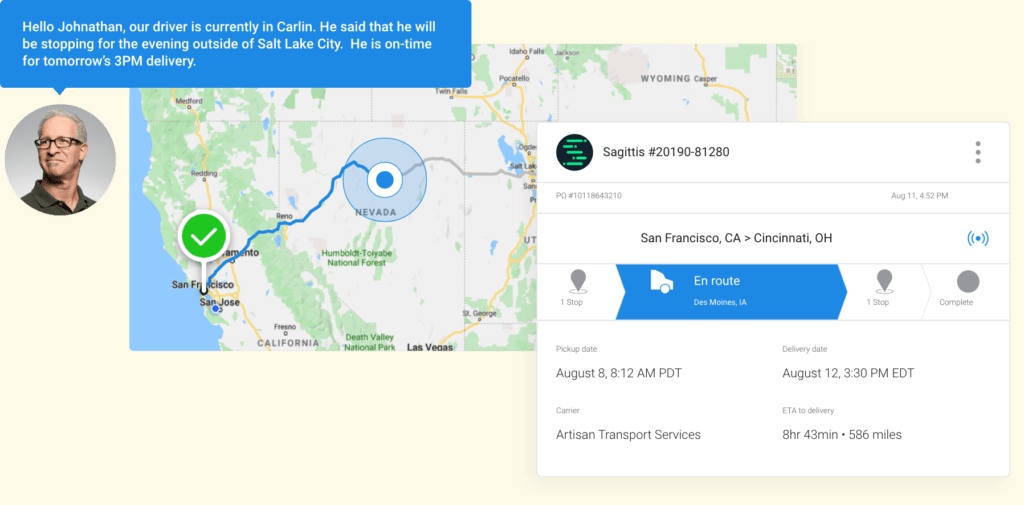
Consider the ordinary question, “Where is my load?” A location helps. So do the pickup details, the latest message, the delivery appointment, and the document that explains what happened. Turvo brings these categories of information together. A map tells an operator where to look; the surrounding record gives that operator something to work with.
The idea predates the present enthusiasm for AI. In a FreightWaves interview hosted on Turvo’s website, co-founder Jeff Dangelo described spending about 13 years in logistics before the company’s founding. His fellow founders, Eric Gilmore and Sai Rajkiran Nagboth, came from consumer technology. The team watched whether businesses trusted cloud storage and whether smartphones were common enough to support the product they wanted to build.
Founded in 2014, Turvo began by tackling the freight broker’s system of record. Dangelo later described an expansion into aggregating information from customers’ many systems and connecting their networks. The underlying question remained appealingly plain: why should several companies performing one job each have to reconstruct its history?
- 01Order
- 02Plan + assign
- 03Execute + track
- 04Document + settle
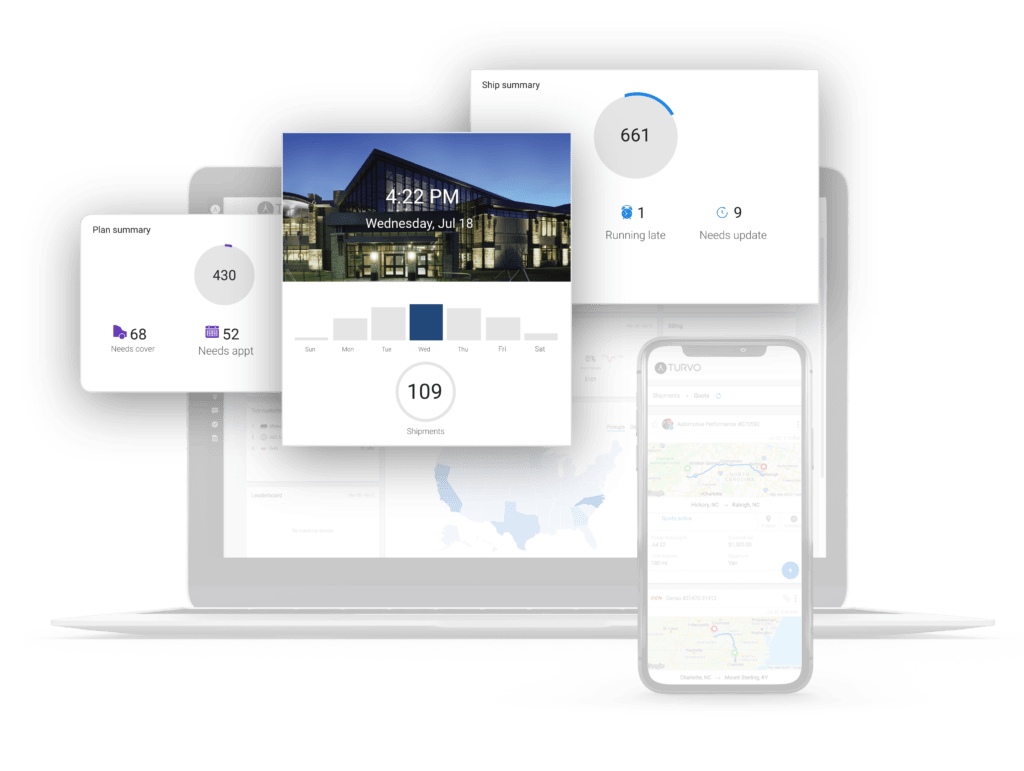
The product range follows that question into the details. Order-to-shipment planning links commercial demand with movement. Appointment scheduling coordinates facility visits. Inventory and warehouse visibility bring another part of the operation into view. Analytics make the accumulated activity useful for management. The driver app carries shipment information into the cab.
The Integration Hub offers a public API, webhooks, data import tools, and point-and-click integrations. That matters because the warehouse, the shipper, and the broker may have bought different software years ago. Turvo’s proposal allows connections to existing systems. Warehouse visibility should therefore be understood in relation to those systems; it does not establish that every customer can discard its warehouse management software.
The arithmetic of fewer interruptions
There is a respectable business beneath the language of collaboration. Turvo sells SaaS to logistics companies. Its published TMS price starts at $5,000 per month, with onboarding, virtual training, data migration, support, and Academy resources listed. Collaboration and visibility pricing is available on request.
$60,000 over 12 months at the starting rate.
Arithmetic only; a customer’s full project cost depends on its agreement.
The sensible purchasing exercise is to count the work a shared record could remove. How often does someone retype an order? How many messages chase a document? Which customers call because they cannot see an update? Then measure those activities after deployment. A shipment count alone cannot show whether the operation became easier to run.
Turvo’s Routing Guide, announced in December 2021, is a concrete example of automation. An administrator defines rules, and shipments can be offered to carriers, carrier groups, or bid boards accordingly. The useful part is the repeatable decision process. Humans still have to decide which rules make commercial sense and handle what those rules cannot anticipate.
The same logic sets limits on the collaboration model. A shared workspace needs people willing to use it and data worth sharing. If partners continue working entirely through disconnected channels, the brokerage may still need to reconcile their updates manually. If shipment volume is modest and coordination is already simple, the starting subscription creates a harder economic case. These are practical deductions from the product and price, rather than reported customer failures.
The customer became the owner
Turvo raised a $25 million Series A in March 2017 led by Activant Capital. A $60 million Series B followed in November 2018, led by Mubadala Ventures, with new investors G2VP and Next47. The Series B announcement put total investment at nearly $100 million. That capital supported a proposition larger than replacing one broker’s application.
Ryder offered one route to that scale. In May 2020, it announced RyderShare using Turvo’s technology to combine data from transportation and warehouse systems. Ryder said its early rollout covered 18 customers and 90 customer locations. It reported productivity improvements of up to 50% among customers heavily reliant on service call centers. The qualifications matter: this was a particular use case and an upper bound reported by Ryder.
Lineage’s relationship went further. A venture investment and collaboration preceded the launch of Lineage Link in 2021. In June 2022, Lineage announced that it had acquired Turvo, with financial terms undisclosed. The announcement said the software company would continue under its own brand, leadership, and board as a wholly owned subsidiary.
2020 RyderShare announced
2021 Lineage Link launched
2022 Lineage acquires Turvo
2026 Alpha Zero partnership announced
The February 2026 partnership with Alpha Zero Global Logistics shows another use of the platform: a foundation for a logistics provider’s own managed transportation offering. Alpha Zero cited open architecture, design, and API capabilities, with plans to connect routing, visibility, ERP, and warehouse tools. Turvo supplies software; the operator supplies its customer relationships and operational judgment.
A network is a habit, too
Turvo competes in a crowded field of transportation software. Broker-focused alternatives include McLeod and Tai; MercuryGate and enterprise transportation suites enter other procurement discussions. Tracking platforms address overlapping visibility needs. Turvo’s case rests on combining execution with collaboration across organizations. That makes participation and integration important parts of a comparison, alongside the feature list.
There is also a candid footnote to the ambition. In a public LinkedIn reflection following Lineage’s IPO, Dangelo questioned Turvo’s cash spending, network growth, and sharing model. He said those experiences informed his approach to a subsequent venture. It is a founder’s retrospective judgment, rather than evidence that the product failed. It does complicate the pleasant notion that a network naturally expands once the software exists.
The lesson a reader can copy is small enough to try tomorrow: attach the discussion to the work. Give each shipment a place where its status, documents, and decisions belong. Decide who may see each part. Start with a painful handoff and measure whether the repeated questions decline. Turvo sells an extensive version of that arrangement. The principle remains useful before a contract is signed: a load should not need a fresh introduction every time somebody asks about it.
Follow the conversation
Turvo website · Company news · Blog · LinkedIn · X · Facebook
Turvo on YouTube · Watch Steve Lyons discuss Vine Line · Product videos