A player sees a row of games. The operator sees a rather different picture: accounts, balances, identity checks, payment approvals and the possibility that one of those systems will disagree with another. The bright part of an online casino is easy to notice. The consequential part is what happens when somebody wants their money back.
TRUEiGTECH builds that less visible machinery. Its customers are businesses launching or upgrading sweepstakes casinos, sportsbooks, online casinos and prediction markets. They can buy a branded starting point, a configured platform or a custom build. Behind the menu sits an appealing proposition: get to market without spending your first year assembling the same infrastructure everyone else needs.
- The product: games, wallets, player accounts and operating tools assembled for other businesses.
- The pitch: no share of gross gaming revenue, with ownership that depends on the deployment model.
- The buying question: what exactly gets handed over when the work is done?
The casino you never see
Consider the wallet. TRUEiGTECH’s sweepstakes player account management software, or PAM, supports Gold Coins and Sweeps Coins in one system. Its turnkey description separates fun-play currency from currency associated with redeemable prizes. Two balances on a screen create a series of backstage jobs: tracking transactions, applying promotions, checking identities and keeping redemption records straight.
The PAM also offers player analytics, configurable bonuses and game management. Operators can change their lobby and campaigns while maintaining the connection to player records. This is the practical appeal of buying an integrated platform. The customer is purchasing fewer seams between systems, along with the ability to manage what crosses them.
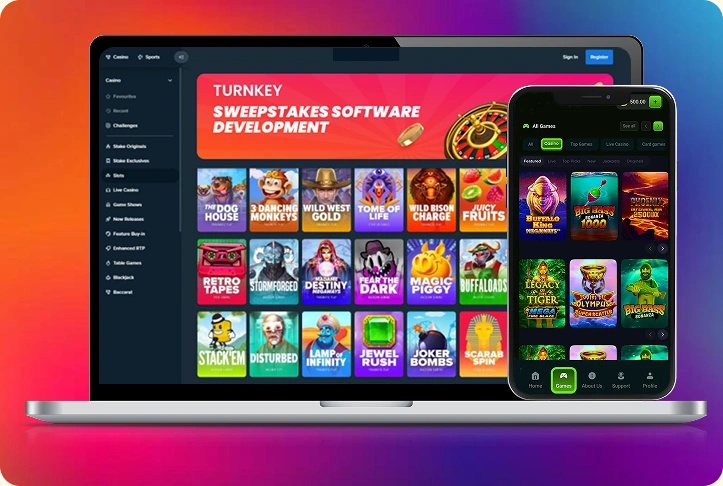
There are other suppliers in this territory. EveryMatrix sells modular casino management and integration software, including connections to third-party wallets. BetConstruct supplies betting and gaming technology. TRUEiGTECH fits into that B2B infrastructure market, competing for operators who would rather configure an existing foundation than commission every component separately.
Read the ownership table
The commercial hook is unusually easy to understand. TRUEiGTECH promotes a no-GGR-share model: the software supplier does not take a percentage of gross gaming revenue under the applicable deal. Its corporate site adds a stronger promise: “Full source code ownership with no vendor lock-in.” For an operator expecting to grow, those words deserve attention.
Then comes the useful detail. The sportsbook page’s comparison table describes white-label software as provider-owned, turnkey software as licensed from the provider and custom software as operator-owned. Elsewhere on that page, the zero-percent GGR offer specifically names turnkey and custom builds. The product table gives the buyer a more precise map than the broad slogan.
Ownership needs an inventory: code, data, documentation and the right to move.THE BUYER’S QUESTION
Price has a scope, too. TRUEiGTECH’s white-label casino page advertises a crypto base setup tier of $10,000-$20,000, with enterprise work priced by quotation. That is an entry-level setup offer for a particular product. It leaves an operator with questions about content agreements, hosting, payments, support and the rest of the operating budget. Zero GGR share cannot answer those questions by itself.
As described in the company’s sportsbook comparison. Contract scope matters.
A four-week clock with dependencies
On May 20, 2026, TRUEiGTECH announced TIGSweepstakes. The package brought platform development, payment connections, dual wallets, games, affiliates, CRM, managed services and documentation handover into one offer. Its announcement framed the problem as coordination: too many vendors, too many gaps between them and too much work left after launch.
The advertised target was under four weeks. A preconfigured foundation makes that ambition intelligible. An operator can select a theme, connect the intended services and configure familiar workflows instead of starting from an empty repository. The company also offers bespoke configurations for customers whose market, payments or operating requirements need more work.
Speed remains a function of the job. TRUEiGTECH’s sportsbook comparison gives custom development a nine-to-twelve-month window. Those two clocks describe different purchases. A buyer with unusual trading logic or extensive customization should expect a different conversation from someone selecting a prepared sweepstakes package. Third-party approvals and market-specific requirements belong on the schedule as well.
Then the games became markets
There is a second thread in the 2026 product story. On April 14, TRUEiGTECH announced a unified prediction-market API, initially available to select partners and early adopters. The company said one integration could connect operators to sources including Polymarket and Kalshi. Its stated aim was to reduce repeated integration work and connect fragmented liquidity.
On May 26 came TruePredict, a sports prediction-market product aimed at iGaming, sportsbook, fantasy-sports, media and fan-engagement operators. The package included market creation, pricing, trading workflows, wallets and settlement. Football’s World Cup supplied a timely sales occasion; the underlying engineering problem was how to turn an event into something users could trade and the operator could resolve.
These announcements extend a recognizable habit: gather difficult connections into one place. They also introduce a different dependency. An event market needs counterparties and reliable resolution, alongside working software. A connection to a market is not an official partnership with it, and an integration announcement does not establish permission to offer the resulting product everywhere.
Ask to see the handover
The public hiring detail is refreshingly ordinary: TRUEiGTECH advertises React and Next.js engineering work and onsite project-management roles in Indore. Building the product still requires people to organize releases, connect APIs and keep the interface usable. The glamorous launch promise rests on familiar delivery work.
For a prospective customer, the useful next step is a demonstration of an entire player journey, followed by a written handover inventory. Ask who owns the database, which code is delivered, which integrations need separate agreements and how a future migration works. An operator seeking control needs those answers before treating a launch date as a decision. The keys are only useful if they open the doors you intend to use.
Open the product drawer
Explore the company, its platforms and its public channels.