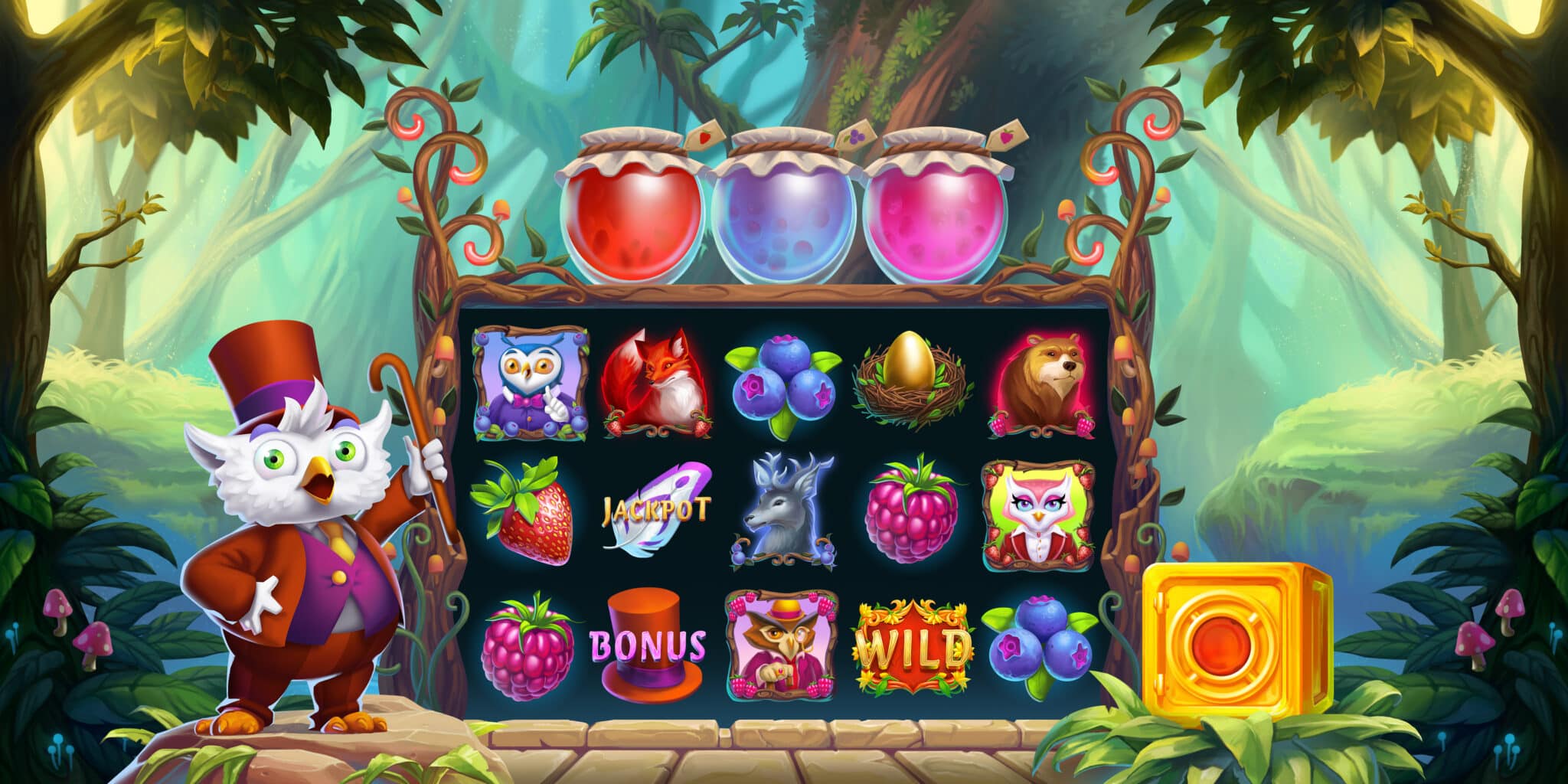
Hootie is an owl who dresses as though the forest has a private members’ club. There is a top hat, a waistcoat, a rather splendid bow tie. In Hootie’s Fortune, he stands beside reels populated by berries, woodland animals and golden eggs. It is an amiable little scene for a business involving casino software, operator contracts and the precise geography of gambling permission.
The owl explains something about High 5 Games. A character can remain familiar while the game around him changes. A studio can send that character from a casino floor to a social app to an online operator’s catalogue. Recognition travels remarkably well. The business arrangements underneath it require rather more luggage.
- The product: slot games, distribution software and tools for casino operators.
- The customers: casino businesses including DraftKings, BetMGM and Caesars, plus consumers using High 5 casino products.
- The advantage: recognizable game families with several routes to players.
- The catch: supplying a licensed casino and operating a consumer platform require different permissions.
A familiar face earns another appearance
High 5 Games was founded by Anthony Singer in 1995. Its back catalogue includes Da Vinci Diamonds, Golden Goddess and Green Machine. These names are useful precisely because a player may know the game before knowing the studio. Casino content often arrives wearing somebody else’s shop sign.
Hootie first appeared in the land-based game Hoot Loot. He returned in Hootie’s Fortune, a 2022 release with five reels, multipliers and bonus features. High 5 called it the 500th title on its social casino platform. That is a platform milestone: the service also carried games from other manufacturers. The owl is charming enough without asking him to prove an inflated production statistic.
Green Machine offers a more recent example. In July 2026, High 5 announced Green Machine Blitz to mark the brand’s 25th anniversary. The new game adds symbol duplication, collection features, four jackpots and a LootLink bonus. The recognizable name does the welcoming; revised mechanics supply the reason to inspect another version.
“respect everything players recognize and love about the brand”
Jerry Wilson, VP of Creative, on Green Machine Blitz
This is a practical design brief. A sequel needs enough continuity to be recognized and enough change to justify its existence. Too much familiarity risks repetition. Too much novelty spends the recognition the franchise has accumulated. High 5’s long-running themes make that tension visible in a particularly compact form: a few reels, a few symbols, another invitation to spin.
The catalogue outgrew the delivery route
In January 2012, High 5 announced a change in distribution. In recent years, it said, it had sold games only to International Game Technology, or IGT. Now it wanted more partners. Singer’s explanation was straightforward: a growing supply of content needed more opportunities to reach players.
There was no confession that the old relationship had failed. The announcement explicitly preserved it. The constraint was the route to market. Producing more games would accomplish little if their distribution remained too narrow. For anyone building software, music or publishing, this is the recognizable part of the story: creative output can exceed the channel carrying it.
The later operator deals show the wider route in practice. A May 2022 DraftKings agreement began with Michigan and contemplated multiple markets. BetMGM added High 5 titles in New Jersey that year and Pennsylvania in January 2023. Caesars Digital expanded the relationship into West Virginia in July 2024, their fifth joint market.
Content, infrastructure and distribution are separate jobs in the same transaction.
High 5 VAULT, its remote gaming server, supplies another piece of the arrangement. Operators gain access to a game library through the supplier’s infrastructure. The operator can offer a broader catalogue without becoming the studio that invents every character, animates every sequence and implements every game.
The customer buying a slot is buying more than art
The player sees the woodland. The operator sees a content supplier and a set of operating tools. High 5 advertises a casino platform with player account management, customer communications, content management, analytics, front-end customization and localized payments. This is software for running a service as well as software for filling its shelves.
Rapid Rewards makes the operator’s motive especially clear. The system supports promotions inside selected High 5 games, including random prizes and feature boosts. High 5 supplies tools and setup; operators control promotions and rewards. A 2021 campaign offered a combined monthly prize pool of $50,000 in New Jersey and Michigan. That was promotional value, rather than the price of buying the software.
The details matter. Published Flash Prizes rules explain that some boosts require a further real-money wager, and that their theoretical value can be deducted from the promotional prize pool. A boost’s advertised value therefore needs to be read alongside its conditions. The operator wants engagement; the player needs to understand exactly what the offer grants.
High 5’s expertise crosses several disciplines. Its careers material describes artists, musicians, engineers and mathematical specialists working together. Cold Castle Studios’ portfolio supplies a tangible example of outside collaboration: its Hootie’s Fortune work included illustration, animation, a logo and user-interface graphics. The pleasant woodland is assembled work.
Three businesses can share the same reels
High 5’s products serve different relationships. Land-based content reaches players through casino businesses and manufacturers. Regulated online games are supplied to operators. Social casino products bring the company brand directly to consumers, with free play and optional purchases. Sweepstakes offerings introduce another set of terms and eligibility rules. Similar-looking reels do not make these arrangements interchangeable.
Game content for physical casino distribution.
Content and technology supplied to casino operators.
Consumer products with their own currency rules and geographical restrictions.
For an operator, High 5 sits among alternatives such as IGT, Light & Wonder, NetEnt and other slot studios. The relationships can overlap: Light & Wonder’s online catalogue lists High 5 alongside other developers. A company selling its own games may also carry somebody else’s. This market rewards useful distribution relationships as well as individual titles.
High 5’s distinction is the combination: recurring casino themes, consumer products, a remote server and promotion tools. That combination does not guarantee better returns or a winning session. It explains what the supplier can offer a business choosing content and how a player might encounter a familiar game in several places.
The expensive difference between supplier and casino
In Connecticut, that distinction became concrete. The Department of Consumer Protection suspended High 5’s supplier licence in March 2025 while investigating an unlicensed High 5 Casino consumer platform. Investigators reported that they could still make a deposit after the platform had said new accounts and purchases would stop in the state.
The failure described in the suspension order was operational: the announced geographical restriction had not reliably stopped the activity investigators tested. It reached beyond the consumer site because the company also held a supplier licence in the state.
Settlement payments included consumer restitution and money for state consumer-protection work. The supplier licence was reinstated effective May 22; the consumer casino ceased operating in Connecticut.
Washington produced a separate reckoning over virtual-coin social casino purchases. A jury awarded approximately $24.94 million in 2025. By August 2026, the court had preliminarily approved a proposed settlement with a fund between $12 million and $30 million. Final approval remained pending at this profile’s publication. A verdict, a proposed settlement and a completed payment are different events.
These episodes put a measurable cost beside a business distinction that might otherwise sound pedantic. Familiar games and existing supplier credentials did not settle whether a particular consumer product could operate in a particular state. The terms of distribution had to survive contact with the actual product.
What travels, and what must be rebuilt
High 5 continued expanding its supplier business. In July 2026, it announced Alberta supplier approval, building on games it said had been available through Play Alberta since 2024. Here the advantage of familiarity is easy to follow: content already encountered by local players could be offered through additional licensed operators.
The useful lesson is specific enough to copy. Preserve characters people recognize. Change the mechanics with care. Add distribution when the catalogue exceeds its channel. Give business customers tools to deliver and manage the content. Each move addresses a different bottleneck.
The conditions matter just as much. A franchise needs an audience that remembers it. A remote server needs willing operators and approved content. Consumer distribution needs restrictions that work in practice. High 5’s history puts all three in view. Hootie may wear the same hat wherever he appears. The business beneath it has to change clothes at the border.
Explore the games and the company
Company website · Game studio and demos · Company news · YouTube product videos