The jacket gives the game away. On one side of the chest: AFX. On the other: Troo. Black body, pale sleeves, a row of snap fasteners. A varsity jacket is an unusually efficient piece of social machinery. Before anyone introduces themselves, it can tell you who belongs together. In Troo Wear’s collaboration with the Berkeley dance group AFX, that familiar garment becomes a small meeting place for two creative identities.
Start there, and the label makes more sense. Streetwear is a crowded category; another logo on cotton is easy to overlook. A jacket made for a particular group has a more specific assignment. Somebody has to recognize themselves in it. Somebody has to want to put it on when they leave the house.
Troo Wear works in that space between personal taste and shared allegiance. Its founder, Christopher C. Lee, built a Bay Area clothing project around freedom of expression. The appealing complication is that expressing yourself often means finding other people who understand what you are trying to say.

A printer before a platform
The company dates its beginning to 2007: a four-color screen printer, hand-drawn graphics, and a box of T-shirts. These are pleasingly literal ingredients. To start this kind of business, an idea has to become something that survives being pulled over a person’s head.
In a student interview published by The Smoke Signal in July 2010, Lee described teaching himself design, marketing, and manual printing. He put sales at roughly 400 shirts, excluding promotional giveaways. He also said printing was temporarily on hold while a better printer arrived and was set up.
That pause deserves attention. The practical cost visible here is time: a production upgrade creates an interval when the work cannot proceed as usual. For anyone making physical goods, a purchase is only one part of an equipment decision. Delivery, setup, and learning have to fit somewhere in the calendar too.
The useful lesson is modest. Plan the gap between ordering a tool and being able to depend on it. A promising design does not shorten that gap. Neither does an enthusiastic audience. The garment still has to get made.
“Freedom of Expression”Troo Wear’s stated philosophy
The audience already has somewhere to be
The label’s project archive moves through recognizable Bay Area gathering places: a sneaker convention, a dance studio, an arts showcase, Berkeley campus events. Troo Wear documented appearances at Dunkxchange and Cal Day, and made a concept tee for RAW San Francisco Presents: VERSE. Its AFX work included both the varsity jacket and a dance promo.
Read those projects together and a pattern emerges. The people and occasions are specific. A dance team needs a shared identity. An arts showcase brings different disciplines into the same room. A clothing label can contribute something tangible to either setting.
This is an editorial reading of the work, but it offers a useful way to think about customers. The potential wearer is a streetwear enthusiast; the potential collaborator may be an organized group. Those are related audiences with different needs. One person chooses a shirt because it feels like them. A team chooses a garment that has to feel like several people at once.
The difference matters when making a brief. “Design something people will like” leaves almost everything unresolved. “Design something this group will wear together” supplies a context, a set of people, and a place to begin asking better questions.
An interpretation of the portfolio, not a measured sales funnel.
What fits in a box of tees?
Quite a lot, eventually. The collection stretches from the Word Bubble Tee to buttondowns, a waterfall cardigan, outerwear, and snapbacks. Some pieces carry the direct language of a graphic shirt. Others work through silhouette, stitching, or embroidery. The archive identifies a Troo Wear varsity team-uniform design from 2012.
The Word Bubble design makes the connection between clothing and speech particularly literal. A speech bubble normally belongs to a character who has something to say. Put it on a shirt, and the wearer supplies the character. It is a small visual joke with a practical job: make the graphic readable.
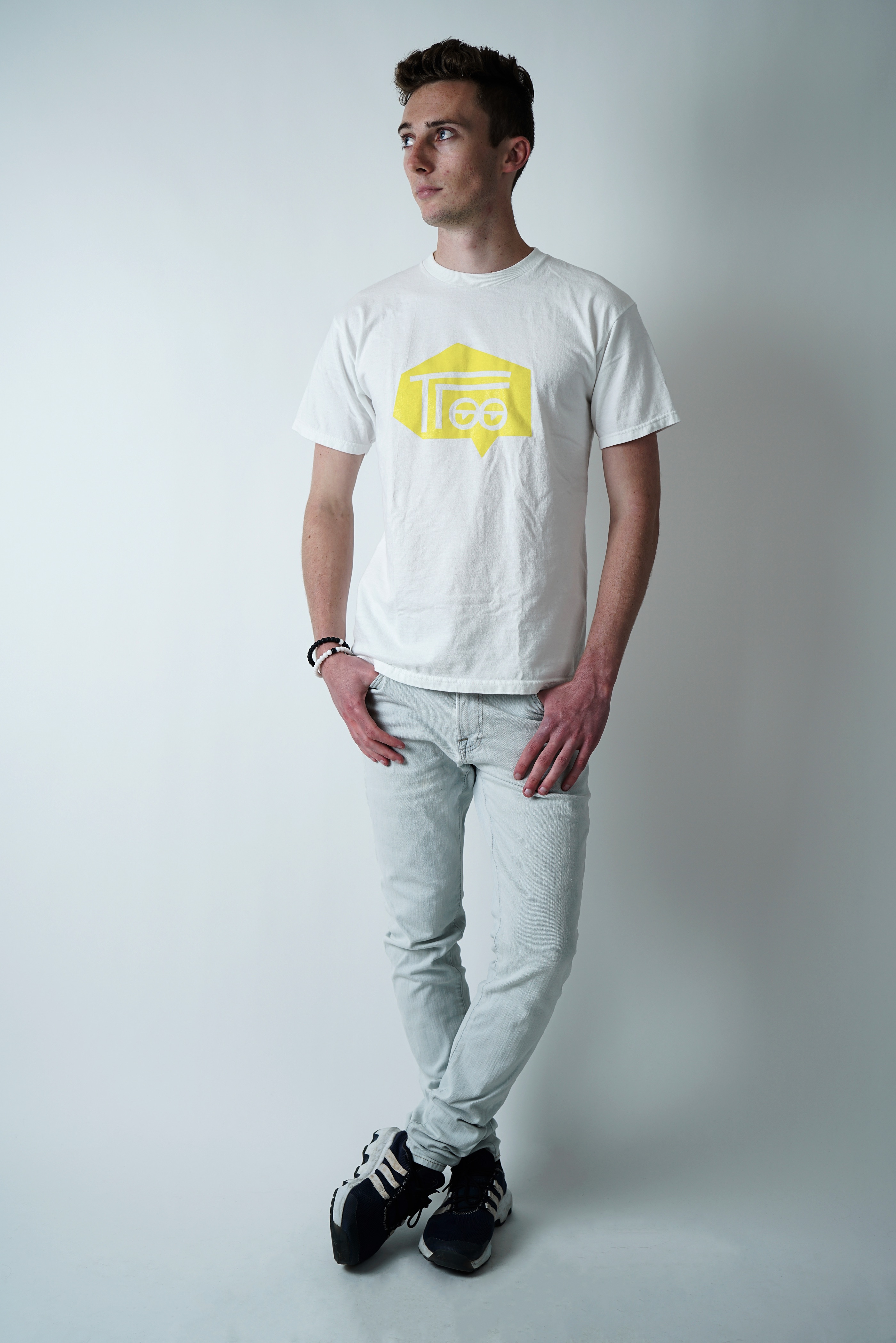
For a prospective customer, this is a portfolio worth approaching with a concrete question. Is the attraction a graphic, a particular cut, or the possibility of a shared garment? The website’s collection and lookbook help separate those interests. Its public contact channel gives an interested wearer or collaborator a next step.
Commercially, the underlying activity is apparel: historically, Lee directed customers to an online shop; the present site organizes his work as a collection, lookbook, films, and projects. In market terms, the relevant alternatives are independent graphic-tee labels, custom printers, and team-apparel designers. Troo Wear’s distinctive combination is the clothing and the creative activity surrounding it.
The shirt needed a photograph
There is another consequence of making clothes. You need to show them. In his photographer biography, Lee describes designing and printing tees as a teenager, then pursuing catalog and lookbook photographs for the brand. Dance groups and other artists drew him further toward cinematography.
That sequence is the most interesting turn in the story. A task that looks secondary can become a discipline of its own. Making an object creates a reason to learn how to present it; presenting it creates a reason to work with other people. The next skill arrives disguised as something that needs doing by Friday.
By 2019, a public announcement introduced Lee’s photography studio, Photomochi, while identifying him as Troo Wear’s creative director. The clothing and image-making belonged to the same person’s working life. His later photography practice helps explain why this label’s archive is so concerned with people wearing the work.
For someone starting a creative project, the part worth copying is the specificity. Pick a group you understand. Make something useful to its identity. Document the result with care. The approach asks for real participation and the capacity to deliver; a group that does not want shared apparel offers little reason to make a team jacket.
Look again at the AFX piece. Its argument is stitched into the front. The label gets a place in the group’s story; the group gets a garment with its name on it. That is a reasonably good day’s work for a jacket.
Follow the thread
Explore the collection, browse the lookbook, or watch the brand’s short films.