At MetroHealth in Ohio, the missing ingredient was publicity. The health system had patients, clinicians and ambitions for research. Yet clinical trial opportunities arrived only a handful at a time, largely through investigators’ professional connections. A hospital could possess precisely what a drug developer needed and still be difficult to find. Somewhere between the patient and the protocol, the introduction had gone missing.
- TriNetX lets researchers test study criteria against real clinical populations.
- Its provider network connects those queries to potential trial sites.
- Software, licensed datasets and scientific services support different research jobs.
- A large cohort helps only when its records contain the details your question needs.
The trial that never reached the hospital
MetroHealth joined TriNetX in 2017. In a company-hosted case study, it later reported one or two study opportunities a week and a 20- to 30-fold increase over earlier routes. Those were opportunities, not a count of completed trials or enrolled patients. Still, the change exposes a peculiar inefficiency: a research site’s usefulness and its visibility are two separate things.
“We needed a better solution.”
David Kaelber, MetroHealth
TriNetX occupies that gap. It connects healthcare organizations, life sciences companies and academic researchers through electronic health record data. Researchers can explore populations, refine study designs, investigate outcomes and find institutions with relevant patients. The commercial appeal is easy to understand. Discovering an awkward assumption while changing a query is rather preferable to discovering it after assembling a trial.
The name sounds like something a procurement department would approve. The underlying question is refreshingly human: where are the people this study needs, and what do we already know about their care?
Send the question, keep the chart
The network’s central mechanism is federation. In its federated query model, participating healthcare organizations retain patient-level data at the source; queries run against those data and return aggregate insights. A researcher gets a way to ask across institutions without receiving a directory of named patients. This architecture depends on provider relationships as much as on software.
Consider a hypothetical trial for adults with a particular diagnosis, a specified laboratory result and no recent exposure to another treatment. Start broad, add each criterion, then watch the population narrow. If a rule removes most potential candidates, the team has something concrete to discuss with the clinical scientists. Is that exclusion medically necessary? Is the time window appropriate? Is the variable recorded reliably enough to use?
TriNetX LIVE supplies a no-code interface for that work. Its query builder, analytics and feasibility tools turn eligibility criteria into cohorts researchers can inspect. The benefit is the chance to argue with a protocol while it is still editable. A polished document deserves no special immunity from arithmetic.
There is a distinction worth preserving. TriNetX also offers separately licensed, downloadable de-identified datasets. Federation describes the provider-connected querying model; it does not mean every product is restricted to displaying aggregate counts. Buyers need to decide which access method their work actually requires.
A count is only the first appointment
A cohort count answers a population question. Recruitment requires a different chain of events: identify an appropriate institution, engage its research team, establish that the site can run the study, and reach patients through approved processes. Eligible people must also be willing and able to participate. The number on the screen cannot make those decisions for them.
TriNetX’s Connect and site-identification capabilities help bridge that distance. Teams can move from patient criteria toward site and investigator insights and outreach. Healthcare providers, meanwhile, can use the network to attract studies and support their own investigators. The arrangement gives institutions reasons to contribute beyond supplying somebody else’s database.
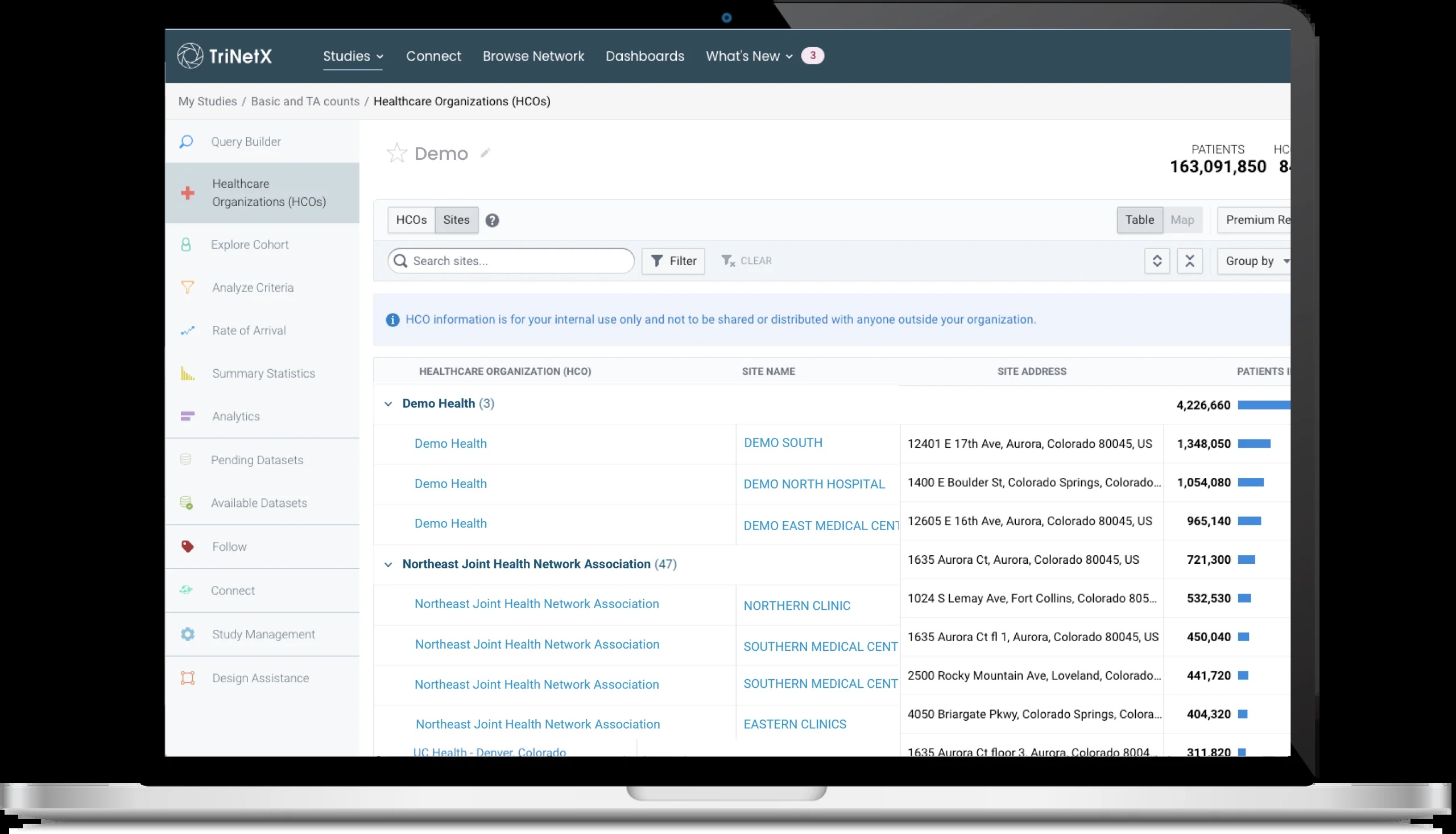
For pharmaceutical companies and contract research organizations, this is operational intelligence. For academics, the attraction may be a multi-institutional population large enough to investigate an uncommon outcome. For hospitals, it can be an introduction to sponsors they would otherwise miss. These customers share records and software, but they are buying answers to different questions.
In June 2026, TriNetX announced that LIVE had passed 300 million patients across more than 240 healthcare organizations and 13,000 sites. The international component matters: the company said most of the roughly 52 million patients added between April 2025 and April 2026 came from outside the United States. Geography expands the questions a network can support, while adding differences researchers must account for.
The bill has more than one line
TriNetX sells a combination of software access, data licensing and scientific services. LIVE supports work inside the platform. Dataworks provides row-level, de-identified EHR data for external analysis. Linked brings clinical records together with claims and other information to study journeys across care settings. EVIDEX handles drug-safety signal detection and management. Consulting adds study design, epidemiology and evidence-generation support.
That breadth is useful because research does not end at finding a cohort. Some teams need data in their own analytical environment. Others need help designing an observational comparison or preparing evidence for regulatory discussions. Each task calls for a different purchase and a different level of scientific involvement.
A published Johns Hopkins workflow makes the cost structure unusually tangible. It distinguishes a free institutional account request from separately negotiated TriNetX data costs. It also lists a $260 local acquisition fee charged through its data-acquisition core. That is a Johns Hopkins processing charge, not the price of a TriNetX subscription. Budgeting needs to include the institution’s work as well as the vendor’s.
The same guidance points local-only queries toward tools such as Epic SlicerDicer in some circumstances. That is a useful market boundary. TriNetX competes for research and real-world data budgets alongside providers such as Optum and Flatiron Health, but a cross-institutional network and a hospital’s internal cohort tool solve different problems. The sensible purchase follows the question.
The molecular turn
The company’s expansion has attracted substantial capital. A $40 million Series D in March 2019, led by Merck Global Health Innovation Fund, brought announced funding at that point to $102 million. Carlyle’s majority investment followed in 2020. Founder Gadi Lachman subsequently announced his departure from the operating role, effective March 2025, while remaining on the board.
April 2026 brought a more specific wager. Regeneron announced a collaboration giving it licensed access to de-identified clinical data and an exclusive opportunity to connect large-scale genomic and proteomic cohorts to TriNetX’s network. It planned to invest up to $200 million. The phrase “up to” matters: an announced commitment is not evidence that the entire sum has changed hands.
Days later, TriNetX announced the acquisition of key Zetta Genomics assets, including XetaBase technology, following a collaboration begun in 2024. XetaBase supports genomic data management and analysis. Together, these developments show the direction of travel: make molecular information more useful by connecting it with the clinical histories that give it context. They do not establish that future discoveries have already happened.
Ask what the records can actually answer
The limitation is written into the raw material. Clinical records document care. They do not automatically contain every variable a researcher wishes somebody had collected. TriNetX’s own dataset offerings address this problem through linked information and extraction of details from narrative clinical notes, including disease stage and biomarker status. More records cannot compensate for an absent measurement.
Local implementation matters too. Johns Hopkins publishes a defined start date for its data and an update schedule. A researcher studying an earlier period or needing overnight refreshes must account for that. Institutional approvals and licensed-use terms also remain part of the workflow. A convenient interface does not remove the obligations surrounding the underlying records.
The lesson readers can copy is procedural. Define the population before selecting sites. Inspect how each criterion changes the count. Ask whether the data capture the outcome and follow-up period. Then establish who can act on the answer. For observational research, choose methods that address the comparison being made; an association needs interpretation before it becomes a treatment claim.
TriNetX is useful when those pieces align: a question suited to recorded clinical data, relevant institutions in the network, and a team able to turn analysis into research. MetroHealth’s experience offers a pleasingly practical example. Sometimes the patients are already there. What is missing is a way for the right researcher to find the right hospital.