The expensive moment in staffing is rarely the resume search. It is 6:47 on a Monday morning, when a shift supervisor discovers that the new forklift operator is missing a certification, the replacement is still somewhere in an email thread, and payroll has a different version of the hours than the floor manager. TRIMAX has built its business around that ungainly handoff. The Mississauga company recruits people, but its sharper product is a record: who was matched, what was checked, what remains current and what happened after the worker arrived.
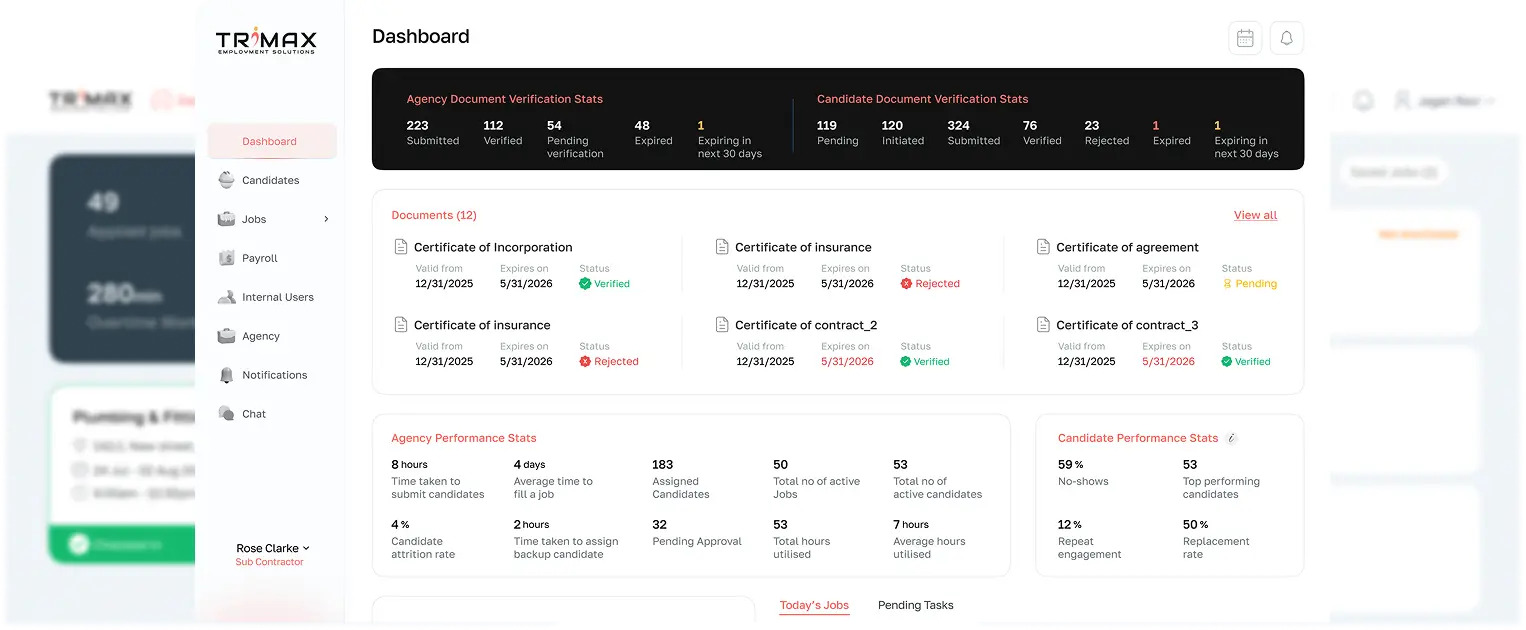
That record lives in Trimax Verify, the proprietary platform behind the agency's temporary, temp-to-hire, contract and permanent placements. It handles candidate matching, identity and credential checks, document storage, onboarding, employer approvals, attendance and payroll. Candidates can use the same system to browse roles, see application status, clock in, read pay records and message a recruiter. The software is not presented as a separate do-it-yourself subscription. It is the plumbing inside the staffing service.
Staffing sells confidence before it sells labour
TRIMAX's founding story begins with a list of mundane failures: slow fills, no-shows, unverified workers, credential gaps and compliance files assembled in a panic. The team had worked inside the traditional agency model and watched employers absorb the cost. The old workflow - phone call, resume, handshake - could produce a person quickly while leaving every important assumption hidden.
Their change of mind was structural. Instead of asking recruiters to be more careful with the same pile of spreadsheets, TRIMAX says it built the platform first and the agency around it. A candidate does not simply move from “available” to “sent.” The relevant identity, work eligibility, background, certification and role-specific documents move through visible states. A recruiter still reviews the algorithmic shortlist. An employer sees verification status before approving it. After approval, offers, tax forms, safety acknowledgements and training records follow the candidate into the first shift.
“Trimax Verify is not a bolt-on to our recruitment process. It is the recruitment process.”TRIMAX company description
This is what the company actually did: it converted the places where staffing breaks into checkpoints. Documents get expiry alerts. Application decisions get timestamps. A GPS-enabled clock-in creates the timesheet that feeds payroll. Employers and recruiters share a view of the pipeline. Candidates get their own view instead of calling a generic inbox for news. None of those features is cinematic. Together, they attack the administrative fog that makes a fast placement feel risky.
One agency, two customers
For employers, TRIMAX targets the people who feel a vacancy as an operational problem: warehouse leaders, plant managers, project teams and hiring managers in regulated or deadline-heavy businesses. Its nine advertised verticals range from warehousing, logistics and e-commerce to manufacturing, construction trades, pharma, IT, healthcare support, finance, engineering, and sales and marketing. The common thread is not collar colour. It is that readiness, documentation or timing can matter as much as the resume.
For candidates, the proposition is different. The service is free. Workers can pursue a temporary assignment, use temp-to-hire as an audition or seek a permanent role. TRIMAX adds status tracking, pay visibility, digital timekeeping and direct recruiter chat. It also records attendance, placement history and employer feedback; strong performers can receive a “Top Talent” designation that raises their visibility for later roles. That creates a small marketplace flywheel: better records can improve matching, and a better candidate experience can improve the employer's supply.
The same machinery, three very different shifts
Imagine a distribution centre adding 60 associates before peak season. The useful filters are immediate: distance to site, shift availability, equipment experience and proof of certification. The employer needs volume, but the floor manager cannot interview 200 people. Here, the platform compresses the pile and the recruiter checks the edge cases. TRIMAX says one company-published engagement delivered 58 verified warehouse workers in under a week and retained 94 percent through the peak period. The number is less instructive than the sequence: define the shift, clear the evidence, keep backup candidates visible and watch attendance after launch.
Now replace the warehouse with a specialized IT project. Availability alone means little; the shortlist must reflect technical scope, contract term and the exact moment the team needs to assemble. One TRIMAX case study reports 63 specialized IT roles filled in 30 days for an ERP program. The workflow remains recognizable, but the human review carries more weight because adjacent technical experience is harder to reduce to a checkbox.
In healthcare or pharmaceutical work, the emphasis shifts again. Vulnerable-sector screening, work authorization, training and expiring documents are not clerical garnish. They determine whether a person can enter the environment at all. The software's contribution is a consistent audit trail; the sector recruiter's contribution is knowing which evidence applies. That division of labour explains the company's broad market claim. TRIMAX is not selling identical candidates to nine industries. It is selling one accountable path through nine different definitions of “ready.”
Role, volume, location, credentials and start date.
Filter the pool, verify the shortlist, add human review.
The employer sees records and chooses the candidate.
Documents, training, timekeeping and payroll begin.
What it costs - and what it is trying to save
Candidates pay nothing. Employers buy a custom staffing engagement; public pages invite them to book a demo or submit a brief rather than presenting a price card. That is normal for managed staffing, where the economics depend on role, wage, volume, duration, geography and which party carries the employment relationship. The direct cost is therefore a negotiated placement fee or staffing markup, not a public software subscription.
The more interesting cost sits behind the quote: idle lines, overtime for the remaining crew, a supervisor repeating orientation, a safety file that cannot survive an audit, or a pay dispute caused by manual hours. TRIMAX's wager is that employers will pay for a tighter process because a cheap, unprepared worker can be expensive by lunch. Temp-to-hire makes that argument tangible: the employer evaluates a person on the job before offering permanence, while the agency manages the bridge.
Where TRIMAX fits in a crowded market
The alternatives are familiar. Large multinational agencies bring scale and established client networks. Local GTA firms bring relationships and speed. Indeed and LinkedIn provide direct access to applicants. An internal recruiting team gives an employer control. TRIMAX occupies the middle: a Canadian managed service with proprietary operating software and sector-specific recruiters.
Its differentiation is not that algorithms can recognize a forklift licence. Competitors can buy screening and workforce tools. The claim is that the same record runs through the whole engagement rather than disappearing between vendors and inboxes. This matters most when an employer has high volume, multiple locations, recurring shifts or a genuine compliance burden. It matters less when the job is a singular executive search built on discretion and a long courtship, or when a small business hires one familiar person every few years.
Steal this
List the five assumptions most likely to ruin day one. Turn each into a required, visible state before approval. Give the worker and the manager access to the same status.
Do not expect this
Verification can remove avoidable risk. It cannot manufacture scarce tradespeople, repair a weak wage, shorten every background check or make a bad workplace retain good people.
The playbook operators can copy
First, write a precise brief. “Warehouse help” is not a requirement; equipment, shift, site, certification, volume and start date are. Second, separate matching from verification. A candidate can look right before the evidence is right. Third, show the decision maker one shared record rather than sending attachments in installments. Fourth, automate the boring sequel: expiry alerts, training confirmation, time capture and pay records. Finally, let candidates see their status. Silence is not a workflow, and it trains good applicants to leave.
The approach has conditions. It depends on employers supplying accurate requirements and reviewing candidates quickly. Workers need a phone and must accept digital onboarding and location-based timekeeping. Integrations and data handling must withstand scrutiny. A standardized pipeline can also become rigid if sector experts cannot override it. And in a genuine labour shortage, the cleanest dashboard in Ontario will still show an empty shortlist.
TRIMAX is still a private company with no disclosed funding, valuation or revenue. Its public case studies report large outcomes - dozens of specialized roles, multi-site trades mobilizations and rapid warehouse placements - but the enduring test is repeat business, retention and clean audits, not the prettiest number on a landing page. Its 2024 Great Place to Work profile, based on a 17-person company sample, reported that every respondent called it a great place to work. That is encouraging and small enough to read literally.
The quiet product is accountability
TRIMAX began in Mississauga in 2023 and subsequently registered in Alberta and Quebec. National reach is a harder project than placing dots on a Canadian map: rules vary, labour pools are local and the recruiter still has to understand the job. The platform can standardize the record. It cannot standardize judgment.
That tension is the company’s most useful feature. TRIMAX has not tried to replace recruiters with a glowing AI button. Its matching engine narrows the pool; a recruiter reviews the shortlist; an employer approves; the system preserves what everyone did. In an industry built on handing people from one party to another, the durable advantage may be refusing to let responsibility vanish during the handoff.