An alert appears on a bank employee’s screen. Something about a transaction deserves a closer look. The software has done its part. Now comes the awkward bit: deciding whether the warning matters, who should investigate it, and what evidence should survive the decision. A machine can produce an alert in an instant. A useful answer requires an organization.
- The work: regulatory advice, implementation and people to run financial services processes.
- The buyers: banks, mortgage businesses, fintechs and capital markets institutions.
- The turning point: Huron acquired Treliant in July 2025, adding its expertise to a broader consulting business.
Treliant works in this busy space between the warning and the answer. Its specialists review controls, validate models, investigate financial crime risks and help institutions change how work gets done. For anyone who has wondered why banks employ consultants after buying expensive technology, the firm offers an instructive explanation. The purchase and the functioning operation are separate accomplishments.
First, fix the warning
Consider a case Treliant published about a leading global bank’s anti-money-laundering transaction monitoring. The assignment included reducing false positives and helping introduce a new monitoring process and system. Those are connected problems. An alert that leads nowhere still consumes a person’s time, while emerging laundering methods require detection rules that keep up.
The team reviewed the monitoring process, trained analysts, introduced rules and updated thresholds. Treliant reported improvements in the bank’s compliance and risk management. The revealing detail is the mixture of interventions: system settings, working methods and human judgment all received attention. The case describes a program that needed adjustment across several parts, rather than a single broken component.
- 01Set the rulesMatch detection to the risk.
- 02Review the alertGive analysts a usable process.
- 03Record the decisionMake the reasoning reviewable.
That combination explains Treliant’s range. Financial crimes work includes customer due diligence, sanctions and transaction monitoring. Other assignments concern mortgage operations, fair lending, risk assessments, regulatory remediation and model validation. Capital markets teams handle regulatory and business change, documentation and data. Managed services and staffing supply capacity when an institution needs people to execute the process.
The distance between Washington and Belfast
Treliant’s base in Washington makes sense for a firm whose work depends on understanding regulatory expectations. Its public histories date the business to 2005. Financial services lawyer Andrew Sandler founded Treliant Risk Advisors; reporting also identifies Jeremiah Buckley as a co-founder. Sandler’s own biography dates his sale of the business to 2017. Vistria became its private equity owner.
The more revealing expansion came in August 2021, when Treliant acquired Belfast-based Vox Financial Partners. Vox added capital markets expertise and European delivery capacity, including operations in Northern Ireland and Poland. Treliant could serve a wider range of work inside financial institutions, extending beyond its traditional emphasis on consumer-related businesses.
“We are a people business, and I will start there.”
B. Scott Fisher, then Treliant CEO, December 2021
In January 2023, Treliant announced plans for 150 Belfast roles over three years. ThinkBusiness reported that 40 were already in place. The planned positions covered capital markets and managed services, with graduate recruitment and training part of the approach. The recruitment announcement described hybrid working. Capacity here meant developing people who could perform specific financial services tasks.
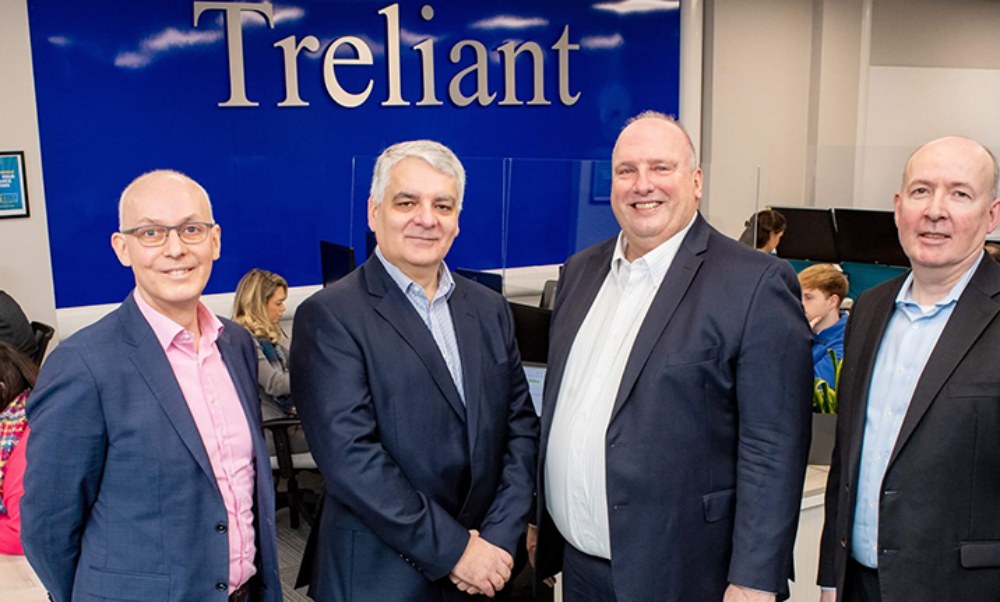
The economics were unusually visible. Reporting put Invest Northern Ireland’s grant support at £750,000 and the planned annual salary contribution at £4.8 million once the roles were filled. These figures describe expansion support and expected payroll. They offer a glimpse of the delivery model: expertise has to be available at a cost clients can support.
Announced in 2023 over a three-year hiring period. A commitment, not a verified completion count.
Treliant considered other locations. Management said Northern Ireland won through its talent, existing knowledge of the work and Invest NI’s support. The lesson is practical: choose a delivery location around the capabilities the work requires. A lower price helps only if the team can produce something a client can use.
The platform needs an operator
Technology partnerships make Treliant’s market position easier to see. KX described a partnership announced in May 2022, pairing Treliant’s expertise with time-series data and analytics technology. KX later highlighted a Treliant tutorial for configuring cloud trade analytics in ten lines of code. It was an approachable demonstration of infrastructure setup, with implementation expertise surrounding the tool.
In October 2025, Eventus announced a collaboration with Huron | Treliant around its Validus trade surveillance platform. The services included risk assessments, alert logic optimization, workflow guidance and operational support. The division of labor was clear: a technology company supplies the surveillance platform; experienced practitioners help clients configure and operate their surveillance programs.
This places Treliant among specialist regulatory advisers and managed services providers. Alternatives vary with the task, from financial crime specialists such as AML RightSource to an institution’s own compliance and operations teams. Its combination of regulatory experience, implementation work and staffing gives buyers several ways to engage. The relevant comparison is the work required, rather than a feature checklist.
What Huron bought
Huron announced the acquisition on July 31, 2025; its SEC filing records the closing on July 11. Treliant joined Huron’s Commercial segment. The stated rationale combined Treliant’s financial services knowledge and global delivery presence with Huron’s digital capabilities. Treliant’s website now leads visitors to Huron’s financial services practice.
For a prospective buyer, the useful distinction is between advice, change and continuing operations. A control redesign needs judgment. A system transition needs implementation. An alert queue needs sustained capacity. Treliant sells services across that sequence. My reading of its cases is that the benefit depends on connecting them: staffing alone leaves weak rules intact, while new software leaves unresolved questions about ownership and execution.
The idea readers can borrow is modest and demanding. Start with one decision your organization must make repeatedly. Check the data feeding it, the rules shaping it and the people responsible for it. Then inspect the result. Treliant’s business lives in those connections, where a written requirement finally becomes something a bank can do.