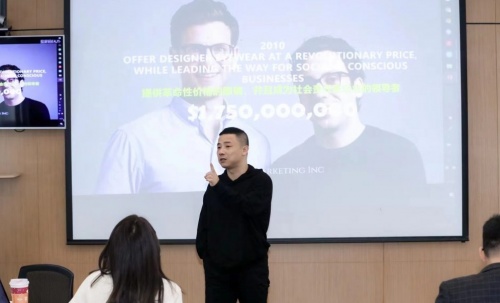
Tony Gu remembers a visit to Facebook that left some of his guests unimpressed. He had brought more than twenty Chinese cross-border business owners. Facebook and Instagram marketing directors each spoke for thirty to forty minutes. The visitors wanted something immediately usable: a way to bring in traffic. In Gu’s telling, the presentations failed their test. There were no satisfying tricks.
It is a revealing anecdote for a marketing adviser to preserve. A trip inside a famous technology company ought to make a handsome professional trophy. Gu uses his account to describe a misunderstanding. The visitors were looking for a mechanism that would do the difficult part for them. He thought they were asking the wrong thing of the platform.
He writes that if such a shortcut existed, his own team would know about it. There is a dry impatience in the observation. The adviser has arranged the visit; the guests would apparently prefer that he arrange a small exemption from the work as well.
That impatience runs through Gu’s public writing. The founder of Sailing Marketing helps Chinese businesses build brands overseas. Again and again, he brings their attention back from the channel to the company using it. Before deciding where to speak, he wants a founder to know what the business means.
A book that began with the clients
Gu, whose Chinese name is 顾仁宝, founded Sailing Marketing in 2015. He is based in Los Angeles. His LinkedIn profile lists Jilin University between 1996 and 2000, and identifies both Chinese and English at native or bilingual proficiency. Those are useful coordinates for a career spent explaining one commercial culture to another.
The company’s early description is straightforward: help international businesses enter the American market through branding and marketing. Its listed services include websites, advertising, content, search and social media. These are the recognizable tools of an agency. Gu’s writing spends much of its time explaining why possession of the tools does not settle what to do with them.
His book 无品牌不营销, rendered in English as No Brand, No Marketing, grew out of that explanatory work. In a March 2023 interview, he said it was originally intended for existing brand clients. Other companies seemed to have the same difficulties, so he decided to share it more widely.
He also made a useful qualification about authorship. He described himself as explaining marketing ideas in familiar Chinese, informed by his team’s practical experience. He did not claim to have invented every idea he was explaining. The ambition was to make the logic usable by people responsible for running businesses.
There is a teacher’s problem inside that ambition. A reader wants an answer that can be carried back to the office. The teacher needs the reader to understand enough to choose an answer when circumstances change. A list of tactics ages rather differently from a way of thinking.
Three letters, several uncomfortable questions
Gu organizes his approach around B.A.D: Build, Align, Distribute. Build establishes the idea. Align brings the people inside the company into agreement with it. Distribute carries it outward. The order matters to his argument. An organization has to understand what it is trying to express before its channels can express it consistently.
His book materials give the stages their own smaller labels: A.U.R.A for building, C.A.R.E for alignment, and L.O.V.E for distribution. He has an evident appetite for initials. They make a memorable vocabulary for subjects that can otherwise dissolve into agreeable abstractions. Almost everyone approves of care in a meeting. The interesting discussion begins when someone has to act on it.
A reading of Gu’s framework. Sequence, not a performance forecast.
In a 2023 discussion of implementation, he connected the brand with company policies, the way employees are treated, and even the office environment. Employees then pass something of that experience to customers through their own work. It is a view of branding that gives people away from the advertising desk considerable responsibility.
Read that argument through an ordinary workday. An employee encounters the organization’s priorities before a customer encounters its campaign. The practical question is whether the employee can recognize the same priorities in both places. If the answer requires a lengthy explanation, the company has some thinking to do.
For Gu, the founder remains involved throughout. Values cannot simply be announced and delegated into existence. His framework asks the person at the top to choose a direction that others can understand, find meaningful and carry into their work. The initials fit neatly on a page. Their implications take up considerably more room.
The founder gets homework
Gu’s April 2023 positioning interview begins with the hazards of imitation. A business sees a category selling well, studies the figures and joins the queue. He argues that data describes behavior without necessarily explaining the reasons behind it. His examples ask readers to consider what a purchase helps a person accomplish.
He sets out three tests for a proposed direction: distinguish the company from competitors, resonate with the intended customer, and motivate the people around the founder. He also warns against assuming that knowledge of Chinese consumers can simply be transferred to American consumers.
These tests help explain the breadth of his brief. A direction can look attractive in a market analysis and still make little sense for the team expected to deliver it. A founder’s enthusiasm can be equally unhelpful if the intended customer has no reason to share it. Gu wants those perspectives considered together.
There is a useful friction here. The business owner cannot outsource every judgment. Someone must decide which audience matters, which commitments fit the business, and which ambitions its resources can support. Research informs those choices. It does not relieve the founder of making them.
“Business is Cultivation, and Brand is Virtue.”
Tony Gu’s stated business philosophy
The sentence captures the philosophical language Gu brings to his work. His biography connects his thinking with Zen, the I Ching and Wang Yangming’s tradition of mind philosophy. He puts those references beside brand strategy and the commercial responsibilities of a founder. The result is a vocabulary in which business decisions are also expressions of character.
The work after the presentation
Gu’s implementation writing makes the argument less comfortable and more concrete. In one essay, he sketches an expensive branding exercise followed by a quiet return to old habits: cheaper packaging, discount-heavy marketplace listings, mechanical replies to complaints. The strategy remains in a drawer while the organization carries on.
These are examples he uses to explain a problem, rather than a named client case. Their appeal is their modest scale. A brand can lose its meaning through decisions too ordinary to attract executive attention. The presentation may have been warmly received by everybody who never has to answer a customer.
His proposed response includes operating procedures, performance measures, sales materials and recurring staff learning. He describes the broader work as a Brand OS. The software metaphor is doing organizational work: he wants the ideas to become part of the system people use, rather than another document they are expected to admire.
A reasonable test of that ambition would be to ask an employee what changed. Which decision became easier? Which priority became clearer? What can they now do for a customer? Those questions translate the language of alignment into something that could be discussed without opening the original slide deck.
A philosophy with an address
The same interest in making an idea tangible appears in Sailing Marketing’s North American Brand Embassy offering. The company describes fixed premises and mobile branded trailers as possible ways for Chinese businesses to establish a physical presence. The proposal combines customer encounters, local relationships and content production.
It is an offer, rather than proof that a particular client has achieved a particular result. As an expression of Gu’s approach, however, it is revealing. A brand might need somewhere a prospective customer can enter, examine a product and have a conversation. In this version of distribution, the meeting has an address, or occasionally wheels.
His second book, 无美好不品牌, is promoted as Business for Good. An October 2026 publication announcement describes it as a continuation of his work on B.A.D. Its themes return to the founder, the treatment of employees and the relationship with customers. The larger aspiration remains consistent: help Chinese companies build brands that earn respect internationally.
Gu’s earlier book materials include a more modest author’s gesture alongside that ambition. He invites readers to point out mistakes. It is a welcome note in a field with a substantial supply of certainty. An adviser asking people to reconsider their habits can usefully leave room for reconsidering his own explanations.
The Facebook visit still serves as a fitting introduction. His guests wanted something they could take away. Gu’s recurring answer asks them to bring something of their own: a clear purpose, a team able to act on it, and the patience to build relationships. The souvenir is homework. A founder may reasonably have hoped for a lighter bag.