At one point in the early life of Credit Union Direct Lending, Tony Boutelle put his hands down hard on a table. People were questioning whether credit unions should make loans at car dealerships. Boutelle was frustrated enough to say he would put in his own money if he could. The business was still something that needed defending. A nationwide lending network was a long way from being an obvious outcome.
That episode resurfaced at the company’s thirtieth-anniversary gathering in San Diego in 2024. By then, Boutelle was still running the organization, now called Origence. The room included people who remembered when the idea had seemed doubtful. There is a particular pleasure in attending a birthday party for something other people once wanted to cancel.
The venture began in 1994 with $200,000 apiece from the California Credit Union League and Golden 1 Credit Union. Stan Hollen, Golden 1’s former chief executive, and Diana Dykstra were part of the early effort. Golden 1’s dealership relationships helped establish the Sacramento operation. Boutelle led the new organization from its founding.
Its proposition required two groups to cooperate: credit unions that wanted to lend to members, and dealers that wanted to sell cars. Neither group could make a network by itself. Boutelle’s working life would become an extended effort to get both sides into the same transaction.
A career already inside the cooperative world
Boutelle arrived at that argument with a career in the credit union industry already underway. A University of Wisconsin-Madison business graduate, he began at the Colorado Credit Union League in 1985. He joined the California Credit Union League in early 1987, moved to CUNA Mutual Group in 1991, and returned to the California league in 1994 to start the business that became Origence.
The sequence matters. His experience ran through organizations serving credit unions before he began building technology for them. His customers’ institutional world was familiar territory. The company he went on to lead was structured as a credit union service organization, or CUSO, with credit unions themselves participating in ownership.
That arrangement gives a practical meaning to the line Boutelle uses in his company message: “We go as credit unions go.” Origence’s purpose depends on its lenders continuing to win business. The technology has to help a cooperative institution complete an ordinary, consequential task: getting a loan to a member.
A familiar name, with room to outgrow it
CUDL is pronounced “cuddle,” an unusually affectionate name for financial infrastructure. It became a working verb among dealers. That is a useful kind of familiarity for a business selling a process: the name slips into the sentence describing the job.
But a name associated so closely with indirect auto lending also set boundaries. Boutelle explained the progression from CUDL to CU Direct to Origence as the company expanded. Under the Origence umbrella, the dealership network sits alongside loan origination technology and outsourced lending services. The old brand remains part of the business rather than being discarded as an embarrassing childhood nickname.
The expansion changed what his organization could do for a credit union. A lender might need a connection to a dealer, software to handle an application, or help processing a loan. Those needs meet inside one lending operation, even when they require different products. Boutelle’s company grew by taking on more of that work.
In 2023, Origence received NACUSO’s CUSO of the Year Distinguished Services Award. Boutelle accepted it in Las Vegas. The recognition covered an organization built with participating credit unions over nearly thirty years. A shared network depends on people continuing to use it, year after year.
The customer moved the meeting
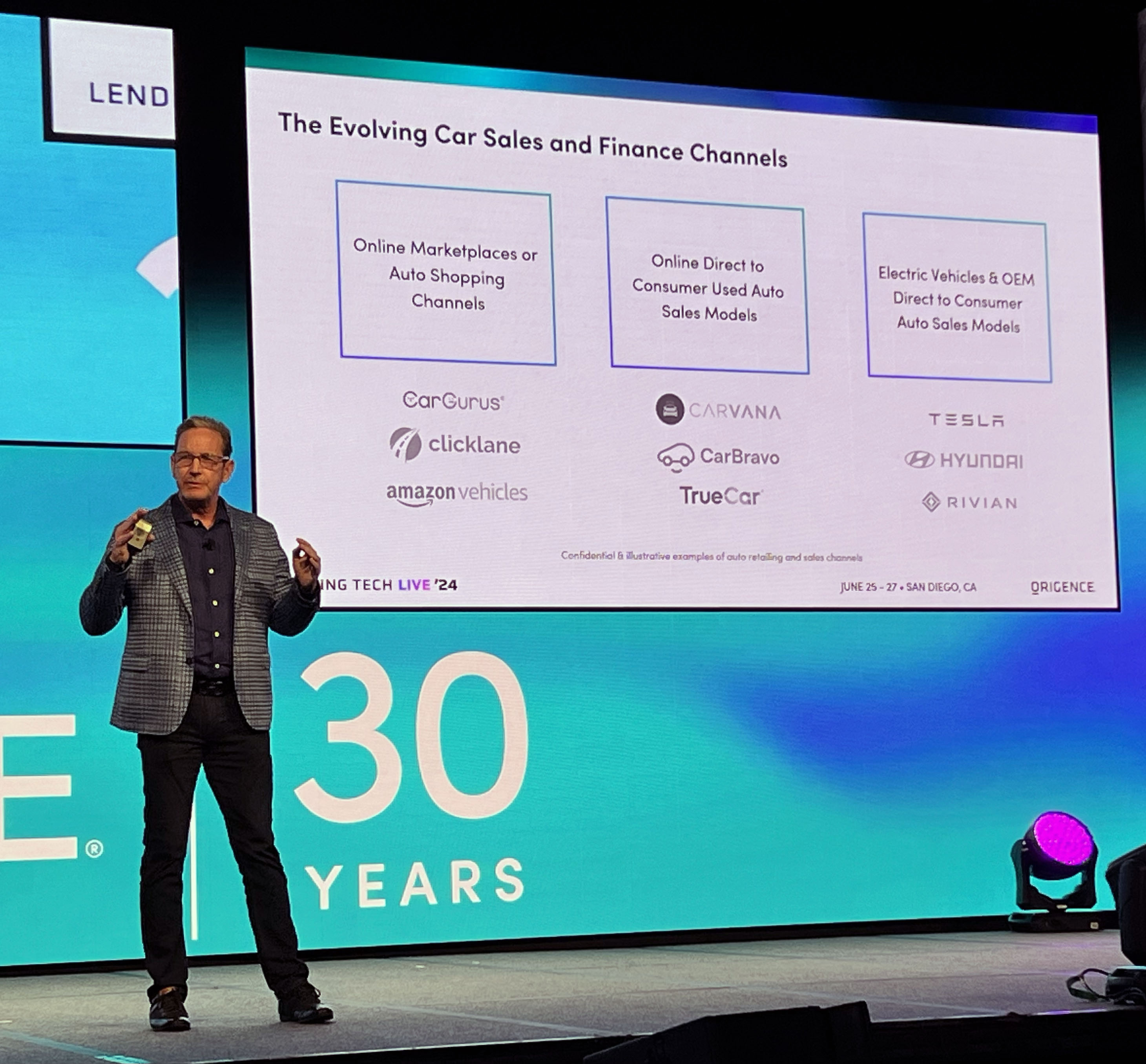
By 2023, Boutelle was asking credit union leaders to reconsider where the decisive lending conversation happened. For years, the dealership had offered the crucial opening. Someone arrived to look at a car, found a vehicle, and encountered financing while the purchase was coming together. CUDL gave credit unions a way into that moment.
Online shopping was moving financing earlier in the process. A buyer could encounter a loan before reaching a dealership, or buy through a business with no traditional franchise showroom at all. Credit unions could maintain their existing dealer relationships and still miss customers whose decisions had already been made elsewhere.
Boutelle’s explanation was concrete: “The top of the funnel is changing; the financing is not necessarily at the dealership anymore.” The phrase describes a shift in timing as much as location. Arriving with an attractive offer becomes less useful once the borrower has accepted another one.
It was an awkward message to bring to lenders with established habits. He described the change as gradual. A process can keep producing loans while the next source of business is forming somewhere else. His response was to seek access to those emerging purchase channels, keeping the same underlying objective while changing the route.
“We go as credit unions go.”Tony Boutelle
One checkout, many credit unions
Tesla made that problem tangible. Its online sales process called for a financing connection that could operate at the scale of the retailer. Origence’s answer was FI Connect, a licensed subsidiary that could originate financing and place loans with participating credit unions.
The Tesla partnership brought credit union financing into the manufacturer’s website and mobile buying experience. FI Connect provided the intermediary: a buyer could take the financing offered at checkout, while a credit union would purchase and service the contract. The arrangement connected a national purchasing channel with lenders that have their own membership requirements and lending capacity.
Boutelle described the process in early 2024 as including borrower enrollment and the transfer of the loan to an eligible partner in real time. The matching work had to be done before FI Connect committed to the loan. Convenience at the front of the transaction required coordination behind it.
There was a tradeoff for credit unions accustomed to having their own brand visible throughout a loan. Boutelle acknowledged that concern directly in a 2024 interview. His response was to ask what alternative would get an individual institution into the same online channel. The question was blunt, and it left the commercial difficulty in view.
The program produced a measurable result. In its first full year of Tesla financing, FI Connect’s participating credit unions financed $1 billion in electric-vehicle loans in 2024. The same year included a Tesla rate subvention program, adding another way for participating lenders to reach buyers through the manufacturer’s financing offer.
The paperwork has a vote
A new sales channel can attract attention. A loan still has to get through processing. Boutelle’s conversations about the future repeatedly return to the work between an application and funding: documents, validation, decisions, signatures, and the transfer of money.
Origence’s 2024 annual report described a pilot of eContracting for CUDL, with a broader rollout planned for 2025. The goal was a paperless process that would help lenders fund faster. It is easy to admire a slick checkout screen. The dealer waiting for payment may have a more demanding definition of convenience.
The company also expanded document processing automation, using artificial intelligence and machine learning to handle lending documents. Its 2024 performance release reported more than five million documents processed, validated, and classified. These are operational measures, close to the daily workload of the people completing loans.
Boutelle has brought some humor to the AI conversation. At Lending Tech Live in 2023, he joked about renaming the business OrigenceAI to benefit from the attention surrounding the technology. The joke worked because the temptation was recognizable. His company’s practical test is more prosaic: whether the technology helps the lending work get done.
Thirty years, followed by another working day
The funding figures show a business exposed to changing lending conditions. Origence’s platforms funded $59.2 billion in loans in 2023 and $53 billion in 2024. In 2025, the total rose to $62 billion, a reported increase of 17%. These are loans funded through the platforms, rather than Origence’s revenue or Boutelle’s personal wealth.
The 2025 results also included 89 new or expanded credit union contracts. Credit unions on the CUDL platform, counted together, retained their position as the country’s largest auto lender for a fifth consecutive year. That aggregate qualification matters. The scale comes from many institutions participating in the same channel.
Boutelle kept returning to efficiency and new lending opportunities in public appearances. A June 2025 conversation covered automation and the borrower’s journey. At Lending Tech Live in June 2026, he discussed document processing, lending trends, and opportunities involving major partners. The anniversary had become another point in a continuing schedule of product and customer conversations.
On October 8, 2026, Origence announced that he had received the California Credit Union League’s Distinguished Service Award for his leadership, advocacy, and contributions to the credit union movement. The league where he had worked before launching the venture was recognizing the career that followed.
His story keeps returning to access. First, credit unions needed a place at the dealership. Then they needed a place in the online purchase. Each new connection has required lenders to work through questions of identity, capacity, and speed. The machinery grew more complicated; the question stayed quite approachable. Where is the customer making a decision, and can a credit union be there in time? Boutelle has spent three decades trying to make the answer yes.