A car loan can end before its paperwork does. The balance reaches zero. The driver moves on. Somewhere in the machinery of vehicle finance, a protection product may still need cancelling and a refund may still need finding. Glenn Munro has built a company around that awkward afterlife.
It is an unusually modest starting point for a technology business. There is no new car to unveil, no dramatic improvement in acceleration. The desired result is money reaching the right account, with enough evidence to explain how it got there. Anyone who has chased a refund will recognize the attraction. The glamour arrives separately, if at all.
Munro, co-founder and chief executive of Lender Compliance Technologies, came to the problem with a career spread across lenders, vehicle businesses and software. His work has included Porsche Financial Services, Hertz, Ford Motor Credit, Volvo Financial Services and Santander. Before leading LCT, he had already been both an investor in lending technology and an executive selling it.
That history gives his present business a particular shape. He knows the institutions that must buy the software, the people expected to use it and the tedious consequences when a process depends on too many disconnected steps. At LCT, the unfinished business at the end of a loan has become the business itself.
The investor who joined the sales team
In July 2017, Munro joined defi SOLUTIONS as vice president of sales. He was already an early investor. By then, his auto finance experience extended beyond 30 years and included sales, marketing, operations and finance. He had also been a founding member of Sixth Gear Solutions, an independent automotive finance startup.
The defi appointment brought him into a company whose products touched loan origination, servicing and the exchange of loan portfolios. His most recent job had been director of credit services at Porsche Financial Services. He was moving from a lender's operations into the business of helping other lenders choose their tools.
There is a useful distinction between investing in software and taking responsibility for its sales. One involves believing the product has a future. The other involves listening while a prospective customer explains why that future may have to wait until next quarter. Munro had put himself on both sides of that conversation.
By January 2020, he was advising Lightico on automotive finance. Its mobile tools gathered documents, signatures, identification and payments. Munro's diagnosis was brief: “certain processes are still stuck in the past.” The remark was about lending, but it could have served as a prospectus for his next venture.
“certain processes are still stuck in the past”
Glenn Munro, on joining Lightico's advisory board, 2020
His path through the industry matters more than a neat sequence of job titles. Lending creates a series of handoffs: dealer to institution, applicant to underwriter, signed contract to servicing team. Munro's work had brought him into several of those environments. LCT would concentrate on a handoff easily overlooked once the main transaction appeared finished.
A refund needs someone to follow it
LCT introduced Refund Control in April 2021. The product addressed cancellations and refunds for finance and insurance products, including guaranteed asset protection and vehicle service contracts. Early payoffs, repossessions and total losses could leave lenders with cancellation work to complete. The software offered a way to send notices, follow the process and preserve a record.
The central design choice was lender control. A financial institution could manage the workflow and see what was happening between the cancellation request and the refund. That visibility mattered because several parties might participate in the transaction. Sending a request was one event. Establishing the amount and tracking the money were further tasks.
- 01IdentifyFind the cancellation event
- 02NotifySend the cancellation request
- 03VerifyObtain the provider's quote
- 04TrackFollow the recovery and record
Munro expressed the purpose in terms that required little translation: “every dime that is due towards the consumer is applied.” For a borrower, the important question is whether the correct money has been credited. For the institution, the same question comes with another: can it reconstruct what happened when someone asks?
Refund Control was built to make that reconstruction part of the process. Notices, amounts and progress could live within a system of record. The appeal is easy to understand without pretending that software makes responsibility disappear. A lender still has work to oversee. Munro was offering a more organized way to oversee it.
Four million dollars for the loose ends
On June 23, 2021, LCT announced a $4.15 million Series A. Automotive Ventures and Driven Capital Partners joined a syndicate of software entrepreneurs. Refund Control was still in its pre-sales phase, with a wider US rollout approaching. The financing backed a young product and the development work ahead.
Capital for LCT's compliance technology and product roadmap.
For Munro, the ambition extended beyond the initial release. He described the funding as support for a broader compliance roadmap and accompanying software. The practical constraint was already clear: the company needed to build tools around the needs of financial institutions, whose appetite for new technology comes with existing systems, established routines and people who have other work to finish.
In March 2022, Cherokee Media Group named LCT to its Emerging 8 companies to watch. Munro credited contributions from lenders, providers, technologists and operational specialists. That is a revealing list. The product required agreement across the people supplying information and the people expected to act on it.
He also discussed the benefit of building on Salesforce and distributing through its AppExchange. The choice offered an established cloud foundation for the workflow. In January that year, he had appeared on Joel Kennedy's ConsumerFi podcast to discuss automated refund controls and Salesforce integration. The conversation put him in familiar territory: explaining how an operational task could become easier to manage.
The art collector and the document pile
A 2020 Lightico speaker biography adds two details to Munro's professional record: he collects modern art and enjoys renovation projects. They are pleasantly specific interests for an executive whose public work largely concerns finance systems. A wall can hold a painting. Behind it, there may be something that needs fixing.
Those interests do not explain his business decisions, but they give a fuller picture of the person making them. The renovation enthusiast and the lending executive share a name; any grand theory connecting the two would be doing unnecessary construction work of its own.
At LCT, the next practical improvement concerned documents. In October 2023, the company partnered with Informed.IQ to support intelligent document processing. The task was to extract relevant protection-product information from forms and lending documents, reducing the need for staff to search deal packages by hand.
Munro described two aims: reducing lenders' costs and shortening the time required to refund consumers. The technology had a defined assignment. Locate the information needed to submit a cancellation, then move it into the workflow. It was an application of AI with a specific destination for the output.
That specificity is useful when considering his approach. A faster document review only becomes valuable here if the cancellation work can proceed. The document is one part of a longer chain, and Munro's stated goals kept both the institution's workload and the consumer's waiting time in view.
A conference photograph becomes a partnership
At AKUVO's 2024 conference, Munro stood beside Jay Mossman for a photograph. Between them was an LCT banner asking how attendees managed GAP cancellations and refunds. Baseball caps occupied the table in front. It was the ordinary equipment of business development: a question, a product and a reason to stop walking.
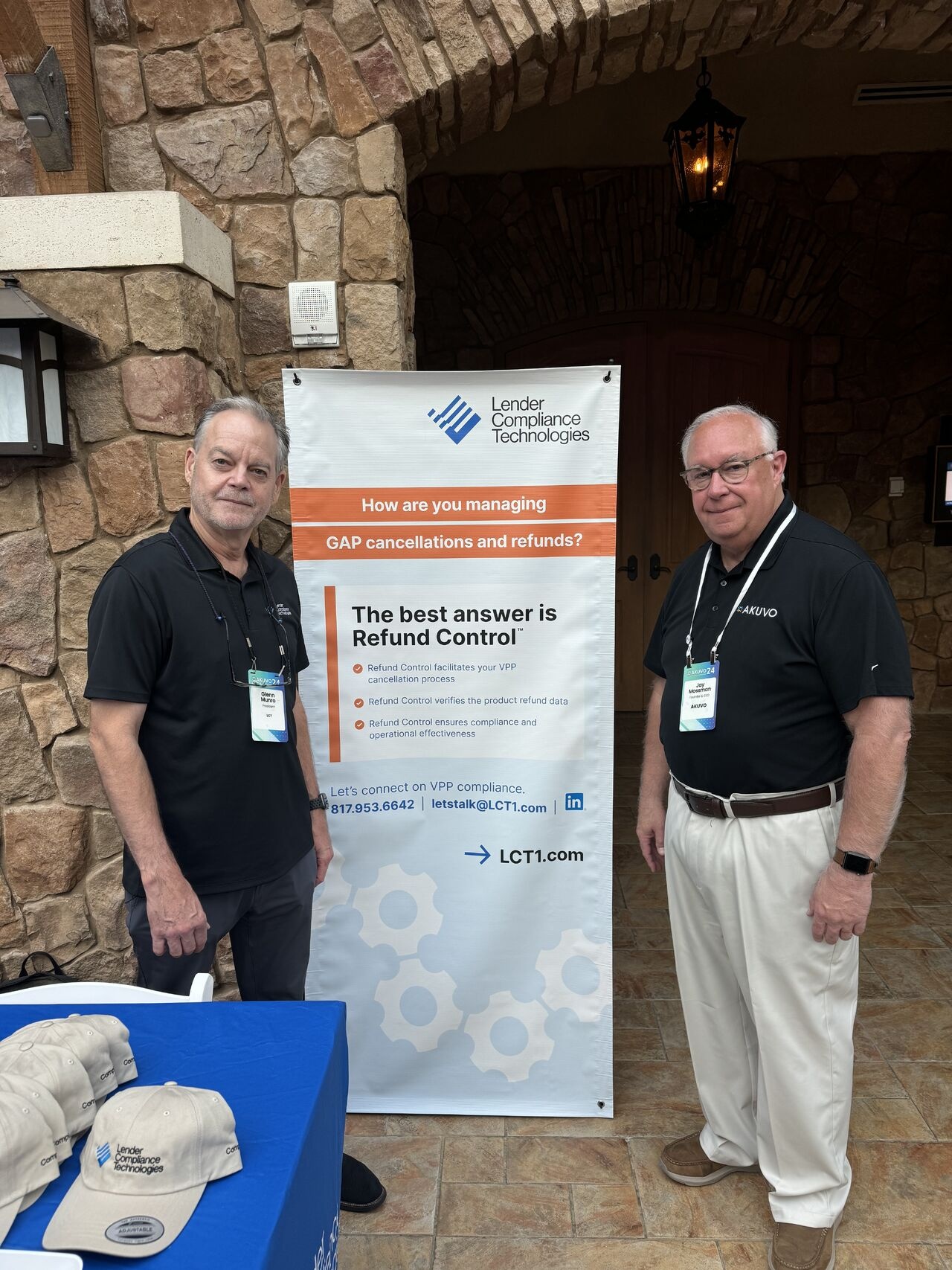
Mossman publicly welcomed LCT as a partner. Two years later, the relationship would acquire another dimension. In September 2026, LCT launched a credit union service organization with One Washington Financial, SWBC and Mossman, who invested personally through NRT Holdings LLC.
Meanwhile, Munro's own title had changed. In December 2024, LCT promoted him from president to chief executive as Brad Rogers joined as executive vice president and chief revenue officer. Rogers brought experience from RouteOne and Motility Software Solutions. The company was adding commercial leadership around the product Munro had helped bring to market.
The new credit union venture gave that work a dedicated route into another set of institutions. One Washington Financial is wholly owned by Washington State Employees Credit Union. The partnership brought together the software business, a credit union investment organization, a financial services company and an individual investor already familiar with LCT through AKUVO.
What counts at the end
At the September 2026 launch, LCT reported that its platform processed more than 100,000 cancellations monthly and supported nearly 30 credit unions serving more than five million members. The figures describe different things: transaction activity, institutional customers and the membership of those institutions. Keeping them distinct makes the scale easier to understand.
Munro thanked the investors and credit union clients publicly, emphasizing compliance, recoveries and lower internal costs. The priorities were recognizable from the earlier product launch. More institutions and more transactions had enlarged the operation; the work still concerned the same stubborn interval between a cancellation and a properly resolved refund.
His career has carried him from established vehicle finance businesses into software investment, sales, advisory work and company leadership. LCT draws those experiences toward a small question with real consequences: what remains to be done after a loan ends? Munro has chosen to stay with the paperwork until there is an answer.