After IEEE Quantum Week in Albuquerque in 2025, Tommaso Demarie had a decision to make. He could fly to San Francisco for more meetings. Or he could go to Arizona with two colleagues and see the Grand Canyon. The meetings had the familiar advantage of sounding responsible. Arizona had a mule ride.
The mule won. At the canyon’s southern rim, Demarie and a colleague found themselves moved by the view. For someone whose working life involves coaxing meaning out of things too small to see, the scale made a pleasing change. Nature had arranged a demonstration that required neither a compiler nor a conference badge.
He later described the trip with a mixture of wonder and mischief. There were photographs sent enthusiastically to friends, a reminder to take in unfamiliar beauty, and the frank admission that he had hesitated over taking the time. The detour reveals a useful thing about Demarie: learning remains an appetite, even when the lesson has no obvious customer.
The two-year stay that became a company
Demarie comes from Ivrea, the Italian town associated with Olivetti. He studied physics at the University of Turin, earning a master’s in environmental physics, and spent a year at Banca Sella before moving to Australia for doctoral research. The route to quantum computing included rather more geography than a job description could comfortably contain.
In 2010, friends in Italy tried to talk him out of the Australian move. Distance, lost connections and the country’s alarmingly inventive wildlife all featured in the argument. He went anyway. Curiosity about quantum information and about the country outweighed the objections. At Macquarie University, he completed his PhD and delivered a graduation speech in May 2014.
His intellectual travelling companion was Dante. Reflecting on his research years, he turned to Ulysses and the urge to cross beyond the known world. He also drew a practical lesson from that story: difficult journeys need companions. The academic who would become a founder was already thinking about knowledge as a shared undertaking.
Singapore was supposed to be another temporary stop. Demarie arrived in 2014 for what he expected would be a two-year postdoctoral experience. He worked at Singapore University of Technology and Design and the Centre for Quantum Technologies, joining Joe Fitzsimons’s research group. Years later, Singapore was still home.
Fitzsimons helped sharpen his interest in theory that could find a use outside the page. Demarie has recalled learning to distinguish between abstract work and work developed with applications in view. Fitzsimons would also become a quantum software founder, at Horizon Quantum Computing. The connection places Demarie within a community of researchers trying to make their science usable.
Leaving the room where you know the answers
In his own account of joining Entrepreneur First, Demarie described himself as shy, slightly awkward, bookish and devoted to learning. Leaving an academic job he loved required a painful resignation letter. Starting a company meant carrying that curiosity into a setting where a good explanation alone would no longer settle the matter.
In 2018, he and fellow CQT alumnus Ewan Munro founded Entropica Labs through Entrepreneur First. Demarie became CEO; Munro became CTO. One took responsibility for the business and the other for technical direction. Their common starting point was physics, with all the pleasure and inconvenience of knowing how much remained unresolved.
An early demonstration made the possibility tangible. At their Entrepreneur First Demo Day, the team had live access from Singapore to a Rigetti quantum processor in California. An investor could watch a computation run on an actual device across the Pacific. The cloud gave a young software company access to machinery it did not have to build.
That September, Entropica was named among Rigetti’s software partners. CQT recorded support from Entrepreneur First, SGInnovate and Toronto’s Creative Destruction Lab. The company was entering a network extending well beyond Singapore. A research background had supplied the vocabulary; now partnerships would supply opportunities to test it.
Demarie also had to reconsider ambition. Surrounded by talented founders, he wrote about the temptation to measure himself against everyone else’s contracts, investment and apparent momentum. His proposed remedy was to admire what other people could do and learn from them. Being the cleverest person in every room would be an exhausting staffing policy.
“You cannot delegate responsibility for decisions.”
Tommaso Demarie · on founding a company
A useful computer has to survive its own calculations
Entropica’s work eventually concentrated on a stubborn obstacle: quantum computers make errors. Their physical systems interact with the environment, and those interactions can spoil a calculation. Increasing the number of qubits gives developers more to work with, but it also leaves them with the job of keeping the computation dependable.
Quantum error correction supplies procedures for protecting information and dealing with faults as the computation proceeds. Demarie explains the underlying ambition plainly: errors must be handled quickly enough that they do not overwhelm the work. A long calculation needs reliability throughout its execution. There is limited satisfaction in receiving a beautifully formatted wrong answer.
Build redundancy into the quantum computation.
Use repeated checks to detect evidence of faults.
Interpret the checks and account for errors as execution proceeds.
His earlier research had already explored questions about what quantum computation permits. In 2016, he co-authored work with Atul Mantri and Joseph Fitzsimons showing that cluster-state computation could remain universal under a restricted choice of measurements. It was a precise theoretical question, the sort in which changing one assumption changes what a machine can do.
At Entropica, the unit of concern expanded from a result on paper to a workflow someone else could use. OpenQAOA, the company’s open-source toolkit, helps users construct and run quantum optimisation routines across different backends. Its existence gives the company’s earlier interest in optimisation a concrete, inspectable form.
By 2023, Demarie was describing Entropica’s central interest as middleware: the software between the person requesting a computation and the hardware performing it. He enjoyed the word. It identified a place where his team could contribute without manufacturing a processor or choosing every eventual application. The challenge was to make those layers cooperate.
He was careful about what the software could then do. A circuit-design tool was part of a larger ambition to design, analyse and execute fault-tolerant computations. Some capabilities were still ahead. That distinction matters in a field where the future can easily occupy more space in a presentation than the product.
The work between the sketch and the chip
Today, Loom Design makes part of that work available as an open-source toolkit. It brings together Loom, a Python library, and Entwine, a browser-based visual interface. Users can sketch operations, export code and investigate error-correction constructions. The interface and the library give different ways into the same technical problem.
This is a recognisable concern for a former researcher. A complicated idea becomes more useful when someone can inspect it, change it and reproduce what happens. The documentation includes surface and repetition codes, simulations and validation. The drawing is the start of the process, with further work needed to make the design rigorous.
Entropica invited others into that process with a two-week quantum error correction challenge in May and June 2025. Students, researchers and developers could use Entwine to explore designs. Teaching and product development meet here: people need a way to understand the machinery before they can ask better questions of it.
The business has acquired support along the way. Entropica announced a US$4.7 million funding round in November 2023, led by LIFTT and Wavemaker Partners. A State Farm Ventures investment extended its Series A to US$5.5 million in September 2024. Those figures describe company financing, with the proceeds intended to support research and software development.
From a Singapore startup to a collaboration spanning quantum software and silicon hardware.
Another connection came full circle in November 2024, when Chad Rigetti joined Entropica’s board. Demarie remembered the early demonstration using Rigetti’s hardware. The person whose company had supplied that distant processor was now someone he could work with directly. For a founder who writes about learning from other people, it was a particularly neat development.
In December 2025, Demarie appeared with Quantum Machines’ Gilad Ben-Shach at Q2B Silicon Valley to present a real-time error-correction testbed. The aim was an automated path from designs to execution on hardware. Timing, controls, noise and integration all had to be confronted together. A promising scheme becomes a different proposition when the whole system has to run it.
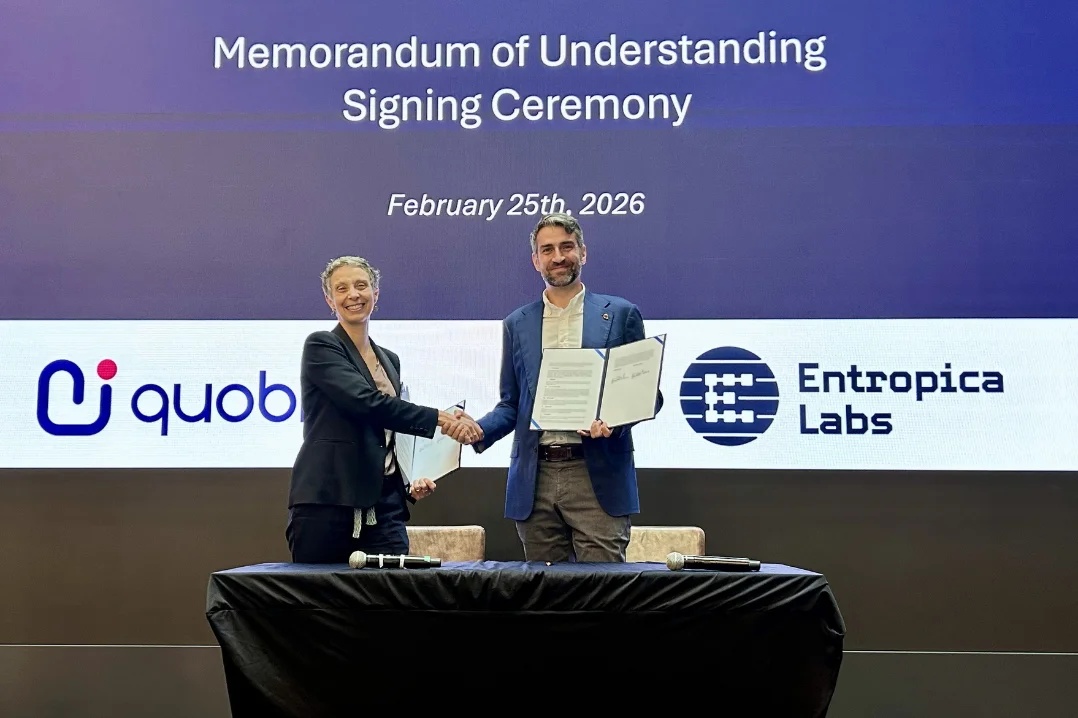
On 25 February 2026, Demarie and Quobly CEO Maud Vinet signed an agreement in Singapore to collaborate on fault-tolerant quantum computing. Quobly brings silicon-based hardware; Entropica brings software infrastructure. Their stated approach puts hardware and software design in conversation early, when architectural decisions can still be made together.
By September 2026, Entropica was discussing Loom Weave and the work of building a surface-code compiler. The recurring concern is continuity: preserving the information needed for error correction as a quantum program moves through software layers. Demarie’s job increasingly involves helping different specialists describe the same calculation without losing something essential between them.
An argument worth keeping open
Demarie’s interests outside the company are pleasingly resistant to a narrow founder biography. He is a certified sommelier and a competitive chess player; his company biography lists an Elo of 1750. He reads philosophy, psychology, history and science, and enjoys Singapore’s food. There is apparently room for more than one form of close attention.
His writing about leadership returns to truthfulness, responsibility and decisions grounded in reality. He urges founders to seek feedback and challenge their assumptions. He also warns against confusing public recognition with the work of running a company. Coming from a CEO who enjoys explaining his field, that is a useful rule to keep within reach.
One of his more compact pieces of advice is to “fall in love with the problem.” A founder can become protective of a solution, he argues, and too rigid to change it. The problem offers a steadier point of reference while the product develops. In quantum computing, there is plenty of work left for that affection to sustain.
The Grand Canyon detour belongs in this story because it shows the curiosity that preceded the company still getting a vote. Demarie had meetings he could have taken, a route he could have followed, and colleagues willing to go somewhere else. He chose to look. For a physicist building a business around what nature allows, it seems a reasonable use of an afternoon.