The first version had a modest repertoire: print a freight bill, print a driver’s check. Tom McLeod has described those early systems as replacements for typewriters. If you are looking for the beginning of a software company, here it is, beside the accounts and the payroll. No need to invent a new human desire. Someone had already done the work. Someone else needed to get paid.
That was 1985. McLeod sold and programmed the original dispatch and accounting package himself, serving a small group of trucking and brokerage businesses. Four decades later, he remains president and chief executive of the Birmingham company bearing his name. The software now touches planning, pricing, documents and communication. Its original concern, the everyday work behind a load of freight, has proved remarkably durable.
There is something pleasingly contrary about his route into this business. McLeod studied piano performance. He wanted to stay in Birmingham. Entrepreneurship arrived by way of a mentor who needed a programmer, rather than a youthful declaration that the world needed another chief executive. His career makes a useful case for paying attention to the work within reach.
A different kind of keyboard
At Samford University, McLeod earned a bachelor of music in piano performance, graduating cum laude. The university lists him with the class of 1976. A music degree is an unusually good opening detail for a trucking software founder, partly because it interrupts the familiar sequence of computer science, startup and funding round. His early professional life took another turn first: roughly five years in sales.
John Snow, an older Bible study leader who worked in computing, provided an opening. Snow had an idea connected to transportation and needed programming help. McLeod wanted more technical work and learned several programming languages over the following two years. He also learned about the industry that would become his business. The chance to learn came through a relationship that already existed.
Consulting exposed him to different companies. Gradually, he concluded that serving a particular kind of customer would let him understand its needs more deeply. Trucking supplied that focus. There were freight movements to plan, bills to produce and drivers to pay. New carriers emerging after deregulation needed systems. For a programmer looking for useful work, this was a fairly direct invitation.
McLeod and his wife, Annette, started the company in 1985. Samford’s account places both of them at its beginning. He has spoken appreciatively of her support through the years. The origin is personal without requiring any mythology: a marriage, a mentor, a new technical skill and customers with a practical problem. Plenty to be getting on with.
“Questions are also an important part of establishing credibility.”
Tom McLeod, 2019
The usefulness of a smaller ambition
One of McLeod’s recurring ideas is that software should gather the information transportation professionals need into one system. That sounds obvious until you consider the alternative: information scattered among people and tools, with someone responsible for making the pieces agree. His insight concerned the person trying to finish a job, and the interruptions that made it harder.
In 2010, as the business marked its twenty-fifth year, it was serving hundreds of carriers and brokers from Birmingham and Salt Lake City. Dispatch and accounting had grown into a broader set of transportation and document management products. The anniversary matters because it shows a company enlarging the amount of work it could handle while keeping the customer recognizable.
Its boundaries were deliberate, too. Early on, the company served both trucking businesses and freight brokers. McLeod later withdrew from brokerage software for several years to concentrate on trucking. After a product rewrite, it returned with PowerBroker in 2006. Giving up a market temporarily is an awkward story to tell in a sales meeting. It is also a concrete expression of focus.
That decision gives his longevity a more interesting shape than simple persistence. Staying in one industry still required choices about what to build and when to leave something alone. Trucking and brokerage have overlapping needs, but their operations differ. A company can recognize both facts and still decide it lacks the room to pursue both properly at once.
Samford graduate
and payroll
enters the market
inside the TMS
The audience gets a say
By 2015, McLeod was telling trucking executives that handling information had become as much a part of their business as handling freight. His questions were concrete: which freight should you pursue, what should you charge, which truck should carry it, and how should information travel during and after the trip? A complicated industry, reduced to questions someone must answer before lunch.
At that year’s user conference in Birmingham, attendees left the opening session to the theme from Back to the Future. The joke suited the anniversary. Thirty years of computing had changed what a transportation office could accomplish, while the freight still had to arrive. A soundtrack could celebrate the distance traveled; the operational questions supplied the next day’s agenda.
In 2019, McLeod discussed applying machine learning to pricing and matching loads. He also introduced Driver Choice, a way for drivers to express preferences and participate in load selection. A driver might want longer trips in one month and shorter regional work in another. The technology made room for that change of mind, an ordinary human complication with consequences for dispatch.
There is a practical attentiveness in this approach. A truck does not explain every constraint on its use. The driver has preferences, the customer has requirements, and the business has costs. Software has to help people negotiate those facts together. More information becomes useful when it can change a decision, rather than merely decorate a report.
A Birmingham address, by choice
McLeod has said he never seriously considered basing the company elsewhere. He wanted to remain in Birmingham and believed he could find work there. In 2019, the business opened a headquarters in Meadow Brook Corporate Park, consolidating its Alabama employees onto one campus. The building represented an investment of approximately $21 million. Staying put had acquired a rather substantial floor plan.
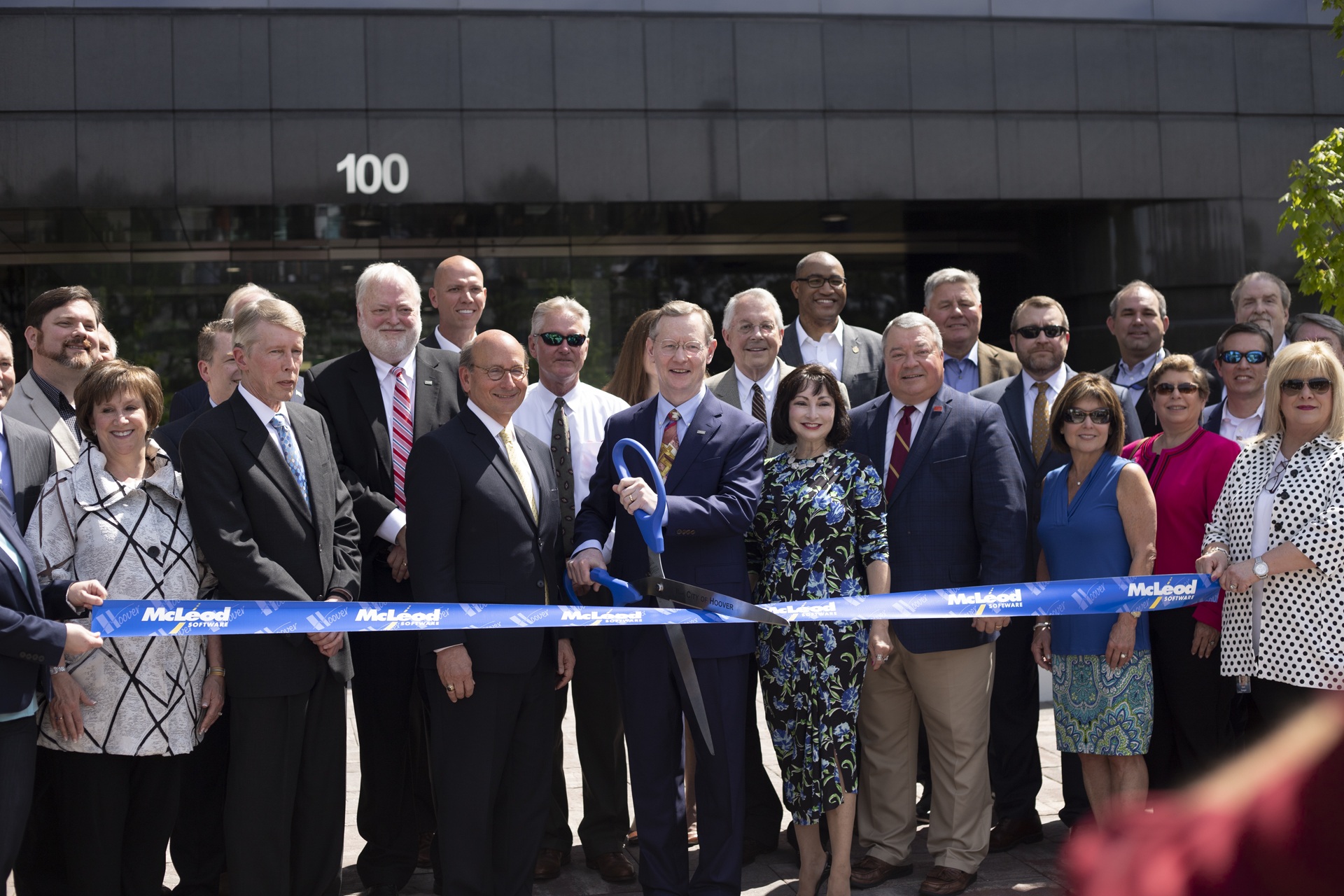
At the opening, the business had more than 950 active customers across North America and over 450 employees. Those are historical figures, attached to a particular occasion. They give the photograph its context: this was a local gathering for a company whose work extended far beyond the people assembled around the ribbon. Regional offices included Salt Lake City and the Chicago area.
Music remained part of McLeod’s life. He served three years as board president of the Birmingham Boys Choir. His industry service included three years chairing the Truckload Carriers Association Scholarship Board of Trustees and chairing the Alabama Trucking Association from 2019 to 2021. These commitments connect the software business to education, music and the community in which he chose to build it.
Another startup, in the same company
By 2023, McLeod’s advice to fleets included using a slower freight market to examine their operations and get more from their software. A downturn could provide time to investigate the numbers and learn unfamiliar capabilities. In 2024, he again encouraged transportation companies to invest in their future. His message required preparation during an uncomfortable present, when postponement might feel easier.
The company was doing its own rebuilding. At its 2025 conference in Denver, an AI-generated version of a younger McLeod welcomed him to the stage. A founder celebrating forty years in business had been introduced by his earlier face. Software conferences do have their peculiar advantages over family reunions.
He called the company’s recent redevelopment its “third startup phase.” The original product had arrived in 1985, followed by a major rewrite around 2000 to 2004. Now LoadMaster and PowerBroker had a redesigned interface, developed with customers to reduce the steps required for tasks. Longevity, in this telling, involved periodically accepting the inconvenience of beginning again.
Early office automation→Connected operations
Planning, pricing, documents→AI-assisted tasks
Orders and communication
A conceptual view of the product’s expanding scope, rather than a measure of performance.
The AI work had specific plumbing. In November 2024, McLeod Software introduced an order creation interface connecting third-party AI services with LoadMaster and PowerBroker. Email content and attachments could become structured orders. Partners included Vooma, Everest and Drumkit. This was an application of AI to a familiar office chore: reading an incoming request and entering its details correctly.
In January 2026, the company and Aurora announced that eligible customers subscribing to the Aurora Driver could book and manage autonomous capacity through their existing transportation management software. The integration had been completed ahead of schedule. A new kind of truck was entering a workflow McLeod had spent decades helping customers organize. The underlying system still had to make the transaction usable.
The next working day
In September 2026, McLeod was still discussing the relationship between customer input and product development. During the PowerBroker rewrite, a group of 30 to 35 companies watched demonstrations every two weeks and responded as the software took shape. Customers could reorder the team’s priorities. Listening, here, had a recurring appointment and a visible consequence.
That month in Nashville, he also urged carriers to maintain rate discipline and manage costs as freight conditions improved. The founder remained interested in what customers would actually do with their businesses once the conference ended. Better conditions introduced decisions of their own. The software could help, but judgment still had work waiting for it.
From piano study to freight billing, from a handful of customers to decades of product revisions, McLeod’s story has accumulated changes without changing its address or its central occupation. There is always another request to understand, another awkward step to remove, another working day approaching. A freight bill and a driver’s check turned out to be a beginning with plenty of room in it.