The sale had collapsed less than a week before closing. At 598 W Armitage in Elmhurst, the buyer’s financing had failed, and Tom Makinney had a dead contract to deal with. He could have left the conversation there. Instead, he told the buyer’s agent to get back in touch if anything changed. Something did.
As Makinney later explained in a public video, the buyers resolved a private financing issue. They returned with an unconditional clearance to close and more earnest money, this time nonrefundable. The property went back under contract. His recap ends with an exuberant “Yeah, baby.” A complicated transaction had earned a very uncomplicated celebration.
The episode offers a useful introduction to a broker whose career has unfolded largely in and around the Illinois city where he grew up. There is no grand speech in it. There is a setback, a conversation kept open, and a practical reason to try again. Real estate supplies plenty of opportunities to be disappointed with other people. Remaining reachable can be the more productive response.
A career with a short journey home
Born in Chicago and raised in Elmhurst, Makinney eventually raised his own three children there. He founded the Makinney Group and now serves as its lead broker at Compass. His territory extends into greater Chicagoland, but Elmhurst keeps recurring in the story: in his listings, his neighborhood commentary, and his civic commitments.
His professional biography dates the start of his real estate work to 1997, following a 1996 degree in Operations Management Information Systems from Northern Illinois University. The work has included new and resale homes, investment projects, and commercial and residential leasing. It is a broad set of assignments for someone whose professional identity is so closely associated with a particular place.
That combination matters. Familiar streets do not produce identical transactions. A buyer choosing a first home, an investor considering a building, and an owner preparing to leave a long-held property bring different questions. A local career accumulates variety without requiring a new hometown every few years. Staying put can be an active choice, with plenty left to learn.
- 1996NIU degree
- 1997Real estate begins
- 2011Crescent Park on camera
- 2019The Sloane House
- 2023A move to Compass
The neighborhood before the floor plan
In September 2011, Makinney appeared in a sponsored neighborhood video about Crescent Park. He was then working with Maria Gracik in Koenig & Strey’s Gracik Makinney Group. The camera found him in Washington Park, talking about the surrounding subdivision. The accompanying account paired two homes at substantially different asking prices within the same neighborhood.
The description lingered on curved streets, mature trees, a small central park, and the parks along the neighborhood’s edges. These are the details that a property search can flatten into a location pin. A house belongs to a set of routes and habits as well as to a parcel. Where does the street lead? What is around the corner? What can someone reach on foot?
Watching a broker discuss a neighborhood also changes the scale of the sales pitch. The rooms are temporarily offstage. The subject is the piece of town someone would be joining. In Makinney’s case, that early video provides a concrete glimpse of local explanation as part of the job, long before the Compass chapter began.
Two houses with something to say
Some assignments require an older vocabulary. In 2019, Makinney was named as the listing agent for Elmhurst’s Sloane House, a Prairie School design by Walter Burley Griffin. The house was designed in 1909 for William B. and Jennette R. Sloane. Its owners had donated a preservation easement to protect the property.
An easement gives architectural history a practical consequence. A buyer is considering a home whose future comes with responsibilities, and explaining those responsibilities belongs alongside explaining its attractions. The building’s authorship is part of what is being offered. So is the obligation to understand what has been protected. The listing brings preservation into the ordinary business of finding a new owner.
Four years later, another Elmhurst home supplied a different kind of history lesson. Makinney represented a Cotswold-style cottage designed by R. Harold Zook and built in 1925. It came to market in June 2023 at $1.1 million and attracted a buyer in less than a month. The owners had bought it in 1964.
The roof was a story in itself. Wood shingles followed an undulating pattern to suggest thatch, while rolled eaves softened the transition to the walls. Makinney spoke about the scarcity of the materials and craftsmanship behind the finishes. “Zook was an artist,” he said. For once, a house’s curves had more to explain than the kitchen’s square footage.
These two listings give substance to his interest in architecture. They also sit comfortably beside his publicly listed service as an Elmhurst Historic Preservation Commissioner. His broader business includes new construction, renovations, and tear-downs. The older houses add a particular question to that range: what deserves to travel intact into the next owner’s life?
“Zook was an artist.”
Tom Makinney, on the architect behind an Elmhurst cottage
New platform, familiar colleagues
In September 2023, the Makinney Group moved from @properties to Compass. Jill Giorno and Jen Goodale joined Makinney in the move. The three brought an existing business and existing relationships with them. A change of affiliation could be announced on a particular day; the experience behind it had taken considerably longer to assemble.
At the time of the move, the team had about $25.6 million in sales volume over the preceding 12 months and more than $20 million during 2023 to that point. Those figures describe that reporting period. They help establish the scale of the business arriving at Compass without turning a past year’s production into a promise about the next one.
Makinney’s stated attraction was the platform and support available to his clients. There is a straightforward business logic here: a team with a defined local market gains access to the resources of a larger brokerage. The value still has to arrive in a form a client can use. Software is useful company for a broker. It cannot attend a showing on someone’s behalf.
Sales volume reported by Makinney’s website for Tom and his team across their careers.
Cumulative sales volume, not personal income.The team’s own account places cumulative sales volume above $500 million. It is a large total, made up of individual decisions: a price agreed, a property prepared, an offer accepted, a problem worked through. The Armitage episode is a reminder that even a transaction that returns to contract can contain an awkward middle chapter.
The bath mats are part of the job
A walkthrough at 127 Oneida in Elmhurst offers a less ceremonial view of the business. Makinney arrives to help prepare an open house, with Jen already inside. There are fireplaces to light, a home theater to bring to life, and rooms to make ready for visitors. The two are hosting together because the house is large.
Then come the preparations that rarely make a property brochure: opening window treatments, putting things in drawers, sorting out lights, and getting bathroom mats out of sight. The camera catches a profession doing its housekeeping. A listing may carry a handsome price, but someone still has to remember the switches.
This is useful evidence of what attention looks like on an ordinary workday. It has a beginning and an end. After the open house, the televisions, lights, and fireplaces need to be switched off again. Presentation involves both welcoming strangers into a property and leaving the place properly when they have gone. The work continues after the last visitor.
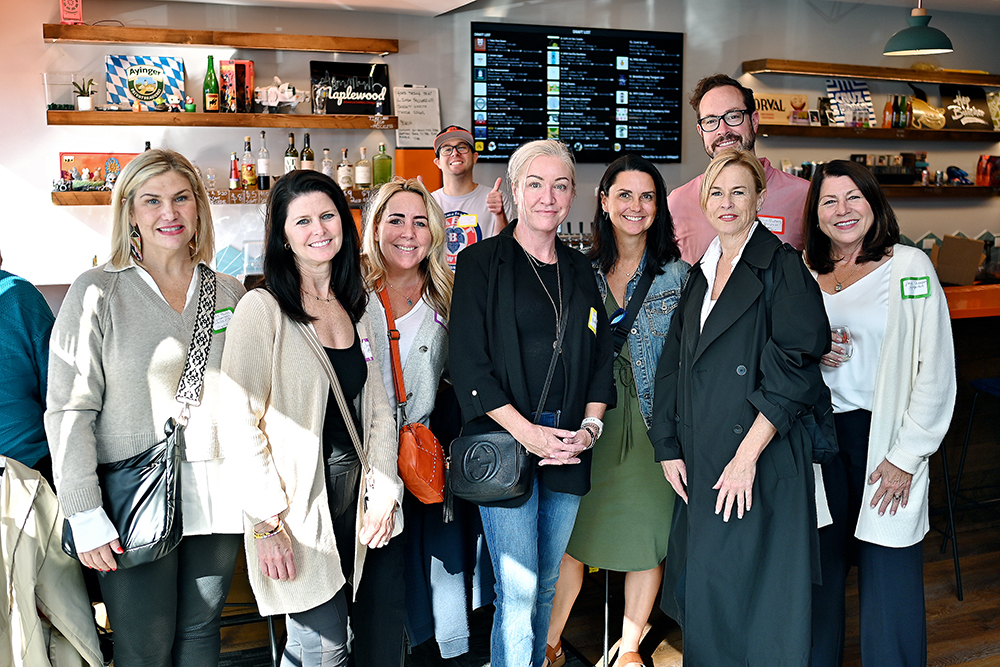
The people on the other side of the table
That same autumn, Makinney was photographed at Beer on the Wall with fellow Elmhurst real estate professionals. More than 50 had gathered on October 17. Goodale and Giorno were among the colleagues pictured with him. An industry built around negotiations had made room for a gathering in the same room.
The photograph supplies a useful counterweight to the solitary broker portrait. Real estate involves people representing different clients, sometimes across the same table. Those relationships have a life between transactions. A gathering does not tell us how any particular negotiation went. It does show the human setting in which a local professional network exists.
Beyond work, Makinney’s biography includes triathlons and stair climbs at the Willis Tower and John Hancock building. His professional profile also records an interest in national and state parks and animal-rescue volunteering. He has served on the Foundation 205 board. There are several ways, apparently, to spend a day without sitting still.
His public LinkedIn activity continued to include an Elmhurst market update in June 2026. The subject was familiar, even as the numbers changed. Across neighborhood videos, historic listings, and market commentary, the recurring task is explanation: helping someone understand the place and the decision in front of them.
Return to the failed sale on Armitage. The useful detail is the invitation to call back. It left room for new information, and the buyers eventually supplied it. In a career measured in years and transactions, that small professional courtesy is easy to overlook. It is also something a person can actually do.