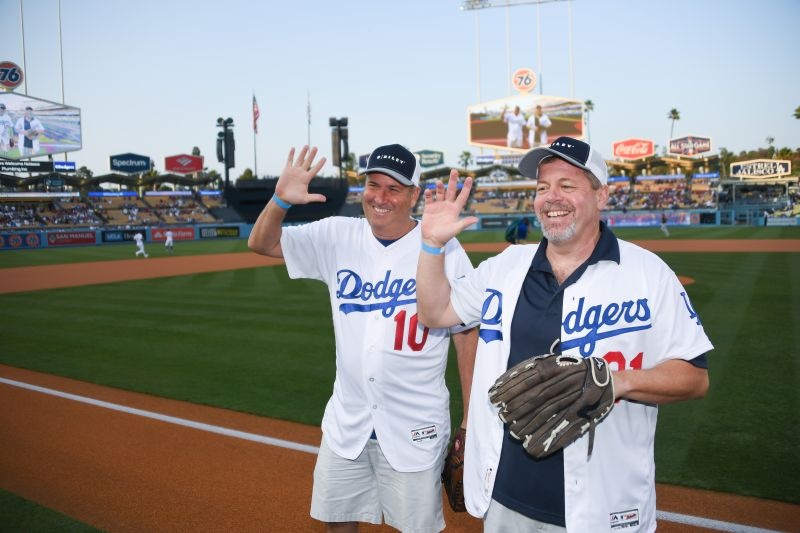
At Dodger Stadium, Tom Kelleher had a glove on his left hand and a Dodgers jersey over his polo shirt. Beside him stood Bryant Riley, his fellow chief executive. Both were smiling and waving. For once, their shared assignment involved a baseball rather than a balance sheet.
The occasion was a ceremonial first pitch on August 17, 2021. Nearly 200 colleagues and friends came along. The evening also helped kick off the firm’s small-cap investor conference, bringing a business gathering into a setting with better grass and considerably louder public announcements.
It is a useful photograph of a partnership that can otherwise disappear inside corporate titles. Kelleher and Riley had already been working together for more than twenty years. Since 2018, they had shared the chief executive job. Here they were, in matching jerseys, with a much smaller coordination problem.
The jobs before the title
Kelleher’s professional history begins with responsibilities that rarely dominate a company’s origin story. From B. Riley & Co.’s founding in 1997 through 2006, he held senior management positions that included chief financial officer and chief compliance officer. The firm began as a research and stock-picking boutique serving Southern California.
Those early titles place him close to the workings of the business: its finances and its obligations. Long before he became co-CEO of a diversified parent company, he occupied roles concerned with whether the organization could account for what it was doing and operate within the rules governing it.
His undergraduate degree offers another detail that interrupts the expected financial biography. Kelleher earned a Bachelor of Science in Mechanical Engineering at Lehigh University. Riley also attended Lehigh, studying finance. The shared institution is a connection; the different degrees are a reminder that their paths were not identical.
In 2006, Kelleher became chief executive of B. Riley & Co. He held that position until 2014. His career was accumulating inside the same business, rather than through a succession of unrelated employers. He later served on the board of Special Diversified Opportunities from October 2015 to June 2017, adding another public-company board assignment during his years as president. The company would change its scale and scope around him.
When the organization grew another set of limbs
The combination with Great American Group in June 2014 changed the business around Kelleher. Investment banking, equity research, sales and trading joined an enterprise with asset disposition, auctions, valuation and advisory capabilities. A research firm had become part of a broader public-company structure.
That August, Kelleher was appointed president of the parent company. He had been with B. Riley for seventeen years. The appointment put him in a role spanning the enlarged organization at a moment when the practical meaning of the combination was still being worked out.
A transaction can put different services inside one corporate boundary immediately. Getting the people delivering those services to understand one another takes longer. The promise of the 2014 combination depended in part on professionals finding useful ways to work across the businesses, while management also pursued cost savings.
Further additions followed. United Online arrived in 2016. FBR and Wunderlich Securities followed in 2017. GlassRatner and magicJack were added in 2018. National Holdings joined in 2021. The sequence broadened the organization across financial services and operating businesses, giving leadership more pieces to consider at once. Some additions extended an existing financial service; others brought an operating company into the portfolio. That distinction helps explain why a single description of the firm could become unwieldy. Investment banking, wealth management and a communications business have different day-to-day demands. Sharing ownership does not make those demands identical.
Twenty years beside the founder
Kelleher joined the parent company’s board in October 2015. In July 2018, the company appointed him co-chief executive alongside Riley, with Kenny Young becoming president. The announcement tied the leadership structure to the growth and evolution of the business following acquisitions and investments.
Riley’s explanation was unusually specific about his colleague. He credited Kelleher with helping the company’s separate operations collaborate and emphasized that they had worked side by side for more than twenty years. The appointment gave an existing relationship a new formal shape.
The historical scale was striking. In the appointment announcement, Kelleher described the journey from one research-focused office to more than fifty offices around the world and almost nine hundred professionals. Those were 2018 figures, a snapshot of the organization at the moment he took the shared title.
The central question was becoming more demanding: how could all these people and capabilities become useful to one another? An expanded service list was easy enough to print. Turning it into a useful conversation between colleagues required a different kind of management.
“Tom has been by my side for over 20 years”Bryant Riley, on Kelleher’s appointment as co-CEO, 2018
Ambassadors, without the embassy
By 2022, one answer involved giving divisions an “ambassador.” The group head was responsible for helping colleagues understand what other parts of the firm did and keeping communication moving between them. The title had a diplomatic flavor, although the territory being crossed was an organization chart.
In discussing the business that year, Kelleher also pointed to cybersecurity work that benefited clients and improved the company’s own internal capabilities. It was a concrete example of the argument for having different specialists inside the same firm: expertise developed in one place could become useful elsewhere.
These details give the collaboration theme some substance. They describe a mechanism, rather than merely an aspiration. A colleague needs to know another team exists, understand its capabilities and have a route into it before a referral or a joint assignment can happen.
For Kelleher, this was part of the assignment that accompanied expansion. Acquisitions brought new people and practices into the group. Communication had to catch up. The ambassador system made that responsibility somebody’s job, rather than leaving it to a hopeful sentence in a presentation.
The harder question: what stays?
Growth was followed by decisions to reduce debt and sell businesses. In 2025, the company sold Atlantic Coast Recycling and the GlassRatner and Farber advisory businesses. By the time Kelleher discussed the year’s operations in May 2026, the work included explaining what had left the group.
He described the divestitures as difficult decisions that fitted the strategy of reducing leverage and focusing the business. There was work after the sales, too. Transition services supported the departing GlassRatner business through the end of 2025. Similar support following the partial Great American sale also ended that year.
He reported another completed project: consolidating the clearing arrangement for wealth management after a multiyear effort. These are less photogenic developments than a ceremonial pitch. They matter to the operating structure, determining how transactions and the administrative work behind them move through a financial business.
On January 1, 2026, the parent company adopted the name BRC Group Holdings. The new name described a diversified collection of businesses and investments. Kelleher remained co-CEO. The continuity of the leadership now sat beside a more selective approach to what the organization should contain.
Back to the connections
On the first-quarter 2026 earnings call, Kelleher discussed a proposed combination of B. Riley Securities and B. Riley Wealth, following an announced intention to repurchase the securities business’s outstanding minority stake. He described the operating purpose as bringing investment banking, distribution and equity research into closer alignment.
His remarks returned to familiar territory: the relationship between the parts. He also discussed using artificial intelligence to help bankers, salespeople and researchers produce analysis more efficiently. The tools were changing; the stated aim still involved getting more useful work from the organization’s existing capabilities.
“We remain relentlessly focused on efficiency across the entire enterprise.”Tom Kelleher, first-quarter 2026 earnings call
The financial picture requires dates and distinctions. For the quarter ended June 30, 2026, BRC reported revenue of $239.1 million, compared with $225.3 million a year earlier. Net income available to common shareholders was $18.5 million, down from $137.5 million in the comparable quarter.
The earlier quarter included substantial income from discontinued operations and a senior-note exchange gain. BRC also said investment appreciation was the main driver of the reduction in its reported net debt during the first half of 2026. The figures describe different influences on a changing company, rather than one uncomplicated trajectory.
That is the setting for Kelleher’s next operating decisions. The executive who helped run a research boutique now shares responsibility for a holding company whose structure has been assembled, expanded and revised over nearly three decades. Experience with the earlier versions provides context; each new arrangement still has to work.
The Dodger Stadium photograph preserves a lighter moment in that long partnership. There is a glove, a ball and a shared appearance before a crowd. Back at work, the task is less easily photographed: deciding which businesses belong together, then helping the people inside them make the arrangement useful.