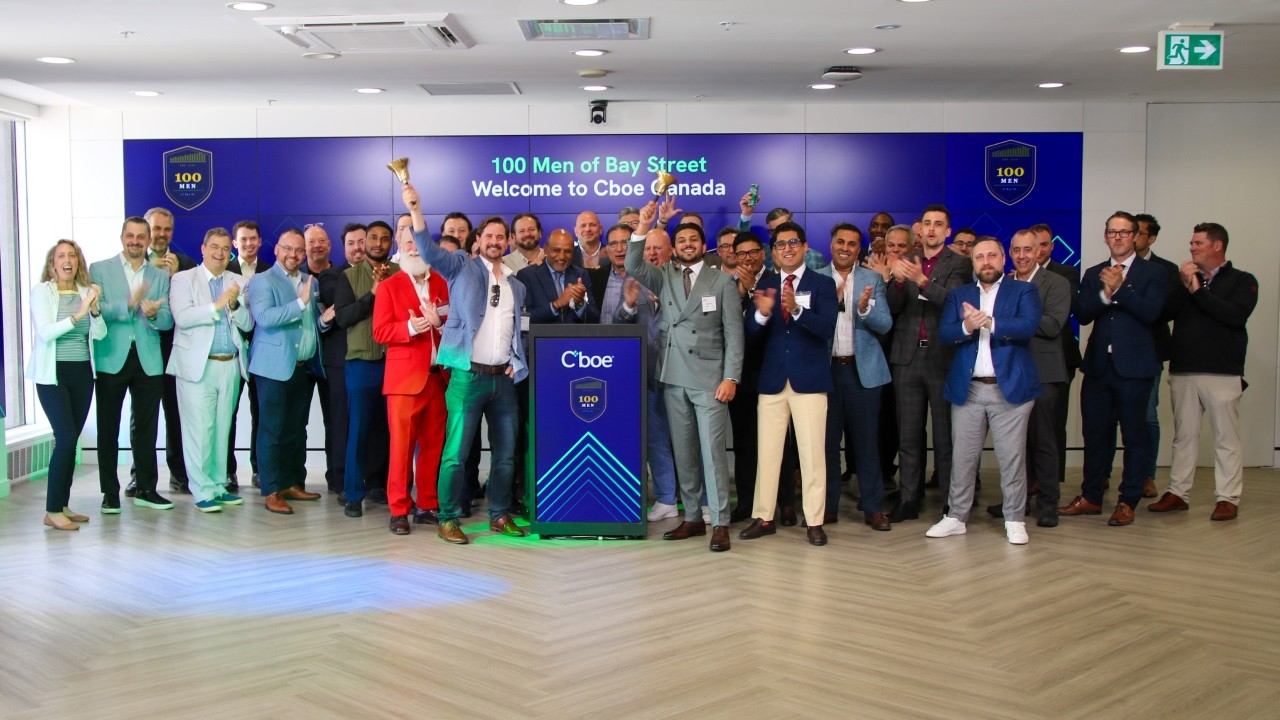
When Joacim Wiklander hosted 100 Men of Bay Street at Cboe Canada, his watch kept interrupting. The room was loud enough to trigger its noise warnings. He later recounted the detail with evident pleasure: a gathering of finance people had made enough commotion to trouble a small computer. UrbanPromise was chosen as the network’s quarterly charitable beneficiary. For an executive whose working life involves keeping electronic markets orderly, there was something rather appealing about celebrating a room that refused to be quiet.
His public career usually unfolds at a different volume. There are trading systems, regulatory submissions, settlement timetables and the machinery that lets an investor’s order become a trade. Wiklander, president and CEO of Cboe Canada, has spent much of that career working on arrangements that most people notice only when they become expensive, unfair or unavailable. The exchange bell gets the photograph. The plumbing has to earn its keep every morning.
That makes his story a useful way into an overlooked question about finance: who decides how the marketplace itself behaves? A stock price attracts an audience. The rules that determine how buyers and sellers meet can quietly influence everyone in it.
Two degrees, then the machinery
Wiklander’s education crossed two disciplines that would remain close throughout his career. He earned a master’s degree in engineering physics at KTH Royal Institute of Technology and a bachelor’s degree in business administration and economics at Stockholm University. Both are recorded as completed in 2000. It is an unusually apt pairing for someone who would eventually have to think about a marketplace as both a computer system and a business.
He worked as an application engineer at OM Technology before joining Orc in 2000 as a trading software analyst. Over the next eleven years, he moved into product management and then strategy. Orc supplied electronic trading technology to financial firms. Its customers needed software that could connect trading decisions to markets; the work put him close to the operational details beneath the polished language of investing.
In September 2011, Orc Group appointed him CEO of Neonet Securities, succeeding Fredrik Lindqvist. He arrived from the group’s chief strategy officer role. Neonet was an agency broker, providing execution services to professional market participants. Software was now only part of the responsibility. He was running a business that used it.
One early decision was decidedly concrete: Neonet closed its New York trading desk as it consolidated operations in Stockholm and cut costs. Around the same period, the firm connected to SunGard’s global network to reach additional brokers and asset managers. The combination offers a revealing piece of career history. Closing a physical presence and extending an electronic one could belong to the same plan.
- 2000Joins Orc
- 2011Leads Neonet
- 2014Joins Aequitas
- 2025NEO technology migration
A new exchange needs a reason to exist
In April 2014, Wiklander joined Aequitas, the organization behind the emerging NEO Exchange in Canada. He would hold trading and data, business and operating leadership roles. The sequence matters: it places him inside the project before its public launch, working across the parts that make an exchange usable and commercially viable.
NEO began operating on March 27, 2015. Jos Schmitt, its founding leader, described the undertaking as a response to insufficient competition and a market that needed to pay closer attention to investors and capital raisers. Building another exchange required more than installing a matching engine. Companies had to consider listing there. Dealers had to connect. Investors needed a reason to care.
Wiklander’s work touched the practical answer. Before launch, he helped announce a designated market maker program bringing together bank dealers and independent firms. The participating firms included Barclays, BMO Capital Markets, National Bank Financial, RBC Capital Markets and TD Securities. Their task concerned a basic requirement of any marketplace: having someone available on the other side when a participant wants to transact.
Then came routing. In June 2015, BBS Securities became the first Canadian broker-dealer to use Aequitas’s smart order router. The system sought to synchronize when tradable orders reached different Canadian venues, addressing advantages associated with speed and information. Wiklander described the purpose in terms of improving conditions for long-term investors and their dealers. Here was a technical product carrying an argument about fairness.
By 2018, he was making that argument in public writing. In an anniversary essay, he contended that NEO’s competition had encouraged the incumbent exchange to improve fees and service. Those were the claims of a challenger with a stake in the contest. They also reveal his chosen measure of usefulness: whether the presence of a new venue changed the experience of the people using the market.
“That is how competition makes markets better for everyone.”
Joacim Wiklander, 2018
The engineer at the settlement deadline
Running an exchange can make seemingly modest calendar changes consequential. In May 2024, Canada moved to T+1 settlement: eligible trades would settle one business day after trading rather than two. The shorter interval required coordination across the industry. A timetable is easy to print. Getting every relevant system to obey it takes rather more work.
Wiklander said Cboe Canada had been ready since the end of 2023 and had provided testing facilities in January so others could prepare. He acknowledged the size of the industry’s undertaking while describing the exchange’s own software adjustment as relatively small. His assessment was practical: fund manufacturers faced operational complications, but they were manageable.
His interest also extended beyond the deadline. Shorter settlement, he argued, meant capital spent less time tied up in settlement systems. He expected a successful transition to encourage discussion of same-day settlement. It was a characteristic scale of ambition: improve a specific mechanism, then consider how much further it might go. There was no need to make the weekend software release sound like a moon landing.
A faster system, a longer preparation
Cboe completed its acquisition of NEO in June 2022. In December 2023, it announced the approved unification of its Canadian regulated operations, effective January 1, 2024. NEO and MATCHNow would sit within one corporate entity, while their trading venues retained their names. The plan connected corporate organization with a coming technology change.
In March 2025, NEO’s trading books moved to Cboe Titanium. Wiklander credited clients, vendors and regulators for a preparation effort spanning fifteen months. His acknowledgments included the Ontario Securities Commission and the Canadian Investment Regulatory Organization. An exchange migration has a broad cast, however conveniently a single executive’s name fits under the announcement.
A smaller wait, measured in microseconds
The published measurements made the outcome tangible. Average FIX order-to-acknowledgment latency fell from a range of 105 to 115 microseconds to 60 microseconds. Cboe also introduced Binary Order Entry to the NEO markets. For the customer, these are different ways of sending instructions into the exchange; for the operator, they are choices about efficiency, consistency and capacity.
Speed alone would make an incomplete description of the project. Existing NEO market functionality was preserved, while changes included a revised closing auction and support for odd lots on NEO-N. The work combined continuity with alterations that participants had to understand. A marketplace can become quicker while still requiring patient explanations.
The global ambition meets a new chapter
By 2024, Wiklander’s responsibilities included global listings as well as Cboe Canada. The broader proposition was to connect companies with investors across Cboe’s exchange network. For an issuer, that prospect involved capital, visibility and liquidity beyond its home market. For an exchange operator, it required turning international reach into a service a company could actually use.
He appeared on the ETF industry outlook panel at ETFGI’s Canadian summit in November 2024, alongside Vanguard’s Sal D’Angelo, LongPoint’s Steve Hawkins and Purpose Investments founder Som Seif, with Deborah Fuhr moderating. His professional world included the people creating investment products as well as those building the venues where the products trade.
That network also shows up closer to home. In May 2026, he publicly congratulated Cboe Canada listings head Tanya Rowntree on becoming board chair of Women in ETFs. Her responsibilities at the exchange included listings strategy and issuer engagement. His endorsement connected a colleague’s external leadership with the exchange’s own work. The institution depended on people who could move between those conversations.
The company’s direction, meanwhile, was changing. On April 22, 2026, Cboe announced an agreement to sell its Canadian and Australian equities exchanges to TMX Group for an aggregate US$300 million. The transactions were subject to separate approvals and closing conditions. Cboe framed the sale as part of a strategic refocusing of its business.
In August, Cboe announced that the Australian transaction had closed. The same announcement said the Canadian sale would close later, subject to regulatory approvals and customary conditions. That distinction matters in a story about an operating exchange. An agreement changes the horizon; the business continues serving its participants while the transaction proceeds.
For Wiklander, the professional thread runs through several versions of the same demanding occupation: making markets work as organizations and as systems. At Orc, the emphasis was trading technology. At Neonet, execution. At NEO, a challenger’s offer to investors and issuers. At Cboe Canada, integration, operating detail and another prospective change of ownership.
The watch anecdote supplies a welcome counterweight. The public record contains plenty of precise machinery, but it also contains an executive delighted by a noisy gathering with a local purpose. Markets require people to show up, whether to provide liquidity, list a company, test a connection or support a charity. Wiklander’s career has kept returning to the arrangements that bring them into the room.