In 2004, Tom Durovsik was interested in lunch. Specifically, the awkward interval between choosing it and paying for it. FreedomPay, the company he had founded four years earlier, was putting contactless payment systems into workplaces and campuses. The lunch queue offered a useful test for a grand technological ambition: could a new way of paying make an ordinary day run better?
It was an unglamorous place to look for the future. A cafeteria has few of the theatrical advantages of a product launch. Nobody applauds when the register works. But Durovsik had already spent years thinking about consumers, first in beverages, then in collectibles. Now he was working on the moment when their intentions became transactions. The less ceremony involved, the better.
More than two decades later, he remains founder and CEO of FreedomPay, based in Philadelphia. His career traces a curious journey from products people notice to systems they generally notice only when something goes wrong. Along the way, the business has moved from payment cards and key fobs to a platform connecting stores, hotels, online purchases and the data behind them.
The consumer marketer behind the terminal
Before FreedomPay, Durovsik was a product director at Pepsi Cola, working on marketing and new products across Pepsi, Diet Pepsi, Mountain Dew and other beverages. He later became president and a minority equity partner at the Franklin Mint, the collectibles business. These were jobs in which the customer’s attention mattered, and getting a product to that customer involved much more than an appealing advertisement.
His career biography credits his Franklin Mint tenure with annual sales rising from $150 million to more than $1 billion, alongside expansion of marketing into 35 countries. Manufacturing, fulfillment and customer care had to keep up. Those figures describe an earlier chapter, rather than FreedomPay’s revenue. They also suggest why a payments founder might be as interested in the organization behind a sale as in the object being sold.
Durovsik holds a BA from Drew University and an MBA from George Washington University. By the mid-1990s, emerging internet technology had caught his attention. He has described the contrast between running an international business before widespread internet and mobile access and seeing what those technologies made possible. That experience supplied a practical point of comparison for his later ambitions in commerce: communication could change the workings of an entire business.
Lunch was a useful beginning
FreedomPay began in 2000. Early mobile-payment proofs of concept involved Nokia, McDonald’s, Bank of America and Visa. The names were familiar; paying this way was still an experiment. In 2004, the company developed stored-value and voucher payments for food service. It had found a setting where the same people returned regularly and where a slow transaction could inconvenience everyone behind them.
By August 2004, FreedomPay had more than 200 deployments. Its system used contactless cards and readers connected to existing point-of-sale equipment. Customers could link an account through a website, then pay by bringing the card near a reader. Durovsik emphasized the size of the market inside campuses and workplaces. An office lunch line might lack the visibility of a restaurant chain, but it still contained customers with somewhere else to be.
The progression widened the job. In 2007, FreedomPay introduced a cloud platform and incentives capabilities. In 2009, it expanded mobile functionality across different payment types. A purchase could now carry information useful beyond the till: what had sold, whether an offer had worked, how a customer’s activity connected across channels. Durovsik’s old world of consumer marketing was meeting his new world of transaction infrastructure.
A wallet goes camping
One of the more entertaining demonstrations arrived in 2010, when FreedomPay provided a payment system for the National Scout Jamboree in Virginia. The event was expected to bring together 40,000 Scouts and 30,000 visitors and volunteers. Its rural location presented a rather direct objection to digital commerce: the necessary infrastructure was missing.
The solution paired prefunded Smart Bracelets with a 3G wireless network developed with a mobile infrastructure provider. Parents could add funds online and monitor spending from home. Scouts could buy snacks and souvenirs with their wrists. A virtual wallet had acquired a distinctly outdoorsy wardrobe.
Durovsik presented the project as evidence that FreedomPay’s FreeWay gateway could adapt to unusual circumstances. The details are more revealing than the slogan. The problem included the account, the connection, the place of purchase and the person funding it from somewhere else. Getting a wristband to work meant joining all those parts. The campsite made a compact demonstration of the larger business.
Room for the engineers, and the artists
In 2017, FreedomPay moved 150 employees from Radnor into about 25,000 square feet at Philadelphia’s FMC Tower. Durovsik acknowledged that the move should have happened sooner. More employees were commuting out from the city; the company followed them back in. A business built around reducing friction had encountered a familiar version on the journey to work.
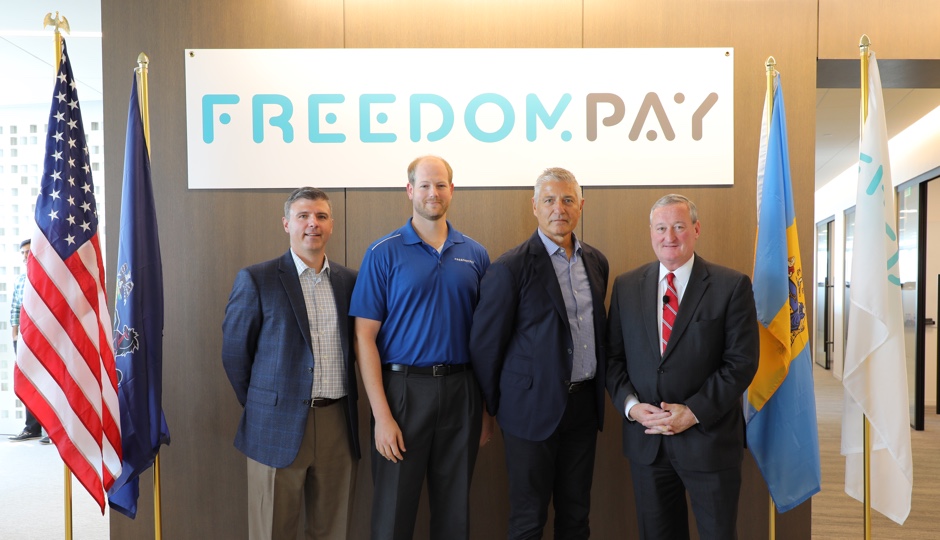
The new office also made room for commissioned work by local artists, including Nate Harris, Meredith Sellers and True Hand Society. The Philadelphia Artist Series connected the company’s technology setting with the city’s creative community. Durovsik wanted a workplace that exposed employees to local art as well as providing the equipment and amenities they needed.
The choice gives the story some welcome texture. Payment infrastructure tends to be described through diagrams and certifications. Here was a founder making a decision about what people would see when they came to work. The office could accommodate both software development and an artist’s interpretation of a cloud. The word was doing rather a lot of work in that building.
What the little black box leaves out
TPG invested in FreedomPay in October 2018, with financial terms undisclosed. At the time, the business offered enterprises a cloud platform covering payments, security, analytics and incentives, with technology that could work across payment processors. Durovsik welcomed the investor’s experience with technology companies as the business pursued further international growth.
In London the following year, speaking with marketing executive Liesl Smith at RetailEXPO, he returned to a favorite distinction: a merchant needed help solving a business problem, beyond acquiring another terminal. His language was direct and occasionally impatient with the industry’s fascination with selling boxes. He wanted product development informed by time spent with partners, merchants and consumers.
“We’ve got to be out in the marketplace.”
Tom Durovsik, RetailEXPO, 2019
He also compared the company’s ambition to the dependable services behind a tap or a light switch. It was an expansive aspiration, expressed through household objects. Electricity is rarely praised for its user experience; people simply expect the light to come on. For a payment business, that expectation is demanding enough. The register has to work while everyone is thinking about something else.
or digital checkout
payment gateway
processing and acquiring
Keeping the choice open
That emphasis on connections remains visible in more recent partnerships. In January 2025, FreedomPay and Verifone announced a global agreement bringing Verifone’s payment devices to the platform in an acquirer-agnostic format. The practical attraction was greater choice of hardware without tying that choice to a single acquiring arrangement. Durovsik highlighted flexibility for merchants in describing the agreement.
Later that month, a Mastercard alliance announced combined access to more than 230 acquirers. For an enterprise trading across borders, the challenge is partly one of coordination: different markets, different payment methods, different systems that still need to fit together. FreedomPay’s proposition gives that coordination a central place. The customer may see a single checkout; the merchant has a much longer guest list.
In January 2026, a partnership with Nuvei extended the same approach across physical and digital commerce. The announced integration covered unified reporting and tokenization, with applications spanning stores, stadiums, hotels and mobile devices. Chris Kronenthal, FreedomPay’s president, has a prominent role in articulating this work. Durovsik’s company has become a team enterprise whose partnerships require both technical integration and commercial agreement.
The receipt has more to say
In September 2026, FreedomPay launched a commerce-intelligence offering on Snowflake Marketplace. It was designed to make transaction data available within merchants’ data environments for reconciliation, analysis and exception handling. Refunds, voids, loyalty activity and disputes belong to the less photogenic end of shopping. They also determine how well a business understands what happened after a customer walked away.
The following month, FreedomPay announced an Atlanta office to strengthen access to payments talent and support engineering and product development. The geographic reach has widened considerably from the early cafeteria installations. The underlying task remains recognizable: connect the pieces well enough that a business can serve its customers and understand its own activity.
Durovsik’s career offers an unusual vantage point on that task. He has worked on the branded product, the machinery of fulfillment and the transaction itself. The technology has changed repeatedly. His attention keeps returning to the purchase, with all its inconvenient dependencies. Lunch still needs paying for. The interesting work begins with everything that has to happen before the next person in line can move.
Continue the conversation
- FreedomPay website ↗
- Tom Durovsik on LinkedIn ↗
- The 2019 business interview ↗
- RetailEXPO conversation ↗
- Early cafeteria payments ↗
- The 2010 Scout project ↗
- Inside the Philadelphia office ↗
- TPG investment announcement ↗
- Verifone partnership ↗
- Mastercard partnership ↗
- Nuvei partnership ↗
- Snowflake Marketplace launch ↗
- Atlanta office announcement ↗