A car salesman can explain a vehicle’s virtues for hours. He can discuss the motor, the running costs and the distance it will travel. Tokushi Nakashima discovered a question capable of ending the presentation: how is the customer supposed to pay for it?
He had gone to the Philippines to develop electric vehicles. For someone who had already spent years building an automotive business in Japan, that seemed a reasonable next chapter. Then he met people who needed a vehicle to earn a living and could not qualify for the financing to buy one. The engineering problem had acquired a banking problem. A better motor would leave that problem sitting exactly where it was.
Nakashima founded Global Mobility Service in November 2013. Its premise was that a person’s work could produce evidence a lender could use. Cars would carry devices; driving and repayment would leave records. A customer who had been difficult for a financial institution to assess might become someone it could finance. His career had taken an unexpected turn, though the destination still involved getting people moving.
A salesman learns to build
Born in Gifu Prefecture on January 1, 1967, Nakashima began his working life selling multifunction office equipment. His customers included large companies and public institutions. Often they already used another supplier’s products, which meant that a visit could begin with the considerable handicap of nobody wanting it.
He has credited those years with teaching him to propose solutions. It is a useful apprenticeship for a founder: a customer’s indifference has a way of editing a pitch. The experience also put him in the habit of looking for an opening in an arrangement that everyone else appeared to accept.
In 1994 he founded Zero Sports. It began with aftermarket automotive parts, the sort of business where a small company has to understand machines made by much larger ones. Electric vehicles entered the picture in 1998, after an experienced engineer who had joined the company asked to develop them.
The work grew into vehicle manufacturing. In 2003, Zero Sports obtained type certification and became Japan’s seventeenth automobile manufacturer. Over time it developed more than fifty EV models. The journey from parts to whole vehicles gave Nakashima a practical education in how much must happen between an idea and something allowed onto a public road.
The order that changed the route
A large order can look like an arrival. For Zero Sports, an order for 1,030 electric delivery vehicles became part of a painful departure. The contract was cancelled, and the business was transferred. Nakashima continued EV development with the company that acquired it, Uzushio Electric.
He has described the responsibility he felt toward investors and partners who had backed him. Continuing to work was a way of trying to repay that faith. This gives his persistence a particular texture. There were people attached to the unfinished business, and he felt he owed them a future result.
He subsequently led BEET Philippine, an electric-vehicle venture in the Philippines. The new setting exposed an obstacle that a manufacturer could easily mistake for somebody else’s department. People wanted to use vehicles for work. Many could not obtain a loan or lease. Manufacturing and finance met at the customer’s empty pocket.
For a driver renting a vehicle, regular payments did not necessarily lead to ownership or create a record a bank would recognize. Work could continue, year after year, without producing the financial standing needed to change the arrangement. Nakashima began considering how to make that work visible.
A working day, written into data
The company he founded combines a vehicle device called MCCS with a platform for collecting and analyzing data. Financial institutions provide financing; GMS supplies technology and information that can support their decisions. It is a business built around making a borrower easier to understand.
The device can control whether a stationary vehicle starts. Nakashima has explained that the design prevents restrictions from being applied while a vehicle is moving and includes fail-safe functions. That distinction matters whenever an explanation of the business becomes shortened to a remote control for a car.
Working hours, distance traveled and payment records can help build a picture of someone’s activity. The proposition is that the lender gains information it previously lacked, together with a way to manage risk. For the driver, the opportunity is access to a vehicle-financing arrangement that conventional screening might have refused.
There is real power in that relationship: a payment failure can affect access to the vehicle used to earn the next payment. The practical value of the model therefore rests on the entire arrangement, including repayment and safe operation. Nakashima’s explanation begins with the person working; the technology is the means by which that activity reaches the lender’s desk.
- 01 / WorkA vehicle enables earning
- 02 / EvidenceUsage and payments create records
- 03 / FinanceLenders gain information to assess
- 04 / OwnershipRepayment creates a route to owning
The ceremony after the last payment
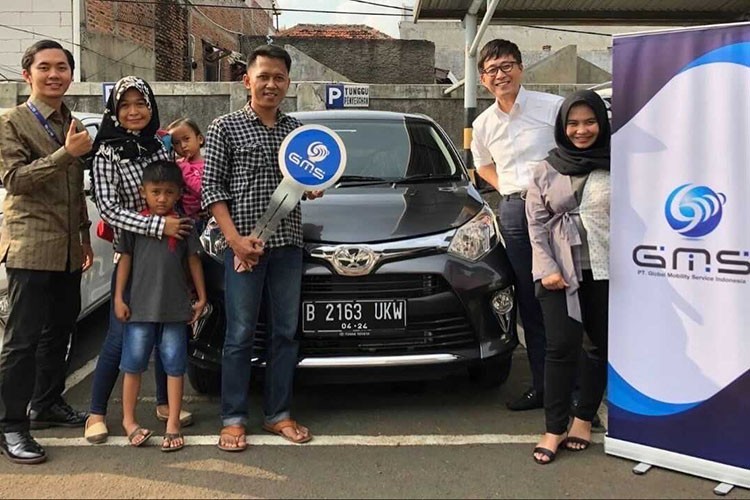
One measure of the idea can be found in an ordinary household purchase. A Filipino tricycle driver named Nagi described buying a fan for his family and basketball shoes for a son after his take-home income increased. He had completed a vehicle loan and no longer had to carry the same rental expense.
In that account, published in 2020, his take-home income had doubled. It was an individual experience, with the scale and detail of a family budget. A fan is a modest object to place beside a discussion of financial technology. It is also unusually good at explaining why the discussion matters.
In January that year, Nakashima presented certificates to one hundred tricycle drivers who had finished repaying their loans. Afterward, he went around the tables talking to participants. The last payment had become an occasion to gather.
A repayment ceremony puts the ending of a loan at the center of the picture. The customer has fulfilled the agreement and owns the vehicle. For a founder whose business depends on connecting work with financial recognition, handing over a certificate gives that recognition a visible form. Accounting rarely gets invited to a party. Here it had earned a seat.
“Society before oneself.”
Tokushi Nakashima, on the culture he wants at GMS
English rendering of his 2023 interview
The cook in the communication space
Nakashima has a domestic answer to an organizational question. He likes cooking. In an office communication space, he has prepared food for employees, giving people a reason to gather and talk. A founder trying to explain company culture can do worse than begin with lunch.
He has said that hiring for ability alone brought problems when newcomers attempted to impose a different culture. Shared purpose became a stronger consideration in how he thought about building the team. The cooking offers a small, practical counterpart to that conviction: people need somewhere to encounter one another.
His interest in younger colleagues predates GMS. A 2017 description of his work records more than a decade of accepting student interns and involving them in creating businesses. They were given a place in the work of building something, with the uncertainty and responsibility that entails.
There is a connection between those two habits. Bringing students into a venture and bringing employees around a meal both require time that does not fit neatly into a transaction. The person who began by trying to win an appointment from an uninterested customer has become concerned with what makes people stay in the conversation.
The loan is a beginning
Nakashima’s ambitions extend beyond the first vehicle. He has discussed education finance and housing finance as later possibilities for people whose working record becomes more visible. The vehicle supplies a starting point for earning and building a record. A family’s plans continue beyond it.
Education has particular significance in his account of low-income households. When parents cannot pay for further study, children can enter work early and face similar limits on earnings. He wants finance to make another route possible. Those are stated ambitions, whose meaning should be kept separate from completed outcomes.
Getting others to participate has been part of the work from the beginning. SBI invested in GMS’s Series A in 2015 and Series B in 2016. Nakashima has described an initially difficult fundraising environment for a business aimed at people conventional financial services did not reach. An unfamiliar customer proposition also required an explanation to investors.
Recognition followed: he became an Endeavor Entrepreneur in 2018. GMS joined WIPO GREEN in 2021, connecting the business with a platform concerned with environmental technology. The link returns to the question that redirected his EV career. Technology’s usefulness depends partly on whether people can obtain it.
A doctorate, then another question
In September 2025, Gifu University announced Nakashima’s engineering doctorate. He had entered the doctoral program in 2018 and spent seven years combining research with the CEO job. His thesis examined ecosystems for regional revitalization through support for venture companies.
The research considered how financial institutions, support organizations and startups can work together. It is a fitting subject for someone whose career has repeatedly crossed boundaries between making a product and arranging the conditions for its use. His experience had become material for a broader institutional question.
By March 2026, he was discussing related questions at FIN/SUM. One session addressed finance, mobility and regional economies in a period of population decline. Another brought him into conversation with Apas Port’s Daisuke Sasaki about using blockchain-based finance connected to real-world mobility assets.
The vocabulary has changed considerably since the aftermarket-parts business. The recurring question is still recognizable. Somewhere, a person wants to work. Somewhere else, an institution controls access to capital. Nakashima keeps looking for an arrangement that allows the two to meet. A car is a useful place to start that conversation. It gives everyone something concrete to point at.