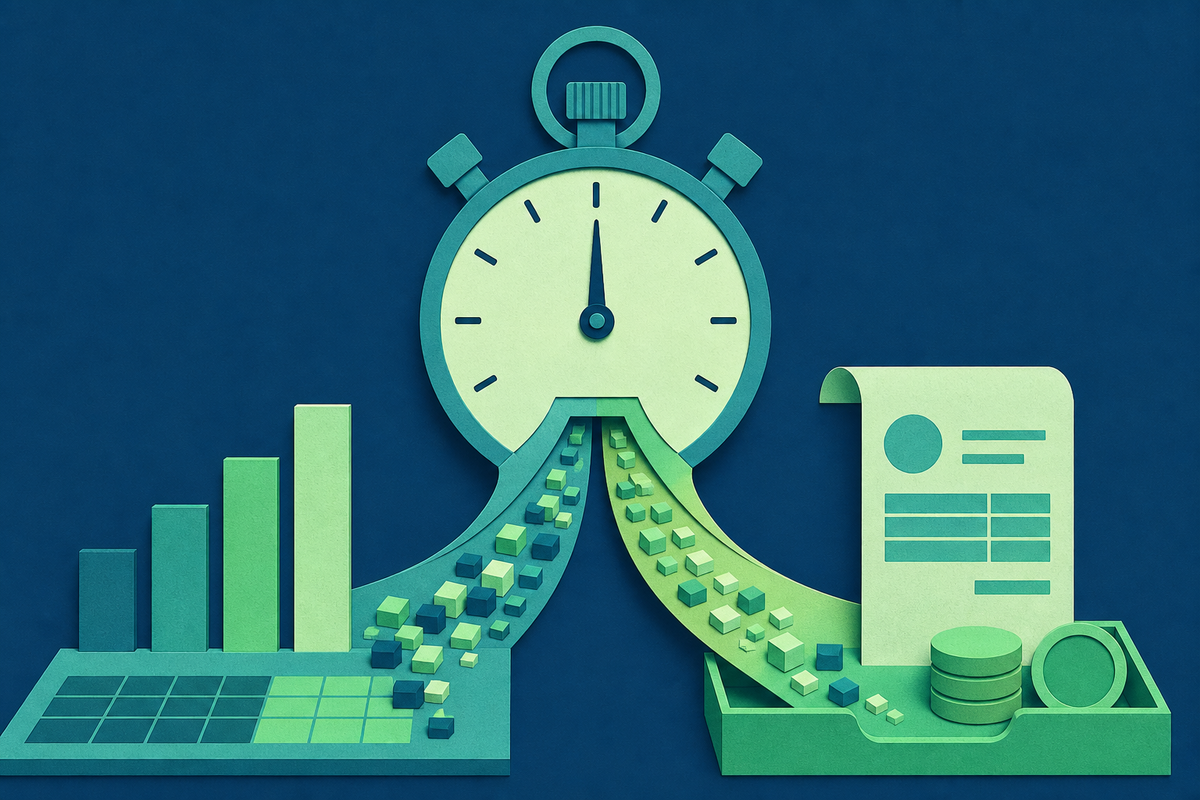
A billable hour has a curious second life. First it belongs to the person doing the work: a designer starting a timer, a lawyer reconstructing a call, a developer filling Friday's blank spaces. Then it changes owners. A project lead checks the entry. An operator turns it into a bill. A client approves the bill. An accountant waits for the money. Toggl Track and Harvest both begin with that small act of remembering. The useful difference is where each product keeps walking with the hour.
On a comparison grid, the products can look like siblings. Both have timers, manual entry, apps, reports, billable rates, team plans, approvals, profitability tools, integrations, and invoices. The columns fill with check marks. The buying decision gets no easier. Feature parity hides product gravity: the screen, workflow, and business problem toward which a product keeps pulling its users.
Toggl Track's gravity is the record of work. It offers real-time, manual, calendar, duration-only, offline, desktop, mobile, browser-extension, and private activity-timeline routes into that record. Once time lands, the product encourages users to group, filter, compare, and report it. Harvest's gravity is the commercial job surrounding the record. Time and expenses feed an invoice; the invoice can recur, accept an online payment, show its status, and copy into accounting software. This is a difference of sequence, not a claim that either product lacks the other's headline feature.
Do not ask which app tracks time. Ask who touches the hour next.YesPress analysis
Toggl Track begins at the blinking cursor
Time software fails embarrassingly early. If starting a timer feels heavy, the data never exists. If the timer is forgotten, the report becomes a work of historical fiction. Toggl Track has spent years attacking this first-mile problem from several angles. A user can press one button, enter time later, drag calendar events into place, work offline, or consult a private timeline of apps and websites before deciding what becomes an entry. Its browser extension reaches into more than a hundred tools. The design assumption is humane and practical: memory is unreliable, work is fragmented, and adoption matters more than administrative elegance.
That capture bias continues in reporting. Toggl groups time by member, client, project, description, and, on paid tiers, dimensions such as task, tag, team, and billable status. Higher plans add labor cost, profit, profitability, custom reports, scheduled delivery, fixed-fee projects, and approvals. For a studio trying to learn why fixed bids keep going sour, or a consultancy trying to compare project economics, this depth is the product rather than a side effect.
Toggl can create invoices from summary or detailed reports. Current documentation says users can edit invoice details, download PDFs, manage created invoices, and send them to QuickBooks on an eligible plan. That matters because an old shorthand - Toggl tracks, Harvest invoices - has become too crude. Yet Toggl's own instructions reveal its center: go to a report, export, then create an invoice. The bill is an outcome of reporting.
Harvest keeps walking toward the bank
Harvest also began as a lightweight timer. Its founders built it in 2006 for their New York design studio, where accurate time made client work legible. Four years later, the company added online payments. That history still shows. Harvest treats time as a business input with an expected destination: an invoice the client can understand and pay.
The path is unusually continuous. Billable hours and expenses can become invoice lines. Receipt images can travel with expenses. Invoices can recur, and their status remains visible. Stripe and PayPal integrations let a client pay online. QuickBooks Online and Xero integrations can copy invoices and payments into the books. None of these actions is exotic. Their value comes from adjacency. Each removed handoff is one fewer CSV, reminder, or retyped total.
This makes Harvest legible to an agency owner or finance operator whose week ends in a billing run. The timer is important because the invoice depends on it. Reporting answers capacity and budget questions, while the workflow keeps pointing toward collection. Harvest says customers have invoiced more than $64 billion through the platform. The number is not a verdict on product quality, but it describes the job users have repeatedly hired it to do.
Toggl Track's center
- Multiple ways to recover and record time
- Flexible grouping and custom analysis
- Project, labor-cost, and profitability signals
- Invoices generated from report data
Harvest's center
- Time and expenses become client invoices
- Recurring bills and visible payment status
- Stripe and PayPal payment collection
- Invoice and payment sync to accounting
The feature list creates a false tie
Software buyers often reward the presence of a feature and ignore the distance between features. Two products may both say “invoicing,” while one generates a document and the other manages a continuing accounts-receivable process. Two may both say “reporting,” while one offers a standard operational view and the other lets a manager repeatedly slice time into a custom model. The noun is the same. The number of clicks, corrections, exports, and owners is different.
This is why workflow should outrank inventory. A ten-person product studio with fixed-fee work might gain more from Toggl's capture routes and profitability analysis, especially when managers suspect that unrecorded revisions are swallowing margin. A five-person consultancy that already records time reliably but lets approved hours sit unbilled could gain more from Harvest's invoice-to-payment continuity. Team size does not decide the matter. The location of the leak does.
When the record is weak
Timers are forgotten, work happens across many tools, reporting needs custom dimensions, or project leaders want a sharper view of labor cost and profitability.
When the handoff is weak
Approved hours wait to be billed, expenses get lost, invoice status lives elsewhere, or accounting staff re-enter invoices and payments.
Price the whole ritual
As of August 2026, both companies advertise an annual paid entry point of $9 per user or seat per month. Toggl calls its tier Starter; Harvest calls its tier Teams. The resemblance ends quickly. Plan gates differ, and Harvest says additional invoices, projects, clients, and tasks can be billed according to usage. Toggl's Premium tier lists profitability, fixed-fee projects, approvals, scheduled reports, and custom reporting. Harvest puts advanced profitability, custom reporting, approvals, and administrative controls in Enterprise.
A seat price is only the visible cost. Add the weekly billing ritual. Count how many people touch a timesheet after submission, how often an operator exports data, how many invoices need correction, and how long payment status takes to reach the project lead. A cheaper timer can be expensive if it preserves a brittle handoff. A fuller billing suite can be wasteful if the team mainly wants clean internal data and already has a working finance stack.
Run a week, not a demo
A polished walkthrough follows the happy path. A useful trial should follow ordinary work: the interrupted call, the forgotten timer, the reimbursable train ticket, the retainer, the fixed-fee overrun, and the client who pays late. Use one live project and carry the same hour through both systems.
- Start on MondayAsk contributors to capture real work using the route they would choose without supervision.
- Repair on WednesdayHave them reconstruct missing entries. Note what the software remembered and what it made them guess.
- Review on ThursdayLet a manager correct projects, rates, notes, expenses, and approvals. Count messages sent outside the app.
- Bill on FridayCreate a client-ready draft, record a payment scenario, and complete the accounting handoff.
- Score the frictionCount duplicated entries, exports, corrections, reminders, and unresolved ownership. Weight the failure your business feels most.
The result may surprise the buyer. Contributors may prefer one timer while operations prefers the other workflow. That disagreement is evidence. Time data is a shared supply chain, and local convenience can create downstream work. The decision belongs to the whole chain, with extra weight given to the stage where value currently disappears.
Also test the boundary with software you intend to keep. If QuickBooks or Xero is already the financial source of truth, watch which records cross over and which person resolves a mismatch. If a business-intelligence tool already owns analysis, test the export or API instead of assuming native reports will replace it. The winning setup may be the product that does less inside its own walls while making the remaining system easier to trust.
The hour tells you where it wants to go
Toggl Track is the stronger fit when the essential asset is a trustworthy, expressive record of work. Harvest is the stronger fit when that record must move quickly through billing and collection. Neither choice removes the need for habits, project structure, clean rates, or someone accountable for getting invoices out.
The revealing question is simple: what should happen five minutes after a manager approves Friday's timesheet? If the answer is “study where the week went,” begin with Toggl Track. If the answer is “send the bill and watch it get paid,” begin with Harvest. Follow the hour after the timer stops. The product's priorities become visible there.
Questions people ask before switching
What is the main difference between Toggl Track and Harvest?
Toggl Track puts time capture and flexible analysis at the center. Harvest connects time and expenses more directly to invoicing, online payments, invoice status, and accounting.
Can Toggl Track create invoices?
Yes. Toggl Track can generate invoices from reports, manage them in its invoice page, download them as PDFs, and send eligible invoices to QuickBooks. Harvest provides a broader native collection workflow around recurring invoices, online payments, and payment status.
Which product suits a freelancer?
A freelancer focused on frictionless tracking and detailed reports may prefer Toggl Track. A freelancer who wants hours and expenses to flow into invoices and online payment may prefer Harvest. Both offer limited free plans.
Which product suits an agency?
It depends on the agency's bottleneck. Toggl Track fits teams struggling with adoption, missing time, and reporting detail. Harvest fits teams struggling with the handoff from approved time to invoice, payment, and accounting.
How should a team compare them?
Run the same live project in each for a week. Have contributors record time, a manager review it, and an operator produce a real draft invoice. Count corrections, reminders, exports, and duplicated entries.