- Togg makes two electric cars: the T10X SUV and T10F fastback.
- Its Trumore app handles the purchase journey; Trugo supplies charging across Türkiye.
- The first big constraint was turning a vast preorder queue into cars, chargers and service appointments.
- Its most useful lesson: launch demand is only the beginning of the customer experience.
In March 2023, Togg opened orders for its first car. Twelve days later, the number waiting was 177,467. A normal car company might have called this a triumph and reached for the champagne. Togg had a more awkward problem: it planned to build about 28,000 vehicles that year. The queue was a compliment, but compliments cannot be driven home.
The company had launched into a country that wanted its own modern automobile brand and into a market where electric car ownership still asked buyers to take several leaps of faith at once. Would the car be ready? Would a charger work when needed? What happened if a screen froze or a part failed? Togg could sell the first answer from its new plant in Gemlik. The other answers required an entire operating system around the car.
That is what makes Togg interesting beyond the national symbolism. It is a manufacturer, yes, but also the operator of a digital purchasing platform, a charging business and a network of physical and mobile service points. A driver experiences these as one brand. If any part disappoints, the badge on the bonnet takes the blame.
The queue was the first factory test
Togg was established in 2018 by five Turkish business groups and the Union of Chambers and Commodity Exchanges of Türkiye. This was no founder in a garage. Anadolu Group, BMC, Kök Group, Turkcell and Zorlu Holding brought the industrial and commercial heft; TOBB joined them. The original share split gave each business group 19 percent and TOBB five percent. The ownership changed later, but the original design made the point: a national car project needed more than one balance sheet.
The company unveiled a prototype in 2019 and opened its Gemlik technology campus for mass production in 2022. The T10X reached customers in 2023. The first twelve-day rush was so much larger than near-term output that Togg used a draw for early buyers. It could collect interest instantly through Trumore; it could not stamp, assemble and deliver cars at app speed. That mismatch was the first practical lesson of the launch.
There was real capital behind it. An Anadolu Group investor presentation put total project investment at about €1.8 billion by March 2023. The figure describes the venture at that date, not a price tag for a single car. It buys facilities, tooling, engineering, people and time - then the bills keep arriving. Togg delivered 19,583 T10Xs in 2023 and 30,093 in 2024. Those are less theatrical figures than the preorder count, and more revealing.
Three businesses wearing one badge
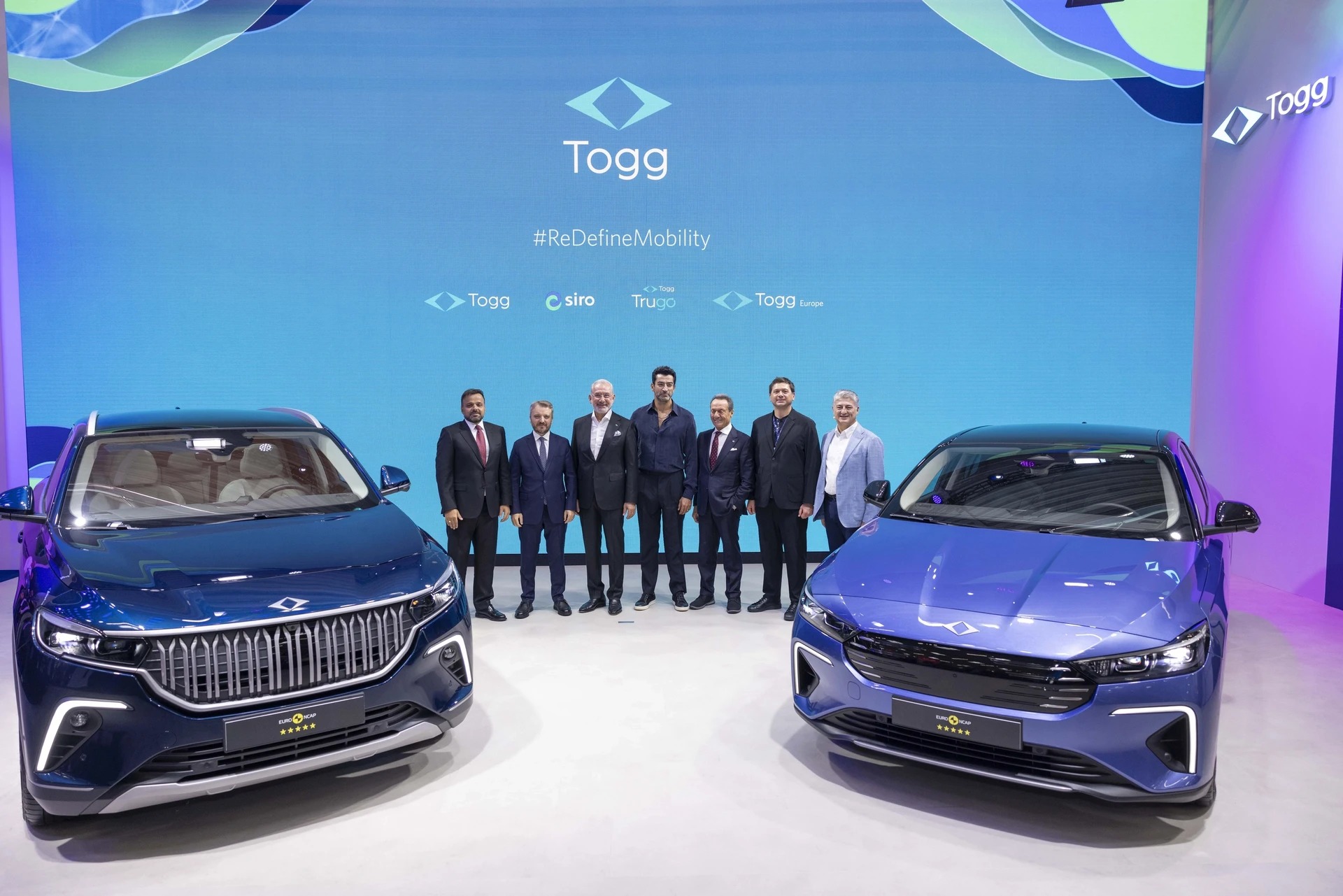
The T10X is an electric SUV. The T10F, a sleeker fastback, arrived in 2025. Both received five stars from Euro NCAP that year. These are the visible products, but Togg talks about a “mobility ecosystem,” a phrase that earns its keep only when the less photogenic parts work. Trumore lets customers configure and order a vehicle and manage parts of the ownership journey. Trugo is a fast charging network that now reaches all 81 Turkish provinces.
The sequence matters. A car without chargers asks the buyer to fund an experiment. A charger without cars is a lonely asset. An app that takes an order but cannot say when the car will arrive is a beautifully designed apology. Togg attempted to grow all three together, then added battery capability through Siro, its joint venture with Farasis Energy. It also began selling optional digital features: its premium Trumore package offers connectivity and digital key sharing for a six-month fee. The business model thus extends beyond the purchase price to charging and connected services.
The cleverer move may be what Togg chose to share. Trugo and rival charging operator Eşarj began a roaming arrangement in 2025, giving drivers access to a combined network through either app. Togg also tested mobile charging with EVbee. A brand can own a charger; it cannot own a driver’s schedule. More usable plugs, wherever they come from, make the car easier to recommend.
The German test is quieter
Türkiye gave Togg an unusual advantage: a home market emotionally invested in the brand. Germany offers a different examination. Buyers there can choose from Volkswagen, Tesla, Hyundai, Kia and many other electric models. They will judge Togg on range, safety, price, software, charging access and the experience of getting a repair. The home-country story may start a conversation; it will not complete a sale.
Togg opened German preorders in September 2025 with an initial allocation of 1,000 vehicles and a refundable €1,000 payment. By year end it reported 144 deliveries there, alongside more than 88,000 total users across its markets. These numbers suggest a controlled market entry, not a repeat of the Turkish launch. Germany gives Togg something valuable: a place to learn whether its integrated pitch travels without its domestic advantage.
“More than a car” sounds like a slogan. For Togg, it is a maintenance schedule, a payment flow and a plug that has to be free when a driver arrives.On the company’s central promise
The company has already adjusted parts of its approach. In late 2025 it began piloting representative dealerships and service points in five Turkish cities, expanding beyond its own experience centers. In May 2026 it announced a partnership with CAIT, a CATL subsidiary, to develop a platform for a smaller B-segment vehicle family. Both choices answer a plain commercial question: which pieces must Togg build itself, and which can it build faster with partners?
What a driver can actually use
For an individual buyer, the offering is concrete. Compare the upright T10X with the lower T10F, configure a version in Trumore, check the financing and delivery process, and map charging along the routes you really travel. A company fleet can make the same calculation at scale. The T10F’s long-range rear-drive version is advertised at up to 623 km under the WLTP test cycle; actual driving range will vary with weather, speed and load. Togg’s charging and service maps are therefore as important to inspect as the brochure range.
For another company studying Togg, the lesson is equally practical. Count demand, but measure the bottleneck after the sale. Put the order journey, energy access and support map on one plan. Borrow partners when the customer benefits from reach more than exclusivity. The approach is expensive and works best when patient capital, manufacturing capacity and a dense enough customer base arrive together. In a thin market, a nationwide charging buildout can outrun its drivers; in a crowded one, a new car must win on ordinary merits. The car may be the easiest thing to admire. The system around it is what owners remember.