Todd Clyde moved from San Francisco to London in 2018 to work on a problem most people would prefer never to notice. When someone buys something, money ought to leave one account and arrive in another. Preferably without a small administrative adventure. The connections take work. Clyde had joined Token as chief operating officer in 2016, and the business of connecting banks to the rest of commerce had become his business, too.
The move put him in London a year before he became CEO. It also gives his story a useful starting point: an experienced software executive crossing the Atlantic to help an existing company grow. His route to the top job ran through commercial and financial operations, the parts of a business where a promising idea acquires invoices, customers and consequences.
A change of city, then a change of chair
On 27 August 2019, Token announced that Clyde would become CEO. Steve Kirsch, its founder and then chief executive, moved to chief innovation officer and remained on the board. Clyde had spent three years as COO. The handover assigned Kirsch more time for the product roadmap and gave Clyde responsibility for driving the open banking business.
That distinction is revealing. Clyde came to the role as an operator with a career in getting unfamiliar software bought and used. The company described the change as a move from startup to scale-up. For him, the assignment involved turning the possibilities of bank connectivity into something other businesses could depend upon.
There was a commercial history behind the appointment. He had worked in enterprise and financial software for more than three decades. His professional biography describes four earlier startup exits, including one valued at $2 billion. Those are company outcomes in a career account, rather than a calculation of his personal fortune. The more useful detail is the repeated exposure to the awkward interval between introducing technology and making it part of ordinary business.
The apprenticeship before the checkout
Clyde studied Management Science at the University of California, San Diego. His working life included twelve years at Accenture, followed by roles in product strategy, sales and operating leadership. DigitalThink, Purisma, ClairMail, Monitise and Mindjet appear along the way. Before leading Token, he was president of Mindjet’s MindManager division.
The sequence moves across several generations of software: e-learning, internet banking, mobile banking and, eventually, banking through application programming interfaces. An API gives software systems a defined way to communicate. Its importance here is practical. A bank account can become accessible within another service, with the customer’s permission, rather than requiring every interaction to begin inside the bank’s own product.
Technology changes its vocabulary with enviable confidence. The operating questions remain stubbornly recognisable. Does the customer understand it? Can the organisation use it? Will the people responsible for security accept it? Clyde’s career has repeatedly brought him close to those questions, across businesses selling very different things.
“So it’s a long game for fintechs, and that takes grit.”
Todd Clyde, 2021
His advice to aspiring fintech entrepreneurs in 2021 was pointed about security infrastructure and the different speeds at which banks and fintechs work. That is a useful corrective to the theatrical pace of technology announcements. A bank cannot adopt a service merely because its demonstration is pleasing. Dependability has to survive the meeting.
A business with somebody else’s name on it
Token.io’s approach puts much of Clyde’s work behind other companies’ brands. Banks and payment providers can use its infrastructure to develop their own Pay by Bank propositions. The person paying may recognise the bank or the checkout provider without knowing the software company underneath. For this kind of business, anonymity can be evidence that the arrangement is working.
In a 2022 discussion, Clyde explained the choice to serve payment providers with white-label infrastructure rather than build a consumer-facing acceptance brand. The pitch was that those providers could reach banks through one integration. The difficulty of connecting different systems would sit with a specialist, while the partner retained its relationship with the merchant.
He was also explicit about the pace of expansion: “We are looking for efficient growth, but not growth at all costs.” That sentence sits comfortably beside the operating history. Adding connections and useful functionality gives partners more to sell. It also gives the infrastructure provider more to maintain. Growth comes with a maintenance bill, an unfashionable document that nevertheless tends to arrive.
Token.io’s Series C, co-led by Cota Capital and TempoCap, backed expansion of its open banking payment infrastructure.
The funding round included Element Ventures, MissionOG and PostFinance, alongside existing investors. The stated work included extending European bank connectivity and developing premium functionality such as variable recurring payments. The spending priorities tell a fairly concrete story about the company Clyde was running: more reach for partners, more things they could do with it.
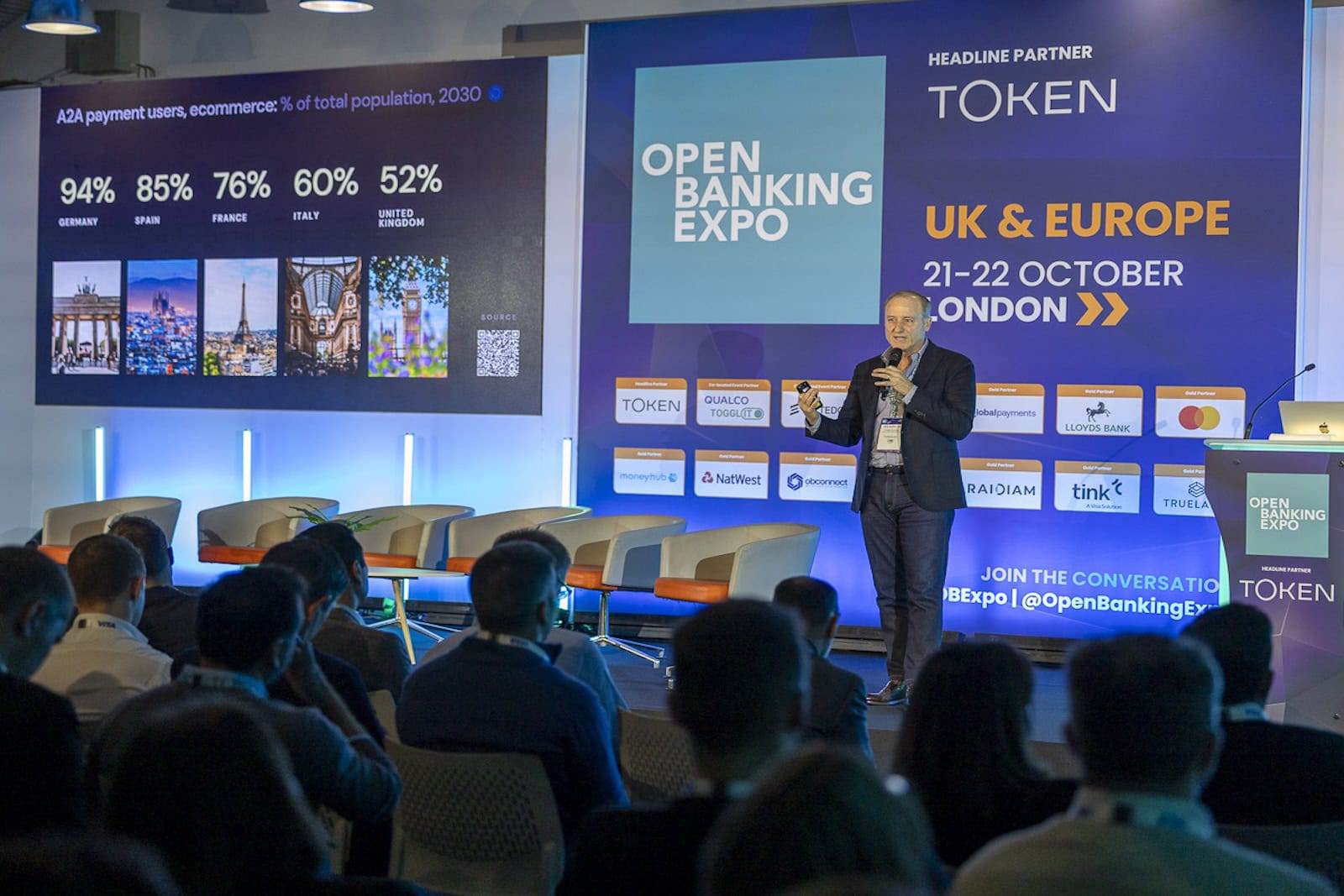
At Open Banking Expo in 2023, he made room on stage for those partners. Nick Corrigan of Global Payments discussed its open banking payment solution. HSBC’s Abbas Rana described the bank’s proposition developed with Token.io. Clyde’s presentation gave customers a speaking part in explaining what the infrastructure was for. That is also a useful way to test a strategy: let someone who has to use it describe the point.
HSBC supplied another chapter in June 2025, becoming a strategic investor after working with Token.io since 2019 on HSBC Open Payments. A customer relationship had become an investment relationship. Clyde framed the collaboration around making Pay by Bank a mainstream option. For a business built around partners, the development was a tangible extension of the model.
The second payment is the interesting one
A one-off payment is an introduction. A repeat payment asks whether the relationship is convenient enough to continue. That distinction runs through Token.io’s recent work. In March 2026 it introduced Account on File, designed to remember a returning payer’s preferred bank and accounts and present them as defaults. Tokenisation lets the service reference an account without exposing the underlying sensitive details.
The promised improvement was modest enough to be recognisable: remove up to two steps from the process. Anybody who has been asked to supply the same information twice can appreciate the ambition. Payment infrastructure meets the customer in such moments. A powerful connection still has to fit into a journey someone is willing to finish.
Return to pay
Account on File recalls a preferred bank and account for a returning payer.
Agree to repeat
Commercial recurring payments need shared rules and arrangements between participants.
Clyde’s January 2025 writing had already set out why banks might care about both sides of this market. They could improve deposits and repayments for their own customers, while also providing Pay by Bank acceptance to businesses. He described Token.io’s revenue model in straightforward terms: software fees, minimum charges and transaction charges. His argument also acknowledged a harder question for banks: what would reward their own investment in additional functionality?
Commercial recurring payments bring that question into focus. In December 2025, Token.io announced that chief product officer Charles Damen had been elected to the UK Payments Initiative board. The industry-led organisation brought banks, payment providers and fintech firms together around a commercial variable recurring payments scheme. The product needed an agreement about how participants would work together.
By June 2026, Clyde was discussing UKPI’s launch and the years spent trying to agree a framework. He described a further e-commerce phase planned for early 2027. His forecast was broad: “You’ll be able to pay by bank anywhere that you use a card.” That remains an ambition about future reach. The practical work beneath it involves rules, participation and enough coverage to make the option useful.
More doors. Fewer keys.
As the market developed, Clyde’s attention returned to a familiar subject: fragmentation. In July 2026, he wrote about the cost of payment providers connecting to multiple schemes, each with its own technical and commercial requirements. A provider could gain new capabilities while also acquiring more development work. The attraction of lower payment costs would be diminished if the connections became expensive to operate.
He returned to the argument in October. Different schemes could serve different countries and payment needs. His proposed answer was infrastructure that let a provider access several schemes through a common layer. Competition could continue, while partners avoided managing every difference themselves. It is a position that fits Token.io’s business, and it sets a clear expectation for what that business should deliver.
The human thread through this career is the willingness to stay with implementation. Clyde has moved between products and countries, from enterprise software to the details of how a bank payment happens again. His work now depends on engineers, bankers, payment companies and shared arrangements arriving at something a customer can use without a tutorial.
The shopper at the end of that chain is unlikely to applaud the integration. They have somewhere else to be. Clyde’s ambition leads toward an everyday moment: the payment completes, the money arrives, and the people involved get on with their lives. After all the conferences, capital and software, an uneventful checkout would be a respectable ending.