Eddie Lewis had a peculiar way of preparing for professional soccer: he practiced with a tennis ball. A smaller object demanded a cleaner touch. At UCLA, he had watched basketball players shoot at smaller hoops. The inconvenience was useful. Make practice harder in one precise way, and the ordinary game might become easier.
Lewis eventually played in two World Cups. But the habit that became TOCA Football was wonderfully unglamorous: a ball, repeated deliveries, another attempt. In 2014, he told Sports Illustrated, “I was getting a week’s worth of touches in an afternoon.” The business began with a question any impatient learner understands: why spend so much practice waiting?
- For players: coached practice using ball-delivery machines, illuminated targets and recorded results.
- For families: beginner classes, camps and indoor soccer, with programs varying by center.
- For everyone else: TOCA Social turns kicking a ball into a bookable group outing.
A machine can deliver a ball. Who delivers the experience?
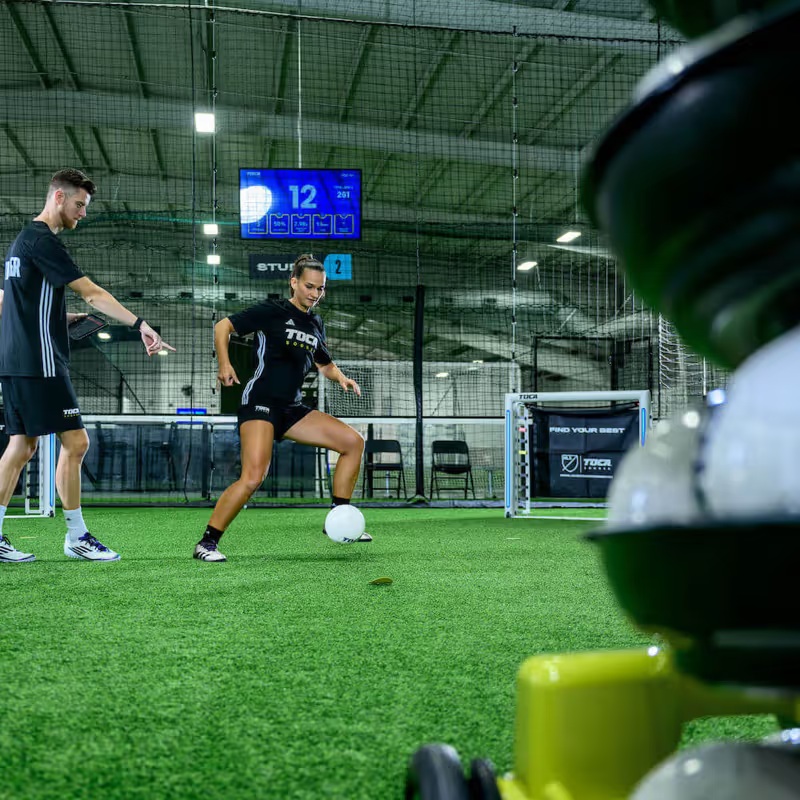
Today’s TOCA is a physical services business built around proprietary technology. Its Touch Trainer feeds smaller soccer balls at adjustable speeds and trajectories. Smart Targets light up, giving a player somewhere to pass or shoot. A coach watches the receiving foot, the body position, the decision. The equipment supplies repetition; the trainer supplies judgment.
TOCA’s account of a typical 50-minute session puts the volume at around 200 quality touches. Treat that as the company’s description of its format, rather than a guarantee of improvement. The useful distinction is practical: individual practice gives one player repeated attention that a team session must divide among a roster.
The harder problem turned out to be the room around the machine. Lewis described the early operation as technology placed inside someone else’s soccer center. TOCA came to believe it could operate those centers better, opened its own, then pursued acquisitions. Owning the setting let the company control the customer’s experience from arrival to the final drill.
That was the consequential change in thinking. A supplier depends on another operator to turn its invention into a good afternoon. An operator can change the afternoon itself. It also inherits the bills, staffing and empty hours. TOCA exchanged a narrower technology business for the demands of running places.
Two customers. Two reasons to return.
For a competitive player, the purchase is focused attention. Private training targets players from seven through adulthood. Beginner and recreational children generally enter through classes for ages one to thirteen. Adults can find leagues and pickup. These are different entry points, with local schedules and availability, rather than one program stretched across everyone.
MyTOCA adds a record of what happened. Players can review session statistics and baseline history, customize a player card and follow division leaderboards. Parents get something more concrete than “practice went well.” A dashboard cannot describe every quality a teammate needs, but it can make a particular exercise’s progress visible.
“But skill is personal. Confidence is personal. Repetition is personal.”Eddie Lewis, on why he built TOCA
Then there is the customer who has no intention of improving a first touch. TOCA Social packages interactive soccer games with food, drinks and group bookings. London’s O2 venue opened in 2021. Birmingham and Westfield White City followed; the first US flagship opened at Grandscape in the Dallas area in March 2026.
The comparison with Topgolf is helpful. A game becomes an occasion that friends can book together without forming a team or committing to a season. Soccer skill still affects what happens when you kick. But the customer’s goal might be a birthday, a work outing or a good hour with friends.
Coaching + repetition
Memberships & programs
Games + hospitality
Bookings, food & drinks
The price of another touch
The distinction shows up in the bill. TOCA’s published guidance puts private-training memberships at most centers from roughly $225 to $255 a month, with children’s classes from around $105 to $110. First sessions or class trials are free. Those are starting figures; the local center’s offer determines what a family actually buys.
TOCA Social’s US pricing page advertises games from $16 per person, varying by booking. UK venues advertise games from £9. Food, drinks and larger events add another commercial layer. One division asks for a recurring place in a family’s training budget. The other competes for the money people spend going out.
Building that combination has required substantial outside capital. TOCA announced a $40 million Series E in June 2021 and approximately $100 million in Series F private offerings in October 2024. The latter backed technology investment, training-center upgrades and additional Social venues. Investors included Harry Kane and chess grandmaster Magnus Carlsen.
$35 million combined. Separate instruments, supporting expansion.
In May 2025 came another $35 million: $15 million in equity and $20 million in debt financing from J.P. Morgan Commercial Banking. That announcement also extended TOCA’s MLS partnership through 2036. The league had become a shareholder in 2022, with cooperation covering training curricula, content and entertainment experiences.
What survives outside the studio?
TOCA occupies an interesting space between private coaching, indoor recreation and activity-led dining. Its difference is the combination: proprietary equipment, a coached service, recorded performance and venues it operates. A local coach may offer superb personal instruction. A public field may offer inexpensive play. Neither automatically supplies that whole package.
The limits follow from the offer. Repeated technical exercises cannot supply every tactical problem, opponent or relationship encountered in a match. Families need a nearby center and room in the budget. The company needs repeat visits and capable venue operations. For Social, the food and service matter alongside the software.
The portable lesson is to shorten the distance between an attempt and the next useful attempt. Then make the result visible. TOCA’s bigger bet is that people return to soccer for different reasons at different ages. In its 2026 Generations Cup, mixed-age teams reached national finals in Dallas. The small ball had acquired a rather large social circle.