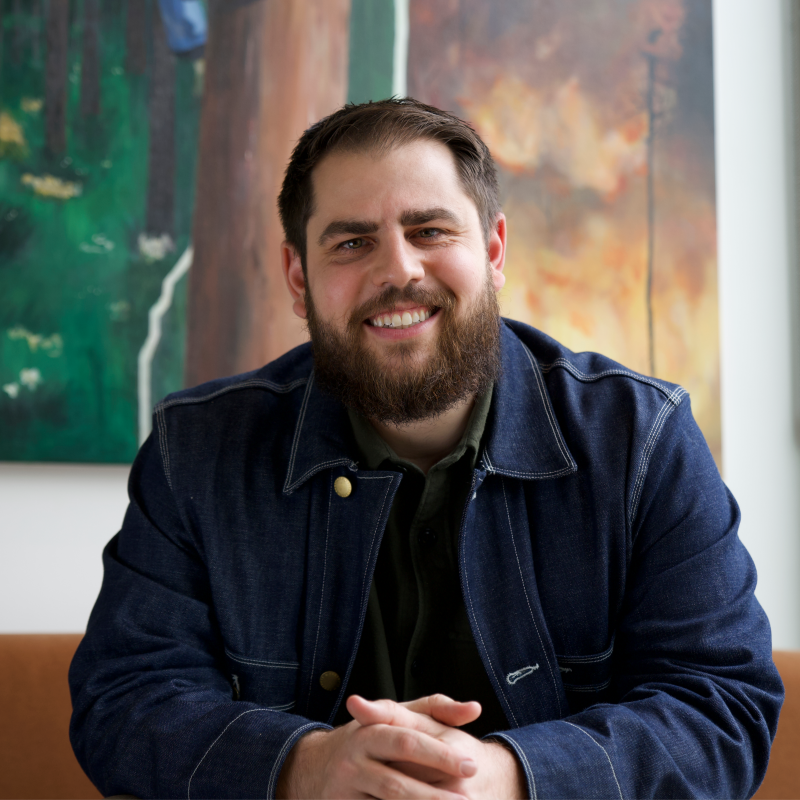
Timothy Barat learned the power grid the hard way, one pole at a time. He worked as an electrical lineworker in Victoria, Australia, handling high-voltage lines in a trade where mistakes are unforgiving. In February 2009 he was in the field during Black Saturday, a day of bushfires that killed 173 people and destroyed roughly 2,000 homes across the state. Many of those fires started the same way: a power line came down, and no one knew in time.
That gap stayed with him. Utilities run some of the most critical infrastructure in modern life, yet much of it is monitored by little more than a customer picking up the phone to report the lights are out. Barat, who had once been a high school dropout before entering the trade, kept turning the problem over. When he moved to the United States in 2013, his wife was uneasy about him continuing dangerous high-voltage work. So he made a hard pivot and went back to school.
He landed at the University of California, Berkeley, and by his own account did not feel like he belonged at first. "I stepped into EECS with a lot of self-doubt and a major case of imposter syndrome," he later said. He stayed the course anyway, earning a bachelor's degree in Electrical Engineering and Computer Sciences in 2019 and a master's in 2020. Along the way he worked as a graduate researcher in Berkeley's Lab11 group, building sensor platforms aimed at modernizing the grid, the exact intersection of hands and theory that would define what came next.
Combining the field and the lab
The idea sharpened around the 2018 Camp Fire, one of the deadliest wildfires in California history, again linked to aging electrical equipment. "Around the time of the Camp Fire, I had begun thinking how my previous experience in the field could be combined with the toolkit I learned from Berkeley to finally solve this," Barat said. In 2020 he co-founded Gridware with two fellow Berkeley engineers, Hall Chen and Abdulrahman Bin Omar. The pitch was simple to state and hard to build: give utilities real-time visibility into the physical condition of their lines.
Gridware's approach is unusual. Rather than tapping directly into the electrical circuit, its Gridscope device reads the grid's mechanical and acoustic behavior. The team describes treating the grid "like a giant guitar as opposed to a circuit board," listening for the vibrations, strains, and sounds that signal a tree limb on a line, a vehicle strike, a failing transformer, or a conductor about to fall. On-device AI and signal processing translate that noise into a diagnosis, and a location.
The hardware is deliberately unglamorous. Each Gridscope is roughly the size of an iPad, mounts on a pole below the lines, runs on solar power, connects over cellular or satellite, and installs in under 15 minutes. Processing happens locally on the device, so it does not depend on a constant connection to the cloud. One podcast host summed it up as "a Fitbit for power poles." The comparison stuck because it is accurate: continuous, low-friction monitoring of something that used to be checked only after it failed.
Proving it before selling it
Barat did not want to learn the failure modes in the field. Before commercial deployment, he built a full-scale test grid, complete with 55-foot poles and 200-foot spans, so the team could stage real-world events on purpose and confirm the sensors caught them. It is the kind of over-engineering that reflects where he comes from. A lineworker knows what a broken conductor actually does, and how badly a false alarm, or a missed one, can go.
The product found buyers. Gridware went through Y Combinator and raised seed funding from investors including True Ventures. It now monitors more than 1,000 miles of power lines across roughly 10,000 poles for 18 utilities, with early field validation work alongside PG&E and ConEd. Barat has noted the company was already cash-flow positive before it raised its later rounds, an unusual position for a hardware-heavy climate startup.
Recognition followed. Gridscope was named one of Time magazine's Best Inventions of 2022, and Barat, Chen, and Bin Omar were listed on Forbes' 30 Under 30 in the Social Impact category. In January 2025 the company raised a $26.4 million Series A led by Sequoia Capital. Then in November 2025 it closed a $55 million Series B co-led by Tiger Global Management and Generation Investment Management, with Sequoia, True Ventures, Lowercarbon Capital, Convective Capital, Fifty Years, and Y Combinator all returning. The money is earmarked for accelerating US deployments and starting a global expansion.
What he is actually after
Strip away the funding headlines and the mission is the same one Barat carried out of the field in 2009. "We have sensors on our wrists, sensors in our pockets, all these incredible ways to sense the world," he has said. "And yet, if you have a power line failure, or you have a power line fall to the ground, often the utility doesn't know that has happened." For crews, that visibility means being sent to the right pole, faster and more safely. For the public, it can mean an outage located in minutes instead of hours, or a fire that never gets the chance to start.
Barat's arc is genuinely uncommon in Silicon Valley. Most founders in energy tech come from finance or software. He came from the top of a pole, and he built a company around the thing he could see from up there that everyone below had been missing. The self-doubt he described walking into Berkeley reads differently now against a company protecting grids across the country. As he put it, if he could show his younger self a glimpse of what they have built, "I think that would be incredibly encouraging."