The eleventh idea had a search bar. Type a subject, find popular tweets about it, and perhaps learn why they worked. Tibo Louis-Lucas and Tom Jacquesson had made ten products before it, with little commercial response. Their plan in 2021 was brisk enough to sound like a dare: launch one new product each week until somebody paid. Tweet Hunter, the simple search tool, was the first to answer back.
That beginning explains more about Louis-Lucas than the eventual sale price. He had already spent years trying to turn ambitious ideas into companies. The weekly experiment stripped the process down to a sharper question. Did a real user have a problem urgent enough to spend money on? Tweet Hunter said yes. The founders listened, added functions, and soon had a business. Then they tried a cousin of the idea on LinkedIn, called Taplio.
Their story has the tidy plot points that business stories love: two friends, a string of misses, a breakthrough, an acquisition by a former schoolmate. It also has an untidy second half. Louis-Lucas later said that the sale cost him a kind of ownership he missed, and that the deal's performance targets made the following years hard work. He did what makers tend to do when the ending feels premature. He opened a new project.
The app for parents, built by nonparents
Louis-Lucas and Jacquesson first built together in 2015. They met in an MBA program and founded Pistache, an app for parents. Neither was a parent. In interviews since, Louis-Lucas has pointed to that mismatch with refreshing bluntness. The company hired quickly and chased funding before it had shown that enough customers wanted the product. It made some revenue and was eventually sold, but it never became the venture they had imagined.
He tried again in 2017 with Dreamz, an educational coding game. More money was raised, a larger team assembled, and the commercial result still fell short. Louis-Lucas then worked as a startup CTO. By early 2020, he and his wife had quit their jobs to travel. The pandemic stopped the plan in France. He returned to the problem he knew how to tackle: making something useful on a screen.
“Everything you can do wrong, we did it.”Tibo Louis-Lucas, on Pistache
The quip is severe, but it carries a practical revision. His next attempt would have a much shorter distance between building and finding out. In 2021 he reunited with Jacquesson at Pony Express Studio. One week would be enough to put an idea in front of users; another week could be spent on the next one if the first drew silence. The goal was revenue, not applause for a clever prototype.
A maker's route
Number eleven gets a customer
The founders' first ten launches found little demand. Tweet Hunter arrived in May 2021. It began as a way to search effective posts by subject, a small solution to an everyday creator's blank-page problem. Louis-Lucas has said competitors were concentrating on scheduling; the opening he saw was helping people decide what to write. As users arrived, Tweet Hunter grew into a set of writing, scheduling and audience tools.
One discarded experiment shows how exacting their test could be. They built a search tool that helped founders find online communities where they could announce a product. People paid to use it, but often needed it only once: after launch, the subscription had little reason to continue. Louis-Lucas later described repeat payment as a more persuasive sign than an excited first day. He also watched for signups that arrived on a day when he had posted nothing, evidence that someone had remembered or recommended the tool without another push from its makers. That was the standard Tweet Hunter began to meet. Louis-Lucas had made the original search function for his own writing; he used it every day before asking strangers to do the same.
The pair contacted creators directly. One, JK Molina, wanted more than a promotion fee. A close partnership followed, aligning his audience with the product's growth. Louis-Lucas later described extending smaller stakes to other creators. This was distribution with skin in the game: people who understood the product's audience had a reason to keep talking about it. It was also a reminder that software can be copied faster than a trusted route to its customers.
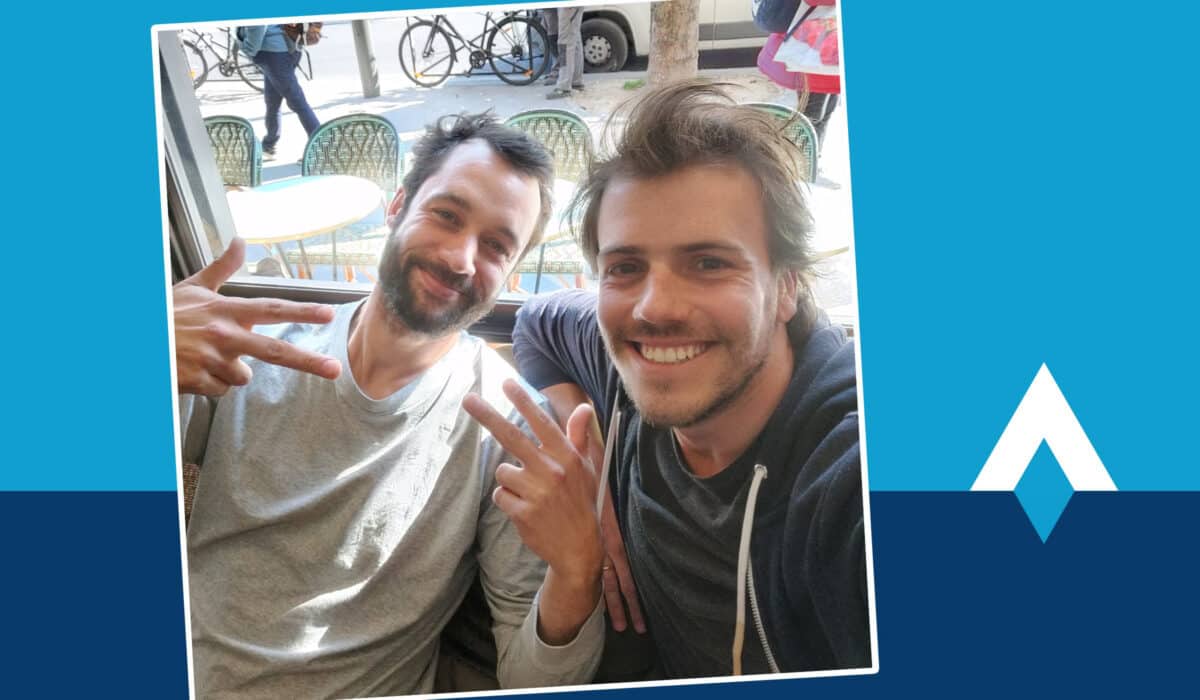
About six months after Tweet Hunter, they launched Taplio for LinkedIn. The two networks look similar from far away: write, post, grow an audience. Louis-Lucas says their different rules and habits required separate products. As they adapted Taplio to LinkedIn, it found its own market. By the acquisition, the businesses had thousands of customers: roughly 5,000 for Tweet Hunter and 3,000 for Taplio, as reported at the time.
Product Hunt named Louis-Lucas its Maker of the Year for 2022. It was a fitting label for someone whose strongest asset was becoming the ability to put an idea in public, read the reaction, and alter course. The award was a marker of recognition. The paying subscribers were the sturdier evidence that the weekly dare had turned into a business.
A buyer from middle school
When Louis-Lucas and Jacquesson looked for a buyer, their concerns were specific. Tweet Hunter depended on Twitter; Taplio depended on LinkedIn. A platform change could threaten either product. A sale could turn some of that uncertain future into a known payment, while giving the founders room to benefit if growth continued.
The eventual buyer was Guillaume Moubeche of lempire, a French software company. Moubeche and Louis-Lucas had known each other since middle school. Their shared past did not replace negotiation, but it made for an unusually familiar table. The terms included $2 million up front and further payments tied to performance. The products were sold in 2022; Louis-Lucas stayed involved during the earnout period. He later said their annual recurring revenue grew from about $1.5 million at signing to $8 million by the end of that period.
It would be easy to stop the profile there, at the satisfying number. Louis-Lucas did not. In 2024, he said the high revenue targets put pressure on the next two years and that he missed owning the products. He said he wanted to keep building apps, grow them steadily and live from their profits. That admission gives the sale a more useful meaning: a successful transaction can still teach its seller what he values.
“I want to keep building apps and reach slow, continuous growth while living off the profit.”Tibo Louis-Lucas, after the sale
The users wrote the next brief
He was already moving. In 2023 Louis-Lucas acquired a small tool called Typeframes. Its original direction was broader, but users kept using it to make short videos. He followed that behavior and developed Revid, a product built for creating and editing short video content. In 2026, he described Revid as generating more than $600,000 in monthly revenue. The figure is his account of the business, but the product turn is the more revealing detail. Once again, the customer showed him a use case more valuable than the plan on paper.
The TMAKER workshop now includes Revid for video, Outrank for search traffic, SuperX for X, PostSyncer for publishing across platforms, Feather for blogs, and newer products including Squad and Bazzly. Louis-Lucas says the portfolio has reached about $1 million in monthly recurring revenue. Those figures change with a live business. The common thread is easier to see: tools for people who need to create, publish and find customers.
His role has changed, too. In 2026 he described himself as the distribution partner across active projects, working with co-makers who build the products. That choice turns an old lesson from Tweet Hunter into an operating model. He can apply a shared approach to search, advertising and creator partnerships across several tools. The person who once shipped a product every week now spends much of his time helping products reach the people who might pay for them.
There is a dry joke in the label “serial founder.” It makes repeated attempts sound like a personality trait, when often they are simply the job. Louis-Lucas's early companies missed, the eleventh weekly test connected, and a sale with a handsome headline came with terms he would later question. He has been unusually willing to say so in public. The interesting trait is not that he always gets the answer right. It is that he keeps asking the market a question clear enough to answer.
On his site, he puts his working belief in plain terms: build a tool for a problem you have felt, sell it to people who feel it too, and keep improving it. That is less glamorous than a lightning-strike origin story. It leaves room for the first ten attempts, the uncomfortable deal, and the possibility that someone will use your next product for an entirely different reason. Louis-Lucas has learned to leave that room open.