Tianqiao Chen has already had the sort of career that usually comes with an invitation to sit quietly on a panel. He founded Shanda, took it public, expanded into digital literature and turned the family business toward global investing. In 2026, however, he issued a rather inconvenient clarification for people approaching him with pitch decks: he wanted to build companies again.
“I am no longer doing VC or angel investments,” he wrote. His preference was to work alongside teams, making businesses from the beginning. He offered an example: MiroFish had started as an intern’s project inside his company. When it began to work, he said, half the equity went to the team. For someone regularly described through the size of his fortune, this was a useful change of subject. The attraction was the work.
His current preoccupation is artificial intelligence. More precisely, it is what AI might discover, and what people should choose to do with the capabilities it gives them. That takes him into companies, essays and arguments about responsibility. Chen has moved a considerable distance from selling access to online games. The appetite for changing the terms of a business is easier to recognize.
Before the worlds on a screen
Born in 1973 in Xinchang County, Zhejiang, Chen graduated from Fudan University with a degree in economics. His early employment offered a respectable route into organizational life: management roles at Shanghai Lujiazui Group from 1994 to 1998, followed by a position in the president’s office at Kinghing Trust & Investment. He had acquired experience inside established institutions before attempting to create one.
In 1999, he started Shanda with family members, including his wife, Chrissy Luo, and younger brother, Danian Chen. The early enterprise worked on a Chinese-language online virtual community. Online games supplied the commercial opening. In 2001, Shanda began operating the Korean game The Legend of Mir II in China. A fictional world became the foundation of a very tangible business.
Looking back a quarter of a century later, Chen recalled borrowing servers through every relationship he could find. He compared their scarcity with the difficulty of obtaining GPUs today. It is a practical detail that cuts through the polished retrospective: before an industry has become an investment theme, somebody still has to locate the equipment.
Free admission, with a business attached
Shanda Interactive Entertainment listed on Nasdaq in May 2004. The company’s story could have settled into a predictable rhythm of more titles, more players and more expansion. Instead, in 2005, it changed an important part of the bargain with its customers. Basic play in major games would become free; players could choose to pay for extra items and features.
Chen acknowledged at the time that the change might hurt short-term revenue. That admission matters. A pricing decision can sound wonderfully obvious once it has been absorbed into an industry’s habits. At the moment of making it, the company must give up something it already knows how to sell. Free admission is an agreeable invitation; the accounts department naturally wants to discuss the rest.
The change placed greater weight on optional purchases and on keeping people interested in the world itself. Shanda had to think about the service surrounding the game as well as the game on the screen. The question of how to organize a technology into a working business would recur in Chen’s career, wearing increasingly different clothes.
“It might have a negative impact on the short-term revenues of our MMORPGs.”Tianqiao Chen, on Shanda’s pricing change, 2005
The reader joins the player
Games were only part of his proposed entertainment business. Shanda’s 2008 reorganization established distinct operations including Shanda Games, Shanda Online and Shanda Literature. Its interests stretched across forms of entertainment that people could enter repeatedly: a game, a community, a novel with another installment waiting to be read.
The literature chapter is especially revealing because it resists the shorthand of Chen as simply a gaming entrepreneur. Digital stories supplied intellectual property that could move into other formats. By 2012, Shanda Literature was discussing copyright operations that included reading websites, mobile reading and game adaptation rights. A story could acquire a second commercial life without losing its first audience.
Hou Xiaoqiang, recruited to Shanda Literature in 2008, described Chen as a loyal reader of the business’s work. That is a pleasing detail in a corporate history: the chairman occasionally appearing in the role of customer. Shanda Games, meanwhile, listed separately on Nasdaq in 2009. The group had become a collection of businesses with different audiences and different demands.
A family business changes its occupation
Chen and his family took Shanda’s parent company private in 2012. The group dates its private investment chapter to 2014. The distinction is useful: changing ownership and changing the work of an organization are separate acts, even when a tidy biography prefers to put them in one sentence.
Shanda’s portfolio broadened into public markets, venture capital, real estate and natural resources. The founder who had once needed servers could now consider businesses and assets far beyond entertainment. The group describes an investment approach spanning early disruptive technologies and undervalued listed companies. Neither end of that spectrum offers much comfort to someone hoping for a quiet afternoon.
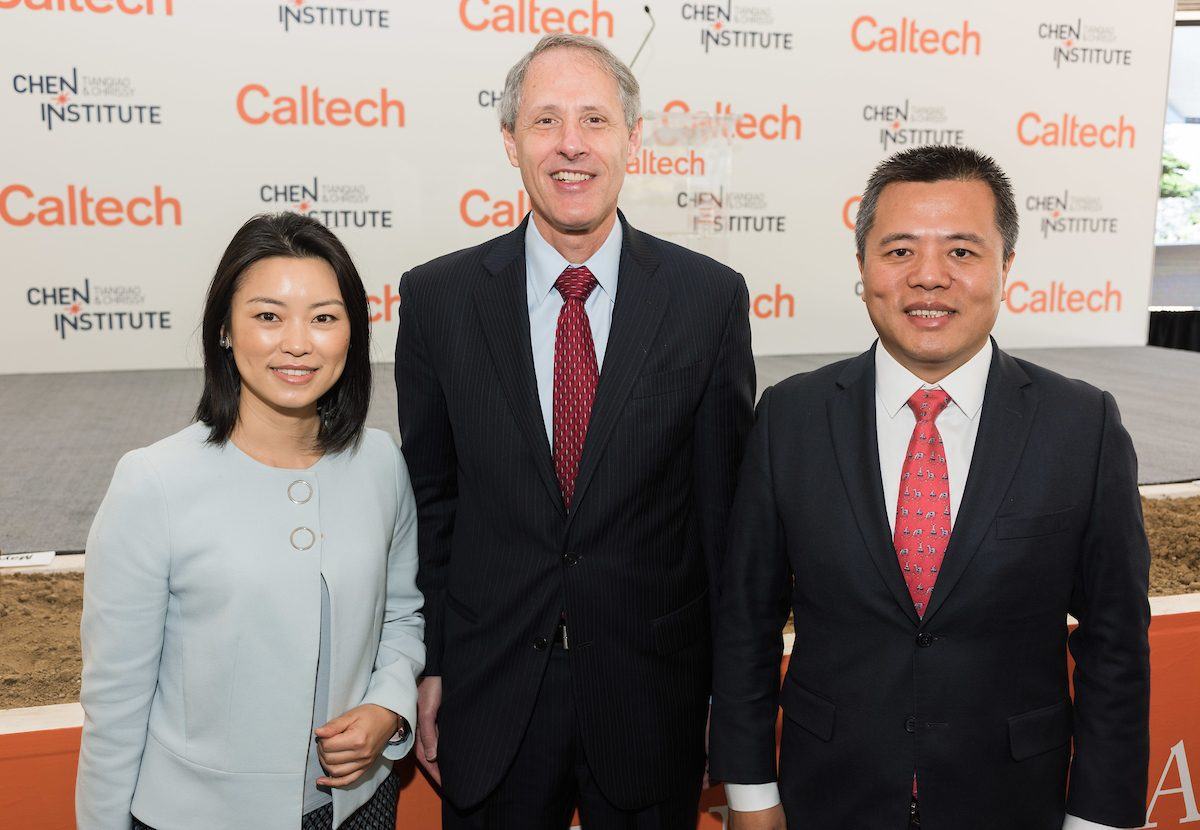
Luo remained central to the wider family undertaking. In 2016, the couple established the Tianqiao and Chrissy Chen Institute. Its support for fundamental scientific research put them into a different institutional world, with Caltech among their partners. At a December 2017 campus groundbreaking, they appeared alongside Caltech president Thomas F. Rosenbaum. The photographs mark another change of scenery in a career with several.
An answer must face the world
Chen’s more recent AI work has given these interests a commercial focus again. He founded MiroMind in 2025 and has become founder and CEO of Apodex. His preferred phrase, “discoverative intelligence,” is slightly awkward on the tongue and quite demanding in its ambition. He wants a system that can propose hypotheses, test them and change its understanding when evidence requires it.
“Helping humanity discover the unknown is the ultimate value of AI to humankind,” he writes. This is his proposed standard for the technology, with substantial engineering still attached. A system that can explain a known result has accomplished something useful. Producing knowledge that can withstand testing introduces a further obligation: the world gets a vote.
In his essays, Chen emphasizes long-term memory, causal reasoning and repeated verification. He wants conclusions to be traceable to evidence and corrected through interaction with an external environment. The language can grow philosophical, but the practical demand is familiar to anyone who has built a product: eventually, it has to work somewhere outside the presentation.
His discussion of scientific AI ends with a personal reference. He describes an aspiration toward “Great Round Mirror” wisdom, a Buddhist image of seeing clearly, and says he gave his science video channel that name. The metaphor supplies a glimpse of the person behind the technical vocabulary. He wants less distortion between a claim and the thing it describes.
Propose→02
Test→03
Verify→04
Revise
A hypothesis meets evidence. The next attempt learns from the encounter.
The organization chart is also under review
Chen extends the argument into the workplace. In The Melting of Systems, published in December 2025, he objects to businesses that add AI to old processes while leaving their basic arrangement intact. The organization has acquired a new tool, yet everyone is still passing work through familiar bottlenecks. A company can buy quite a lot of software while preserving its original talent for meetings.
His alternative depends on capabilities such as reasoning, tool use and memory becoming reliable enough to support a different distribution of work. Humans would supply direction while AI undertook more execution. This remains his forecast for how companies might develop. It asks a founder to reconsider departments, information flows and the value of coordination, rather than merely authorize another subscription.
There is a historical rhyme with Shanda’s pricing decision: the arrangement surrounding the technology deserves examination too. The analogy has limits. An AI organization is a different proposition from a free-to-play game. What carries across is Chen’s willingness to question a familiar commercial structure when he thinks the underlying capability has changed.
The next decision still belongs to someone
In July 2026, Chen explained why he had begun writing publicly. He wanted to examine AI alongside economics, politics and wider social change, and to encourage readers to form their own conclusions. ChenNative and his Substack make his thinking available beyond the closed room of a company or an investment meeting. Readers can follow an argument as it develops, including its speculative edges.
His January essay I Choose, I Shoulder, Therefore I Am puts responsibility near the center of his account of human agency. Decisions acquire weight because people live with their consequences. It is a revealing concern for an entrepreneur working on systems intended to accomplish more on their own: increased capability leaves the question of ownership waiting on the desk.
The latest business ambitions are substantial. In an October 2026 interview, Chen said he had invested $2 billion of his own money in AI and could provide another $2 billion. He also described revenue, break-even and listing goals for the new venture. Those remain plans. The old Nasdaq chapter supplies experience; it cannot supply the result of the next one.
For now, Chen’s career offers something more interesting than a completed lesson. The economics graduate who helped sell online worlds is back among teams and unfinished products, with an argument about how machines might expand knowledge. He has the means to keep going. He has also made his preference public: there is something he would still rather build.