The league needed one more team. By the spring of 2024, Thomas Gilbert and Diana Matheson had spent months assembling a Canadian women’s professional soccer competition. Halifax had come aboard as the fifth franchise. The other owners had set a deadline. A sixth club was still missing, and all the talk of a new league depended on filling that last place.
Gilbert proposed using their equity in the league to acquire a club in Ottawa. The founders would take on another piece of the enterprise they were trying to launch. A national project would become a local obligation, complete with a stadium, staff, supporters and bills. The solution came with a rather substantial follow-up assignment: run a soccer team.
That decision, captured in the documentary The Pitch, gives Gilbert’s career change its particular shape. He had entered the project as an operations leader from consumer businesses. He would emerge as a co-founder of the Northern Super League and the CEO of Ottawa Rapid FC. Solving the missing-team problem had given him a new job.
An assignment that escaped the classroom
Gilbert met Matheson in 2021 while studying for an Executive MBA at Queen’s University’s Smith School of Business. They were assigned to the same team. She had retired from international soccer; he wanted to move his consumer-business career toward work with more purpose. During an entrepreneurship class, they helped pitch the business case for a Canadian women’s league. Their proposal won the most votes.
The idea survived the class. They talked over beers, put thoughts on napkins and kept considering the opportunity. In 2022, a voice memo from Matheson asked Gilbert to pursue it with her. They co-founded Project 8 Sports Inc. The fictional investment of a classroom exercise had become a business requiring actual investors.
“Diana is a force. It’s hard not to be inspired.”
Thomas Gilbert
There was useful difference in their experience. Matheson knew professional soccer from the inside. Gilbert knew the work of launching and operating consumer businesses. Their partnership joined a player’s understanding of the missing opportunity with an operator’s responsibility for making a venture function.

In December 2022, Project 8 publicly set out its plan to launch in 2025. Vancouver Whitecaps FC and Calgary Foothills SC were the first announced teams. The proposal also described opportunities for referees, coaches, managers and supporters. The ambition extended beyond finding Canadian players a place to sign a contract. It involved creating the work and relationships around a domestic competition.
A launch year is a wonderfully compact promise. It conceals an enormous number of appointments. Owners must commit, sponsors must agree, teams must form and people must believe the next person will do their part. The sixth-team decision belongs in that middle stretch, where a proposal has acquired a deadline but has yet to acquire a fixture list.
A city to come back to
Before soccer, Gilbert led operations and sales at a frozen-pizza startup in Toronto. His wider background included direct-to-consumer businesses, hospitality and consumer packaged goods. The industries may offer different Saturday-night entertainment, but they share a practical concern: people have to choose the product, then find a reason to choose it again.
His career had also taken him across Canada. He had lived and worked in six provinces, including both the Atlantic and Pacific coasts. Ottawa remained a focal point for him and his family. Taking charge of the Rapid brought a national career back to a city with personal significance. He arrived with consumer-business experience and a local connection to the place where he would put it to work.
Establishing that local operation meant finding a home between matches. In February 2025, the club announced the RA Centre and its House of Sport as its official base. The team would be headquartered there while playing at TD Place. For a new organization, an office and a community of neighbouring sports organizations are useful possessions. Somebody has to know where to send the paperwork.
The partnership also put the club alongside an existing Ottawa sports community. Gilbert described it as part of building foundations on and off the field. That is a quieter milestone than a name reveal, but a club spends considerably more days preparing for games than playing them.
The people behind the badge
At the August 15, 2024 unveiling at TD Place, Gilbert appeared alongside league president Christina Litz and Ottawa mayor Mark Sutcliffe. Before the badge was revealed, he announced three front-office appointments: Stephanie Spruston as chief operating officer, Heidi Bloomfield as chief sport officer and Kristina Kiss as technical director. The organization was acquiring the people who would turn an identity into a working club.
The name had been developed with agency Critical Mass. Gilbert explained the search for something between North American mascot names and traditional soccer identifiers. “Rapid” kept returning to the discussion. It suggested movement and connected with the Ottawa Valley’s geography. A naming committee had included national-team players, local people and marketing executives.
The crest carried the same attention to place. Its peregrine falcon was native to Ottawa; the spaces between the wings referred to the Ottawa, Rideau and Gatineau rivers. Blue drew on water and sky, while the orange accent referred to the Centennial Flame. A professional team was introducing itself through things its future supporters already knew.
An arena gives its answer
Gilbert received an early indication of the city’s appetite in another team’s building. When the Rapid announced Desiree Scott’s signing at an Ottawa Charge game in January 2025, more than 6,500 people were gathered for hockey. Scott’s appearance on the screen drew a response that stayed with him.
“This city is ready for women’s professional soccer.”
Thomas Gilbert, February 2025
Scott’s arrival also made the new opportunity concrete inside the squad. Defender Liv Scott, who is unrelated to Desiree, had grown up watching her. Now they would be teammates. An athlete formerly encountered as a national-team figure was joining the same workplace. The distance between watching and participating had shortened.
The league’s opening framework included a C$50,000 minimum salary and a C$1.6 million team salary cap. These were terms for a profession taking shape at home. For Gilbert, the crowd’s response offered confidence; for players, the emerging league offered another destination when deciding where to work.
The price of a second season
In March 2026, Arcadia MapleLeaf Soccer became Ottawa’s majority investor. Its principals were Nick Sakellariadis, Ellen Shumway and Michael Savit. Sakellariadis would serve as chair. Existing owners were also increasing their investments. Gilbert remained CEO as the club moved from its inaugural season into the next set of financial and operating decisions.
He described the new backing in terms of the ability to keep investing in talent, operations and the supporter experience. The emphasis was on having resources for the years ahead. Opening a club creates commitments that continue after the introductory excitement has passed.
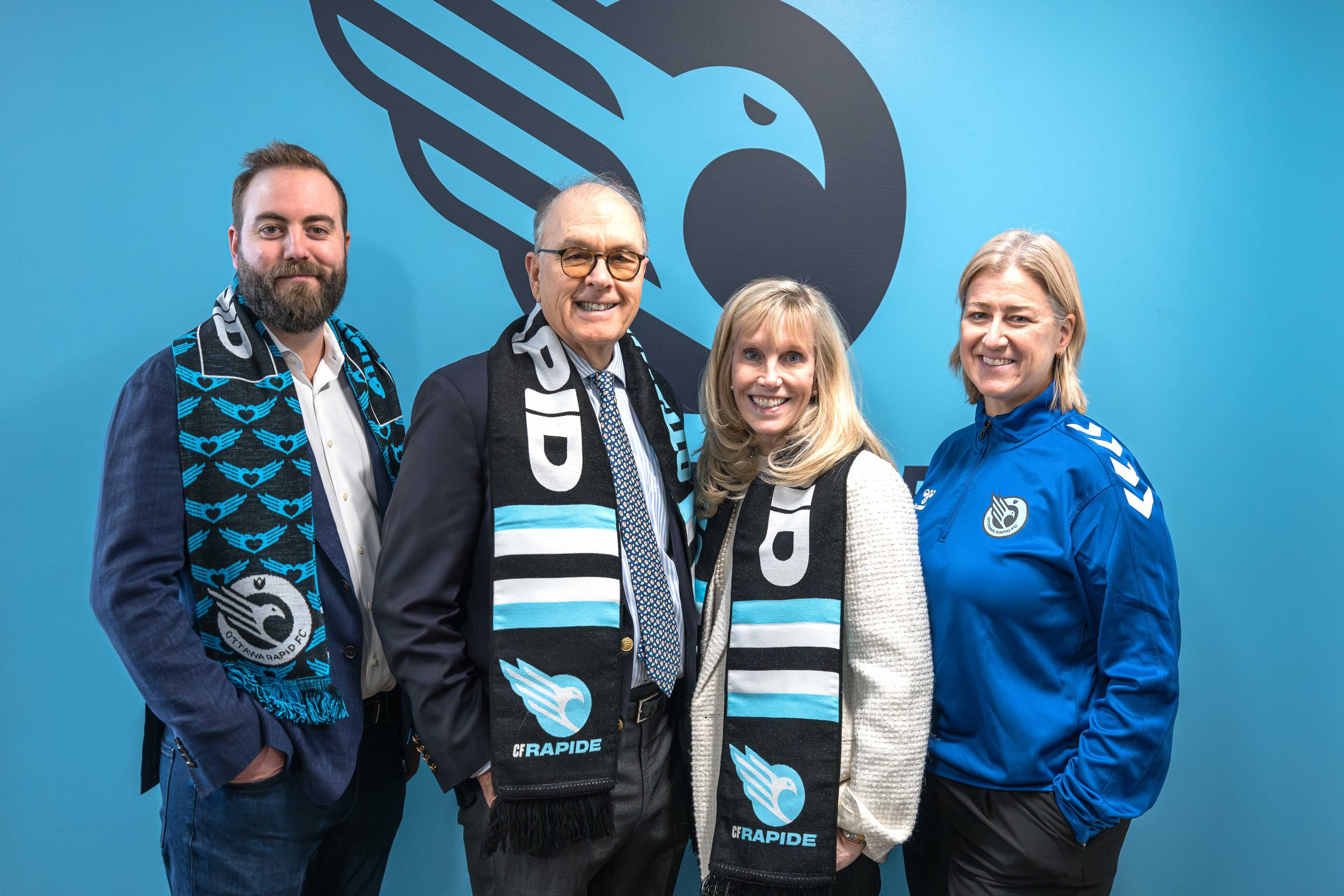
The incoming group brought experience outside soccer. Sakellariadis was co-executive chairman of the Dayton Dragons baseball club; Savit had more than four decades in professional sports. Their arrival added a further layer to Gilbert’s assignment: working with an ownership group focused on a durable Ottawa franchise.
There was continuity to arrange on the field, too. In August, Ottawa appointed Carmelina Moscato as its next head coach through 2028. Katrine Pedersen would retain responsibility through the 2026 campaign, with Moscato preparing for 2027 and taking over afterward. The announcement gave players and staff a clearer view of the coming season while the current one continued.
For Gilbert, Moscato’s return illustrated the league’s purpose. She had coached in Denmark, Mexico, the United States and Saudi Arabia, and had previously played in Ottawa. A domestic professional structure could bring experienced Canadian coaches home as well as players. The original business-school question was now producing decisions about who would work on an Ottawa touchline.
In September, the Rapid secured a second consecutive playoff berth. Their first season had ended after a second-place regular-season finish and a semifinal defeat on penalties to Vancouver. In 2026, they had also put together a league-record ten-match unbeaten run. Gilbert credited Kristina Kiss and the technical team for the foundation behind the repeat qualification.
A further possibility waited in the calendar: TD Place was scheduled to host the November 14 championship final. Ottawa still had to earn its place. The host stadium could be booked in advance; the home team could not. For a CEO accustomed to arranging what can be arranged, sport reserves a few decisions for the players.
The invitation after the invitation
The club’s everyday work extends around those results. Before kickoff, the Fan Zone offers activities; after selected matches, young players can train with the coaches and scrimmage on the pitch. The Rapid Rush initiative reaches toward children already participating in soccer. Gilbert talks about giving them recognizable professional players to admire close to home.
He has a short description of the business: “We’re in the fan business.” At TD Place, that means attending to the time before and after the match as well as the game itself. A family can encounter the team through an activity, a youth session or a familiar player, then find its own reason to return.
Gilbert’s route into soccer began with a class assignment and grew through a partnership. When the league needed its sixth team, he helped supply an answer. Now Ottawa has a club with staff, owners, players and supporters, each with a stake in what happens next. The founding problem had a deadline. The work he took on in solving it comes around again with every fixture.