The first thing Ottawa Rapid FC sold was not soccer. It was the right to say you were there at the beginning. In August 2024, months before a player kicked a league ball, the new club asked supporters for a C$50 deposit. It would be credited toward inaugural season seats, which started at C$339 for 13 home matches at TD Place. A small payment made an abstract promise tangible: professional women's soccer, in Canada's capital, on a recurring schedule.
Then the promise had to play. On April 27, 2025, 6,980 people watched Ottawa beat AFC Toronto 2-1. Min-a Lee scored the first goal in club history; Olympic champion and captain Desiree Scott supplied the late winner. Supporters came down to the pitch afterward. It looked spontaneous, but it also revealed the actual product. Ninety minutes mattered. Proximity mattered more. The players were not remote celebrities passing through on international duty. They worked here.
01 / The useful answer
What the company actually does
Rapid is a privately held consumer sports company wrapped around a football team. It stages home matches, sells season memberships and single-game seats, builds group and premium experiences, licenses sponsorship inventory and moves jerseys, hoodies and hats through a Shopify store. League broadcasts extend the audience beyond the stadium. Youth clinics, school visits, nonprofit appearances and themed matchdays create the local distribution loop.
Its customers overlap but do not behave alike. Families want an affordable afternoon with enough off-field texture to keep children occupied. Serious supporters want competitive football, recognizable players and stakes. Youth clubs want a visible top rung on the development ladder. Sponsors want a live local audience plus the favorable association of investing in women's sport. The club must satisfy all four without turning the match into a corporate picnic with a game happening somewhere behind it.
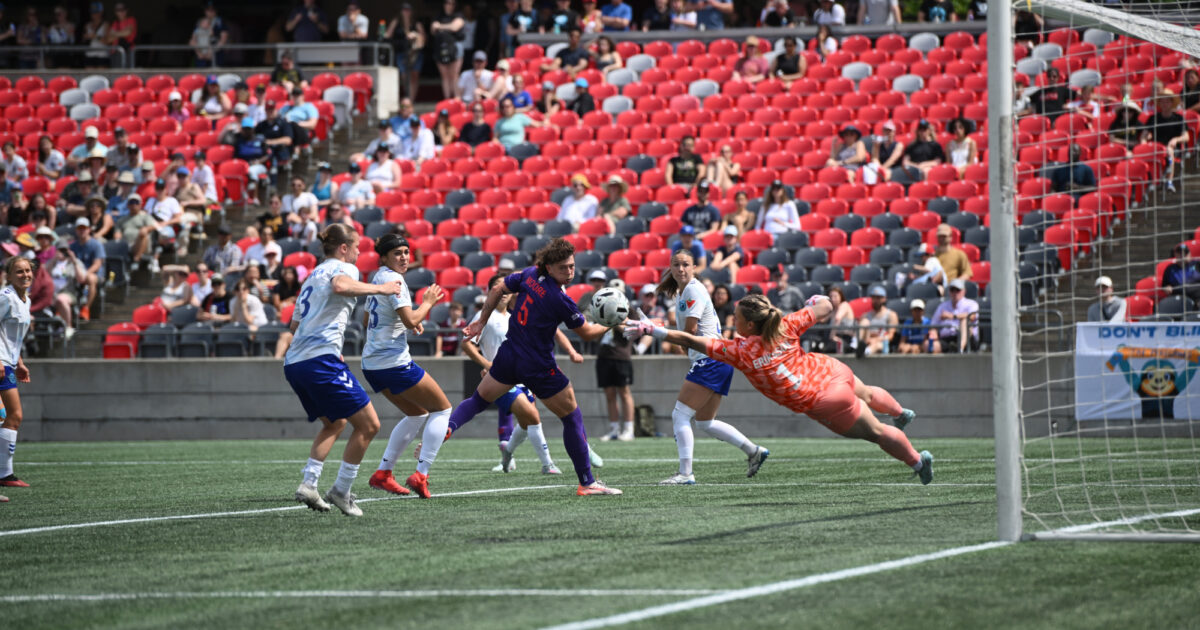
That makes its closest alternatives broader than the five other Northern Super League clubs. Rapid competes with Atletico Ottawa for soccer attention, with the Senators, Charge and Redblacks for sports budgets, and with every concert, patio and family plan that can occupy a summer evening. The club is different for one simple reason: it is Ottawa's only professional women's soccer team, operating in Canada's top domestic women's league. The scarcity is real. The advantage is not permanent.
“The teams that build lasting franchises do it the same way every time - disciplined operations, deep community roots, and genuine investment in the fan experience.”Michael Savit, Arcadia MapleLeaf Soccer
02 / Name, bird, rivers
A badge designed to be retold
The club's branding is unusually economical. Rapid suggests the speed of the sport, the rapids and geology of the Ottawa Valley, and the forward motion of women's football. The team worked with agency Critical Mass, explored several waves of alternatives and kept returning to the same word. That is the “what changed their mind?” answer: alternatives did not dislodge the name because none carried as much local and emotional freight.
The circular crest hides more Ottawa trivia. Its peregrine falcon, a local bird and the fastest animal on Earth, is drawn in attack. The negative space in its wings references the Ottawa, Rideau and Gatineau rivers. The ring becomes an O; a tulip nods to the city's annual festival. Light blue comes from water and sky, while orange points toward the Centennial Flame. It is a compact set of stories a ten-year-old can repeat from the back seat. That matters. Sports brands spread through retelling.
Rapid reinforces those stories with access. Its community program accepts requests from schools, fundraisers, soccer groups and nonprofits. Players appear at youth events across Ottawa-Gatineau; youth associations can organize match experiences; some nonprofit appearances are unpaid. A 2025 partnership with the Ottawa Heart Institute Foundation placed the Canadian Women's Heart Health Centre on the kit sleeve and added screenings, education and fundraising. In 2026, a Christie Lake Kids ticket link returned 10 percent of qualifying purchases to local youth recreation.
This is marketing, plainly, but it works because both sides receive something useful. The club finds future supporters in places where they already gather. Community organizations receive attention, access or money. Athletes become local protagonists instead of content units. The flywheel fails when any piece feels extractive.
03 / First failure, then capital
The season ended. The experiment didn't.
On the pitch, Ottawa's first failure arrived after a better start than a new franchise could reasonably demand. The Rapid finished second in the 2025 regular season, qualified for the inaugural playoffs and lost the semifinal to eventual champion Vancouver Rise. It was a clean sporting disappointment: close enough to clarify the standard, not catastrophic enough to scramble the company.
Off the pitch, the warning was more subtle. Opening-day curiosity is not retention. A large stadium can make an ordinary crowd look sparse. Fans online complained about prices, especially against cheaper local soccer alternatives. Those comments are anecdotal, but the underlying issue is not: a new league has to earn repeat purchases before novelty decays. Community symbolism cannot make a household budget elastic.
In March 2026, Arcadia MapleLeaf Soccer took a majority stake. The price was not disclosed; existing owners also increased their investment. Arcadia's Nick Sakellariadis brought experience from the Dayton Dragons, the Cincinnati Reds affiliate associated with a record consecutive sellout streak. Michael Savit brought four decades in sports ownership and operations. Ellen Shumway brought a career in consulting and financial services. Their stated playbook was almost defiantly unsexy: disciplined operations, community roots and fan experience.
The club called the investment “significant,” but the more informative phrase was “capital runway.” Rapid had already proven it could assemble a team, win matches and attract a launch crowd. The new money was meant to support talent, operations and the repeated small improvements that turn attendance into behavior. The change of mind was not from belief to doubt. It was from launch mode to institution mode.
04 / The second-season test
A sporting company still needs the sport
The 2026 results have made the business case easier to tell. Ottawa opened strongly, played Bay FC in San Jose in the first publicly open match between an NSL and NWSL club, and by August 9 had stretched its unbeaten run to ten league games - an NSL record - while leading the table with 33 points. The club also advanced to the semifinal of the inaugural W Canadian Championship. TD Place was selected to host the NSL final in November.
There is transition inside the success. Inaugural coach Katrine Pedersen will leave after the season to be closer to family. Ottawa has already hired former Canadian international Carmelina Moscato through 2028. Moscato once played for the Ottawa Fury and has coached in Mexico, the NWSL and Saudi Arabia. The handoff was announced early and framed around continuity, development and culture. That is useful operational hygiene: resolve a known vacancy before it becomes a weekly drama.
Commercially, the club continues to widen the product. National Bank became the 2026 front-of-kit sponsor. The online store carries club apparel from youth shirts to premium collaborations. A C$50 “Rapid FC Connect” membership offers a scarf and ticket savings for people not ready to commit to a full season. It is a sensible low-risk rung between follower and season-seat holder.
05 / What to steal
Build the ritual, not the launch
A credited deposit converts vague enthusiasm into a list of people who have crossed a small psychological threshold.
A name and badge should reward a second look. Rivers, tulips and a fast bird make the identity portable in conversation.
Local investors, youth clubs and community partners bring networks as well as money. Ownership can be a go-to-market system.
Social follower, single ticket, C$50 membership, multi-game pack, season seat. Each rung asks for a little more commitment.
Readers can copy the mechanics, not the mythology. Start with a founding cohort who pays something. Make the offer legible. Recruit partners whose existing communities overlap with the audience you need. Turn each live event into a distinct episode while preserving a recognizable ritual. Let customers meet the humans delivering the product. Measure the second visit more carefully than the first.
The model would not work everywhere. A city needs a meaningful base of players and supporters, a venue that can be operated at tolerable cost, reliable broadcast or streaming access, and patient ownership. Pricing must fit the local entertainment market. The football must be credible. If the product is weak, the calendar awkward or the stadium experience hollow, community outreach becomes an expensive substitute for demand. There is also no shortcut around league health: a club cannot stage compelling competition alone.
The first crowd proves curiosity. The second season starts to prove a company.
Ottawa Rapid FC is still too young for a victory lap. Its revenue and valuation are private. Majority investment buys time, not loyalty. Even the record unbeaten run will eventually end. But the club has already done the scarce thing: it made professional women's soccer a local, ticketed, weekly proposition instead of an occasional national-team celebration.
Now comes the less cinematic work. Answer the ticket email. Improve the fan zone. Get the jersey delivered. Help the child meet a player. Make next Saturday feel different from this one, but familiar enough to become a plan. Ottawa built the team. The business will be built one return visit at a time.