A viewer watching an esports stream in 2017 was, to Theta’s founders, also a tiny piece of a delivery system. Their machine had bandwidth. The next viewer needed video. Why send every frame through a distant server when a nearby machine could pass it along? Theta Network was built around that exchange, with token rewards to persuade strangers to lend their idle capacity.
Today the object for hire is often a graphics card rather than a broadband connection. The customer may be a university lab training a model, a developer buying inference time, or a football club answering a fan’s question. The underlying habit is familiar: find unused computing resources, coordinate them, and pay the owners. Theta’s real product has become the coordination.
- Theta began as a decentralized video delivery network and launched its own mainnet in 2019.
- EdgeCloud now rents GPU capacity from community nodes and hosted data centers for AI, video and rendering jobs.
- The company also builds AI agents for organisations, including sports clubs, on top of that compute.
- Its economic test is practical: match a job to a cheaper suitable machine without making reliability somebody else’s problem.
The first plan had a small plot twist
Mitch Liu and Jieyi Long came to Theta through SLIVER.tv, an esports streaming business. Liu had helped start mobile games and advertising companies; Long had worked on VR video and streaming systems. They knew the delivery bill that grows with every extra viewer. Their proposed cure was a peer-to-peer network: viewers relay video to other viewers and receive tokens for contributing bandwidth. The pitch was less fanciful than its crypto vocabulary made it sound. Every stream needs distribution. Theta wanted to buy some of it from the audience.
An early wrinkle says something about the company’s appetite for changing course. Theta planned a public token sale for January 2018. After its private presale was oversubscribed, and following legal advice, it canceled the public sale. The private sale had raised about $20 million. That is token financing, not a later $100 million equity round: in March 2021, investors staked more than $100 million worth of THETA in a validator node, a very different transaction. Conflating the two gives a handsome but misleading funding story.
“Whoever contributes value/data will be rewarded.”Mitch Liu, describing Theta’s original idea in 2018
Theta’s mainnet arrived in 2019. In 2021, its Edge Network extended the work from passing along video to encoding and transcoding it. This mattered because a GPU that can process a stream can process other kinds of jobs too. By 2024, demand for AI compute had made that possibility more than a technical curiosity. Theta launched EdgeCloud in May of that year and put its existing distributed hardware to another use.
A cloud made of several kinds of cloud
EdgeCloud is a hybrid marketplace. On one side are independently run edge nodes with spare capacity, including consumer graphics cards. On the other are hosted data center GPUs and cloud infrastructure. Customers can rent hardware, run containers, use notebooks, train models, call inference APIs or use Theta’s video services. A 2025 Hybrid beta gave node operators the ability to set hourly rental rates. The buyer chooses a machine suited to the job and budget; software handles provisioning and routing. In a company dashboard image from 2026, a community RTX 3090 was listed at $0.13 an hour and a hosted H200 at $3.69 an hour. Those are examples from a changing market, not guaranteed rates.
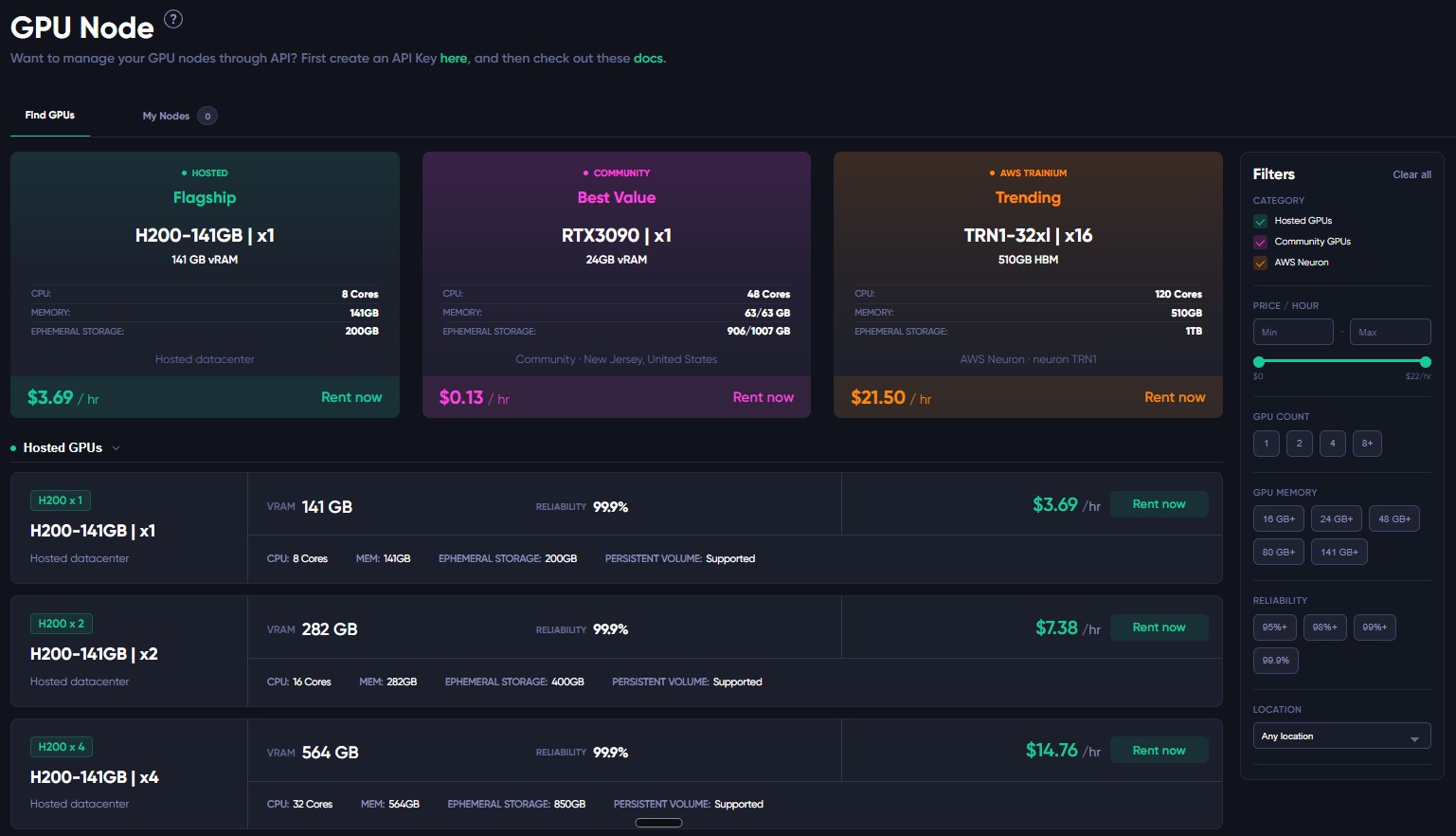
That mixture is the distinction. A conventional hyperscaler offers standardized capacity in its own facilities. A pure peer-to-peer market depends on other people’s machines. Theta tries to use both: a large training run can go to a data center GPU, while a smaller inference or rendering job may suit a community card. It says its edge network grew from about 10,000 nodes in early 2024 to more than 30,000 by July 2026. That figure describes potential supply, not 30,000 paying customers.
Company-reported network size. A node count alone does not measure available GPU hours or completed customer jobs.
The blockchain is the accounting layer behind this odd assortment. Theta says it records and verifies work and distributes rewards; node operators receive TFUEL for completed tasks. Customers need not become blockchain specialists to rent a GPU. The business model is more recognizable than the vocabulary: usage-based compute, model and video services, with enterprise integrations on top. Public disclosures do not establish Theta’s revenue or margins. Nor does the value of tokens staked in its network tell us either number.
A chatbot at the turnstile
Infrastructure becomes easier to judge when it has to answer an ordinary question. In a Philadelphia Union example, a supporter asks which seats might suit their grandparents. UnionBot proposes options and points to ticket information. Olympique de Marseille uses a French and English agent for membership and matchday questions. D.C. United announced a multiyear partnership in September 2026 for a similar assistant. The same company that once moved video between fans now wants to answer them.
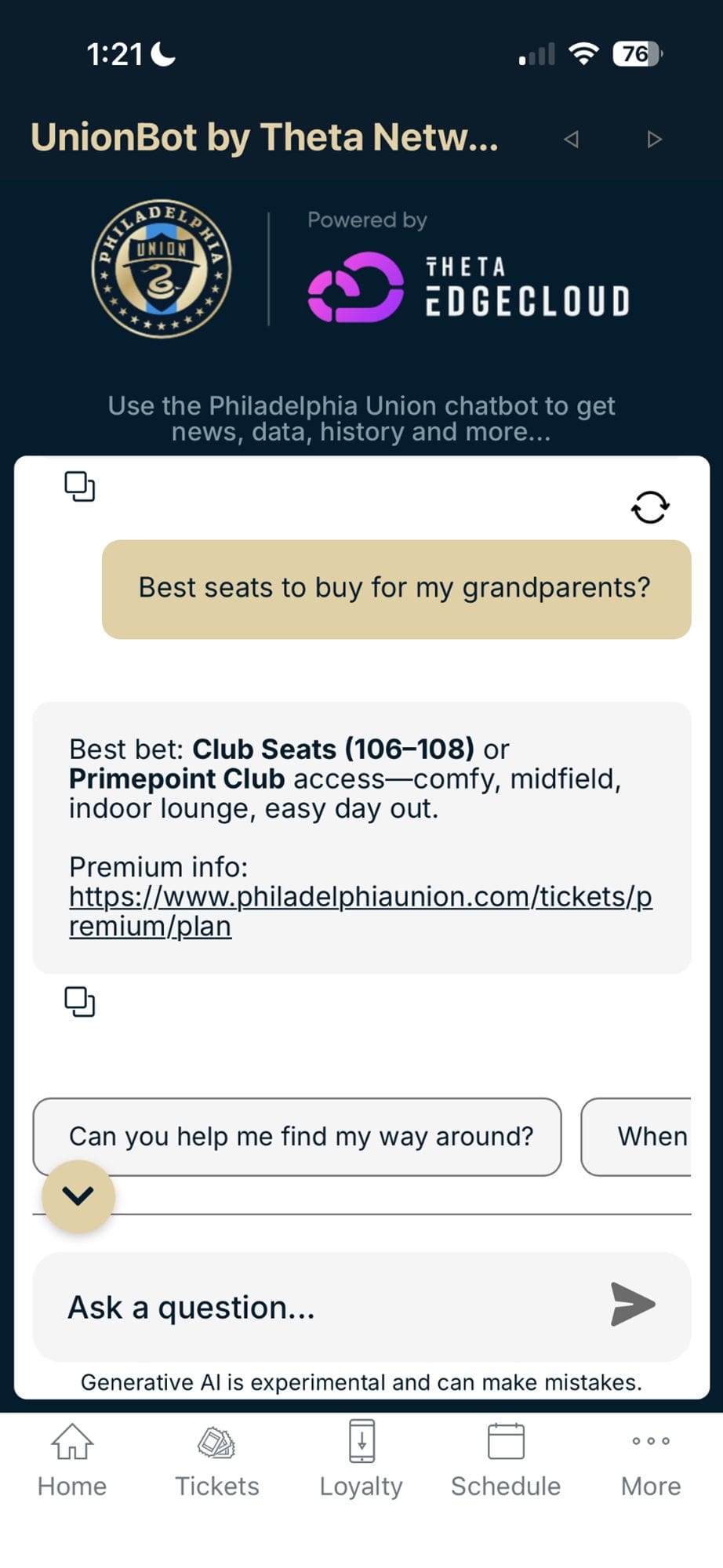
These agents use information supplied by the club, such as schedules, ticketing, venue details and league data. Theta says they can hand conversations to staff during working hours and collect follow-up details after hours. Club staff can inspect recurring questions in a dashboard. That feedback loop may be more valuable than the novelty of a chatbot: a rush of questions about parking or a sponsor promotion can reveal what the club failed to explain.
Research groups are a different buyer. Brandeis University’s Liu Lab adopted EdgeCloud in 2025 for machine learning work, and Theta has announced other academic customers in Asia, Europe and North America. Developers can rent GPUs directly; video platforms can use livestreaming or video-on-demand APIs. In 2026 Theta added AI Characters for game developers and expanded APIs so AI agents could discover and provision GPUs. A September deal with BytePlus brought generative video and image models to EdgeCloud in supported Asia-Pacific markets. Each product gives the compute network a new path to a paying workload.
The trick worth borrowing
Theta’s move is a useful lesson for anyone who has built expensive infrastructure for one niche. The network for relaying esports video was also a way to recruit machines, measure work and compensate owners. Once AI changed the price of GPU time, the same coordination system could be offered to a different market. The copyable move is to inventory the capability underneath the first product, find where demand has become sharper, and then build a buying experience that hides the complexity.
The catch is equally concrete. A scattered supply of consumer cards cannot be treated as a single dependable supercomputer. Jobs with strict data controls, guaranteed latency or specialized interconnects may need hosted infrastructure; moving data and handling failures can erase a cheap hourly rate. Theta’s hybrid design is an answer to those constraints, not proof they have vanished. Its competitive set includes AWS and Google Cloud on one side and distributed compute markets on the other. The measure that matters is whether a customer’s job finishes at the promised cost and quality.
It is a slightly comic ending for a company that began by asking viewers to help the video arrive: the video network found that its most useful audience might be the people building AI. A supporter in Philadelphia wants a seat recommendation. A researcher wants an available GPU. Neither needs to care who owns the machine in the middle. If Theta can keep that indifference intact, it has made the infrastructure do its job.