Theresa Condor was making lists of potential customers before Spire had put a single satellite into orbit. There was no stream of observations to sell yet. There were people to call, problems to understand and a rather large question hanging over the enterprise: when the machinery worked, who would need what it produced? It was a sensible question to ask before sending the machinery somewhere expensive.
Condor had come to the space business through development work and finance. The unfamiliar engineering made her hesitant at first. She wondered whether this would become a lasting occupation. More than a decade later, she was running the company. Her route to the chief executive’s office offers a view of space entrepreneurship from the customer’s end of the telescope.
A shipping route into space
Before the satellites, there was Bangladesh. Condor lived there for roughly three years, working on private sector development and trade promotion. She saw how small enterprises connected to larger supply chains, and how exports could affect an economy. Trade was visible in what people could make and sell, well before it became an entry in a national account.
Her education included a government degree at Cornell and a master’s in international finance and policy at Columbia’s School of International and Public Affairs. At Citigroup, where she worked from August 2008 to February 2012, she became vice president of trade risk distribution on the Latin America desk. The job put her on another side of the same exchanges: the financing of physical goods moving around the world.
The leap to satellites becomes easier to follow when you keep the ships in view. One of Spire’s early businesses was collecting maritime data. Information about vessels could make the movement of goods more visible. Condor already understood why that movement mattered. Space gave her another means of examining an economic system she had encountered at ground level.
“I care about what happens on Earth.”
Theresa Condor, 2024
The first million-dollar signature
Spire’s early commercial history passed through the Ardusat project and Nanosatisfi before the company took its current name. Condor worked on the initial business case, fundraising, business development and corporate partnerships. Those responsibilities are sometimes compressed into the word “business,” as though the satellites might simply acquire customers once someone switched them on.
The milestones were more concrete. She signed the first international memorandum of understanding, the first letter of intent and the first million-dollar contract. Each represented a different degree of commitment. An expression of interest is encouraging. A customer willing to pay a million dollars has rather more exacting expectations.
She also helped lead expansion into Singapore and Glasgow. International growth meant putting operations and relationships into places where the company intended to work. It added another practical dimension to a business whose equipment could circle the planet: a global view still required local arrangements.
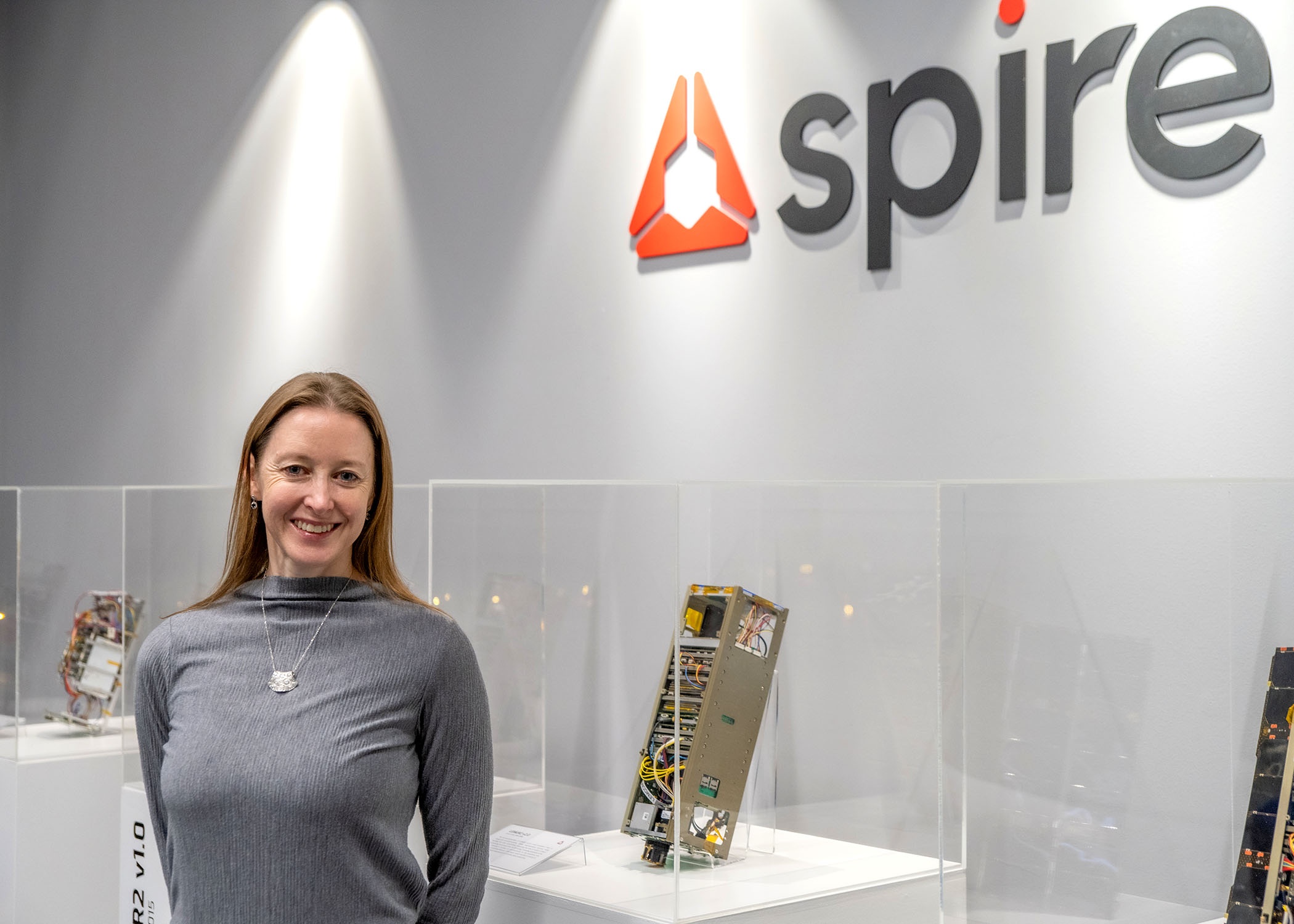
In October 2021, Condor became Spire’s first chief operating officer, with responsibility for its weather, aviation, Earth intelligence and space services businesses. The appointment put a formal title around work that had grown with the company. Her experience included discovering what customers wanted and helping turn those requirements into functioning lines of business.
A satellite needs an explanation
Condor has a useful habit of explaining spacecraft with objects that can be found outside an aerospace laboratory. In 2015, she described a small satellite’s deployment through a jack-in-the-box comparison: the spacecraft rides inside a standard container, then a spring pushes it into orbit when the lid opens. The explanation gives a reader something to picture without requiring an engineering vocabulary.
In that early account, the oceans were central to the opportunity. Collecting information across remote areas was difficult; a constellation could observe places where conventional coverage was sparse. She talked about ship tracking and weather information in terms of planning, operations and decisions. A business could care deeply about those results without taking any particular interest in the rocket ride.
- 01 / ListenSatellites receive radio signals.
- 02 / InterpretMeasurements become usable data.
- 03 / DecideCustomers apply it on Earth.
Conceptual illustration of the path from collection to use.
A price tag, and a public purpose
Her writing makes clear that the commercial argument has never exhausted her interest in the data. In 2018, she distinguished between the price that information commands and the broader benefit it can produce. Weather observations can have a paying customer and a public purpose. A price tag tells you about one transaction; it cannot describe every consequence of the information being available.
That argument fits a career that began with development and moved into banking. The financing needs to work. So does the eventual application. Her attention goes to the connection between the two, including the awkward questions about who bears the cost of collecting information and who gains from its use.
By 2020, she was arguing for governments to act as anchor customers for commercial space businesses. Public procurement, in her account, helps create demand and gives companies a foundation from which to develop commercial markets. It is a more involved relationship than a government simply stepping aside while entrepreneurs get on with things.
In 2021, she explored another commercial arrangement: space as a service. Customers could purchase access to capabilities rather than assume every responsibility involved in owning infrastructure. The attraction resembled the appeal of subscription software, although the equipment had a more demanding commute. Her concern was how to turn investment in space into services that customers could actually adopt.
The corner office came with a closing deadline
Condor became CEO on January 1, 2025. Peter Platzer, the previous chief executive, became executive chairman. By then, the founding team member had spent years inside Spire’s commercial operations. The succession brought continuity of experience into a period that offered very little administrative peace.
Spire was dealing with an accounting restatement and the contested sale of its maritime business to Kpler. The transaction had been agreed under Platzer. Completing it became an immediate concern for Condor. The sale eventually closed in April 2025, and the company used proceeds to retire its outstanding debt.
There is a particular twist here. The maritime business had helped connect her background in trade to the promise of satellite data. Now selling that business was part of making room for Spire’s next phase. A company’s history can explain its direction without requiring every early activity to stay inside it forever.
On her first-quarter 2025 earnings call, Condor identified closing the transaction and putting her executive team in place as key priorities. Celia Pelaz had joined as COO; Gabriel Oehme as chief transformation officer; Alison Engel became CFO. The next work involved costs, efficiency and execution. These were responsibilities with consequences that could be measured much closer to Earth than orbit.
- 2013
- Formal company record dates her Spire roles from February.
- 2021
- Appointed the company’s first COO in October.
- 2025
- CEO in January; president in March.
Why Munich belongs in the story
In July 2025, Condor made a case for civil and defense users to share satellite infrastructure. Multiple applications could draw on common assets, with processing and operations tailored to different needs. Her examples included environmental observations and detection of navigation interference. The proposal asked governments to think across departmental boundaries as well as across technical ones.
It also returned to the commercial problem of making expensive capabilities useful to enough people. Shared infrastructure requires coordination before it produces savings. Agencies with different budgets and priorities have to agree on what they need. Condor’s argument treats that institutional work as part of delivering space capability.
In May 2026, Spire announced a satellite manufacturing facility in Munich. The initial work would support demonstration satellites for EURIALO, a European Space Agency-backed effort to locate aircraft independently of traditional satellite navigation. The company said the facility had capacity to produce up to 100 satellites a year. That figure describes capacity, rather than a tally of spacecraft already completed.
Manufacturing in Germany also addressed the growing interest in sovereign space capabilities. Customers increasingly cared where equipment was built and who controlled it. For a company selling into several countries, the industrial location had become part of the offering. The commercial conversation now included factories, supply chains and national requirements alongside the performance of a sensor.
When the questions change
By September 2026, Condor was reflecting on a change she had noticed during visits to the Munich facility. Early in the company’s life, people questioned whether very small satellites could do useful work. The questions she now heard concerned production speed, scaling and the capabilities that would come next.
She framed this evolution around customer trust. A demonstration can establish that something is possible. A service that enters someone’s daily operations creates a continuing obligation to deliver. Reliability accumulates through work that may look ordinary when considered one contract or one manufacturing milestone at a time.
That is a fitting place to leave Condor’s story for now. The person who once had to find prospective buyers before there was anything in orbit is dealing with the expectations of customers who already depend on space. The calls still matter. Their subject has changed.