As a teenager in Austria, Peter Platzer had an objection to his passport. The document had correctly identified his nationality. That was precisely the trouble. He wanted it to describe a larger affiliation: citizen of Earth. A border seemed an arbitrary thing on which to hang so much of a person’s future.
He had grown up close to the Iron Curtain. The difference between life on one side and life on the other was difficult to square with the small distance involved. In his later telling, birthplace was a lottery. He had drawn a fortunate ticket. The passport, apparently, had failed to acknowledge the draw.
Decades later, Platzer would co-found Spire, a company sending small satellites around a planet that does not arrange its weather by nationality. The connection is tempting, though the route between the teenager and the founder was hardly direct. There were laboratories, consulting assignments, trading desks, another degree and a return to being a student at an age when many executives are shopping for a more comfortable chair.
The passport with the wrong address
Platzer was born in Vienna in 1969. His early interests included science fiction, particularly the German series Perry Rhodan. He remembered its emphasis on people coming together across external divisions. The appeal went beyond spacecraft. It offered a way of imagining who belonged with whom.
That helps explain the persistence of the word “global” in his working life. For Platzer, it carries an argument about people as well as a description of a market. Satellites cross borders; the people building and using them live under different flags. His enthusiasm for that arrangement predates the business case.
There was also a less diplomatic early experiment. Asked about the first technology that interested him, he recalled investigating a clock by smashing it. Reassembly proved beyond the investigator. His subsequent work would involve rather more expensive instruments, with a correspondingly stronger incentive to keep them intact.
“I want it to say Peter Platzer, citizen of Earth.”
Peter Platzer, recalling his teenage passport objection
A detour with a purpose
Physics came first. Platzer studied at the Technical University of Vienna and trained at CERN and the Max Planck Institute. Space interested him, but interest and a viable career opportunity did not yet line up. He moved into consulting with Boston Consulting Group, working in Europe and Asia.
Harvard Business School followed. He completed his MBA in 2003 and was a Baker Scholar. Then came quantitative finance: research at The Rohatyn Group, a director and proprietary-trading role at Deutsche Bank, and portfolio management at Vegasoul Capital. The instruments had changed. Data remained central to the work.
The sequence is easy to describe as a departure from science. Platzer’s own account puts more emphasis on continuity. He was interested in how the world worked and in what information could reveal about its future. Markets supplied a particularly unforgiving setting in which to practice that interest. Eventually, he began looking again at a field he had previously found difficult to enter.
A Singularity University executive program in 2009 helped sharpen that attention. He identified several changes arriving together: pressure on government space budgets, private fortunes entering the industry, and increasingly capable small satellites. Each mattered. Together they suggested an opening for a business that an earlier version of the industry might not have supported.
In 2011, he left finance. He enrolled at the International Space University in Strasbourg, studying space science and management. He also researched nanosatellites at NASA Ames. Going back to school supplied more than a credential. It put him alongside Joel Spark and Jeroen Cappaert, the people with whom he would start the company.
- PhysicsVienna · CERN
- ConsultingEurope · Asia
- FinanceNew York
- Space studyStrasbourg
- SpireFounded 2012
676 people buy into an orbit
The early venture was called NanoSatisfi. Its ArduSat project offered an unusually tangible introduction to commercial space: people could help fund a satellite and gain access to experiments aboard it. Arduino processors and sensors made the proposition comprehensible to a generation accustomed to writing code and seeing what happened.
The Kickstarter campaign ran for a month in 2012. Its goal was $35,000. It finished with $106,330 pledged by 676 backers. Those numbers matter because they describe people making a small, specific commitment to an idea that might otherwise have sounded remote in every sense.
pledged by 676 backers
The educational ambition was explicit. In 2013, when he was honored as a White House Champion of Change for crowdfunding, Platzer described students uploading instructions, tracking a satellite and downloading results. Access should extend beyond a few wealthy or exceptionally equipped classrooms. A real machine in orbit could give a programming exercise consequences worth paying attention to.
The project’s public challenge also invited software, science and hardware ideas. What could someone do with sensors already above the atmosphere? The question moved part of the invention outside the founding team. Instead of asking everyone to admire a satellite, it asked them to propose a use for one.
The business was taking shape alongside that invitation. Education provided an accessible starting point. A network of small satellites could also collect observations for organizations with recurring needs and budgets. The company that became Spire would build around that second opportunity.
A company with its ears open
A satellite business has a communication problem before it has a sales problem. Say “satellite” and people may imagine television, internet service or photographs of their house. Platzer has used a three-part distinction: some satellites talk, some look and some listen. Spire’s work belongs in that last group, collecting radio-frequency signals.
The distinction changes what customers are buying. An image shows a surface. A received signal can help describe activity or conditions that a photograph cannot supply in the same way. Spire developed applications in weather and in tracking ships and aircraft. The commercial value rested on useful information arriving repeatedly.
That made the customer’s decision central to the enterprise. An observation is valuable because someone has to plan a route, anticipate conditions or understand a changing situation. The launch is an indispensable event in that chain. It is also an intermediate one. The work continues after the rocket has disappeared from view.
Platzer’s ambition for forecasting came with a suitably exacting comparison: the dependability of Swiss train schedules. It is an aspiration, rather than a claim that the weather has agreed to run on time. The desired outcome is greater confidence in decisions people already have to make.
The career conversation goes both ways
His ideas about running a company deserve a place beside the spacecraft. Platzer has described a system built around autonomy, mastery and purpose, with quarterly career discussions in place of the conventional annual review. Among the subjects: what employees enjoy, what they want to learn and where they hope to go.
One question even reaches beyond the company: what work might someone want to do after Spire? It is an interesting thing for an employer to ask. The possibility of leaving becomes part of a discussion about development, instead of an awkward subject everyone carefully steps around.
Platzer also worked as a career coach at Harvard Business School. Giving someone advice about a next move has a particular resonance in his case. His own résumé includes enough changes of direction to make a strictly linear definition of progress difficult to defend.
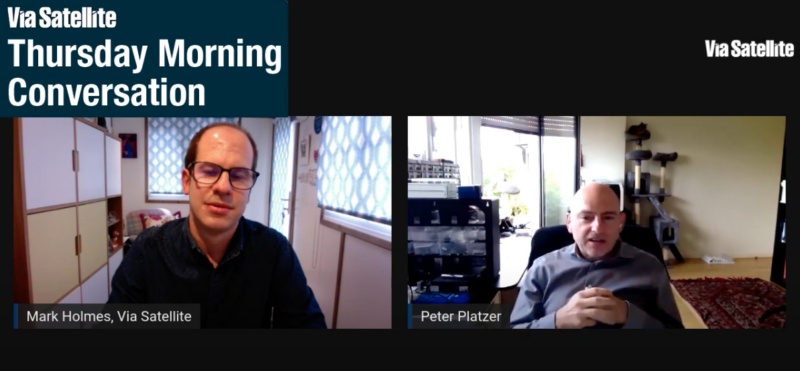
The person outside that résumé has his own collection of interests. Platzer is a classically trained tenor. During a 2020 video conversation, his cats made appearances. Their names, Wolfie and Nannerl, referred to Mozart and his sister. Even the interruptions had received a musical education.
There is also the HP-41 calculator. He learned assembly programming on the machine and later collected examples of it. His public profile lists mountain adventures, including Kilimanjaro and Everest Base Camp, and names The Lord of the Rings as a favorite book. Space occupies plenty of the biography. It has not claimed every shelf.
A different chair, the same planet
Spire became publicly traded in August 2021. In December 2024, it announced the next change in Platzer’s job: Theresa Condor would become CEO on January 1, 2025, and he would become executive chairman. Condor had been part of the founding team and served as chief operating officer.
The succession followed twelve years of his leadership. His chairman’s responsibilities included guiding the company’s vision, leading its board and pursuing major opportunities. By April 2026, Spire’s proxy statement continued to identify him in that role. The founder remained involved, with a different assignment.
The company also changed shape. In April 2025, Spire completed the sale of its maritime business to Kpler for approximately $233.5 million before adjustments, alongside a $7.5 million services agreement. It used the proceeds to retire outstanding debt. A business built to gather information had reached a point where deciding what to keep was itself an important decision.
Platzer’s route makes the founding moment look less like a sudden conversion than the meeting of a longstanding interest with workable circumstances. The teenager had a planetary affiliation in mind. The physicist acquired commercial experience. The finance professional returned to a classroom. The company emerged with collaborators he met along the way.
His old passport objection remains a useful place to end up. It was a young person’s complaint about a line on a document. Years of work gave it a practical expression: instruments that travel around the Earth, collecting information for people who must make decisions on it. The planet supplied the subject. Platzer kept finding another way to study it.