The first Chip City business plan contained a modest number: 100 cookies a day. It was a reasonable hope for a 250-square-foot shop in Astoria, Queens, opened on limited hours by two childhood friends in 2017. Then the doors opened. Theodore Gailas later recalled that the shop passed its daily goal in the first hour. Somewhere between cookie 101 and the line outside, the plan became a keepsake.
The number matters because it catches Gailas before the polished title, the expansion maps and the investment announcements. He is now Chip City’s co-founder and chief brand officer. Back then he was one half of a friendly argument. Gailas and Peter Phillips had challenged each other to make the best cookie they had ever tasted. The contest did not produce a winner so much as a company.
The forecast met the front door
The comparison is about pace, not total first-day volume. Gailas said the initial daily target was exceeded within the opening hour.
A local Facebook group helped spread the news. Families arrived. Phillips would later remember an “army of strollers” outside the first store. Chip City’s early following grew through Instagram, where opening times and upcoming flavors became useful information. A bakery that was not always open gave people a reason to pay attention to when it would be.
The diner education
The partners arrived with different tool kits. Phillips had worked in commercial real estate, construction and development. Gailas came from food and hospitality. His family owned and operated diners in Manhattan, an education conducted in booths, kitchens and the thousand small negotiations that separate a restaurant from a room containing food.
That division of experience is easy to see in the company they built. One founder understood sites and construction. The other understood how a product acquires a public personality. Chip City’s proposition could fit on a napkin: large cookies, baked fresh, served warm. Yet the presentation around that proposition became deliberately busy. Shops used vivid color and local graphics. The menu changed. Candles, mugs, tins and socks carried the brand away from the counter.
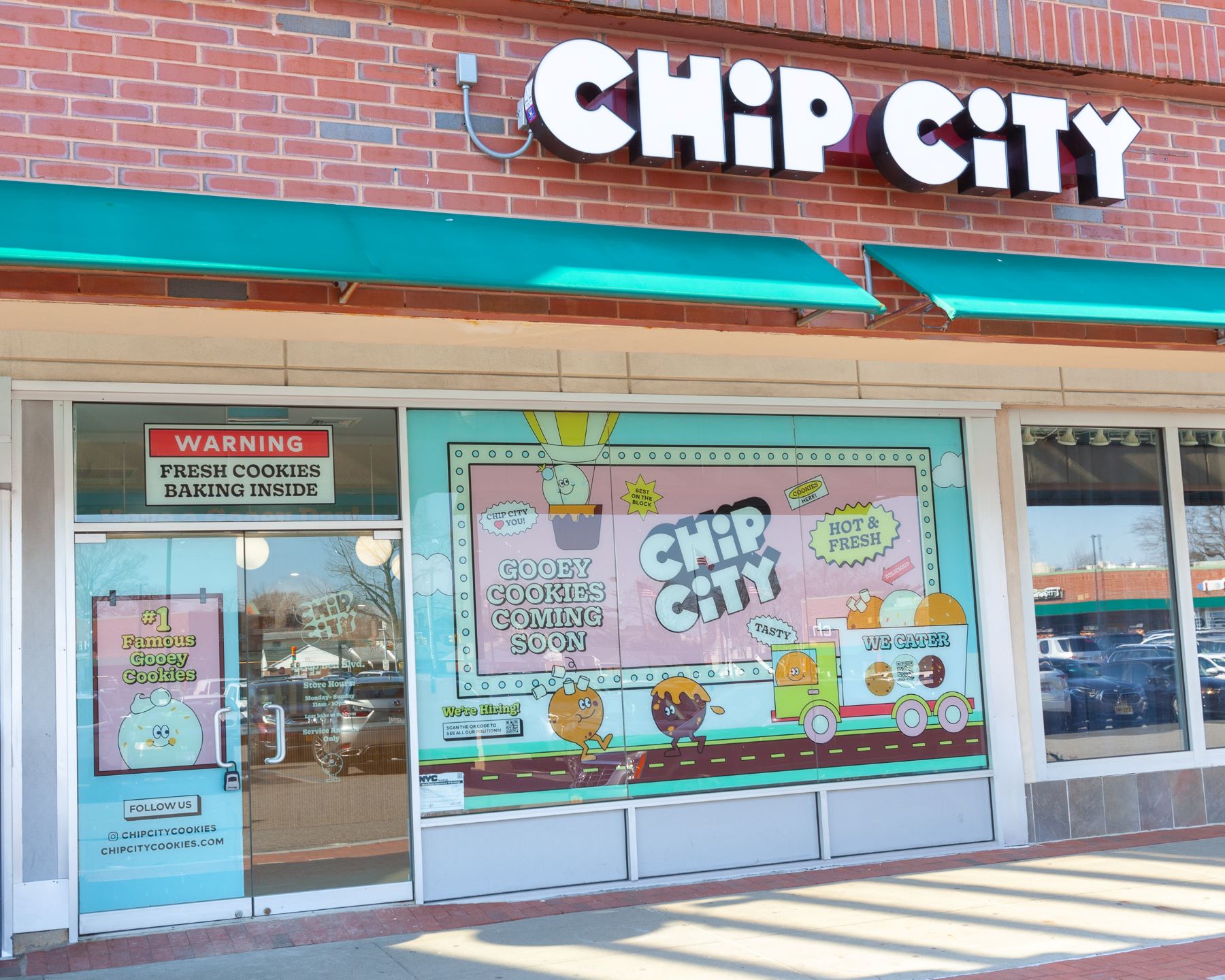
Gailas has a useful sentence for the strategy: “To be known for something, you have to do one thing and do it really well.” The line sounds austere until one looks at the menu. Chip City does one category, certainly, but it lets that category wear costumes. Chocolate chip supplies reassurance. Baklava, cannoli, Italian rainbow, blueberry cheesecake and hot honey cornbread provide the gossip.
A menu with appointments
In 2024, Gailas described a nine-cookie lineup: five continuing best sellers and four changing slots for seasonal ideas, filled cookies, another dairy-free option and new experiments. That architecture is more interesting than endless choice. It gives regulars enough certainty to buy a favorite and enough uncertainty to check the schedule.
The menu behaves less like a catalog than a small publication. There are recurring columns, seasonal issues and an occasional cover story. A specialty cookie might appear for one day. The Italian Rainbow Cookie became a limited event capable of producing long waits. Each Friday reset offered the social team something new to announce and customers something harmless to debate.
This is where Gailas’s title makes sense. A chief brand officer does not merely choose colors. He shapes the recurring promises a company makes. At Chip City, one promise is quality: strong ingredients, trained bakers, fresh batches through the day. Another is novelty within boundaries. The cookie changes, but it remains unmistakably a Chip City cookie: thick, warm, crisp at the edge and soft in the center.
The feed points to the front door
The rotation also solved an old retail problem with a new-media habit. A bakery can post the same chocolate chip close-up only so many times before even melted chocolate begins to look like office furniture. A changing menu gives the publishing operation a fresh subject every week. In 2024, Chip City said it had nearly 300,000 organic social followers in New York, supported by an in-house marketing team that included design, social coordination and content production under Gailas. One Instagram video approached three million plays.
Those figures would be decorative if the attention stayed on the phone. The practical objective was a visit. At the time, roughly 70 percent of business came from in-store pickup. The feed showed the break of a cookie and the dramatic center; the shop supplied heat, aroma and immediacy. Each medium performed the job it could do better. Video made the texture visible at scale. The counter made it edible.
This loop helped Chip City occupy a useful position between a neighborhood bakery and a standardized chain. Its cookies were designed to photograph well and travel through social channels, but they were still finished in front of a local audience. The company could promote one flavor everywhere while adjusting the room around it to a particular market. Consistency lived in the product and voice; variation lived in the weekly calendar and the walls.
The discipline is easy to overlook because the output is playful. A limited release needs production planning. Daily posts need a pipeline. A bright store needs decisions about type, illustration and what should stay quiet. Gailas’s work sits at that junction, where appetite becomes scheduling and a joke becomes a repeatable graphic system. Brand, in this version, is not a layer applied after operations. It is the choreography that helps operations look effortless.
The scent before the sign
Branding usually arrives through the eyes. Chip City also works through the nose. Gailas has described the aroma filling each store and reaching the street as bakers cycle fresh trays through the oven. Phillips gave the effect a neat commercial name: “smell equity.” The phrase is funny because it puts a balance-sheet collar on a childhood memory.
The smell does something a social post cannot. It catches people who had no intention of buying a cookie. It makes the production method visible without showing the production. The company says its dough is prepared centrally, portioned and frozen, then baked at each shop. Freezing turned out to help the cookies hold their structure. A logistical convenience became part of the texture, while in-store baking preserved the theater.
By 2024, the central Queens commissary measured 18,000 square feet and supplied dozens of stores. The system could sound industrial, yet the customer encountered a warm cookie and the smell of butter. This is the quiet trick in the Chip City model: scale is kept backstage while freshness performs out front.
Money, with a side of counsel
In 2022, Danny Meyer’s Enlightened Hospitality Investments put $10 million into Chip City. The business had 14 locations at the time and ambitions beyond New York. Gailas’s reaction was revealing. “It wasn’t just the money that was attractive about this deal,” he said. “It was the association and mentorship from leaders who have done this before.”
That is the remark of someone who knows that a popular first shop and a durable chain are different organisms. Money can rent the next address. It cannot automatically transport judgment, culture or the feeling of a line outside a Queens bakery. The company needed operating knowledge as much as capital. Enlightened Hospitality invested another $7.5 million in 2024, earmarked for stores, people, services and creative collaborations.
Expansion introduced the predictable tension. A brand known for neighborhoods had to cross state lines without becoming anonymous. Chip City’s response included store graphics tailored to the market rather than one repeated room. The ovens remained electric, which simplified construction. The menu continued to change. Nationwide shipping offered access to people following from places with no local shop.
Keeping the argument alive
The public record around Gailas is unusually consistent. He talks about ingredients, freshness, rotation, design and the pleasure of anticipation. He does not present the origin as destiny. The first-shop expectations were “very humble,” he has said. That understatement gives the story its charm. Two friends did not begin by announcing an empire. They began by disagreeing about a cookie.
Their partnership assigned that disagreement useful jobs. Phillips, the builder, helped make the physical model easier to repeat. Gailas, the food-and-hospitality operator, helped make repetition feel lively. One solved for construction and throughput; the other helped ensure that customers had something to look forward to after the novelty of a first visit.
The result is a business whose most persuasive ideas remain small. Bake often enough that the street can smell it. Keep a favorite on the menu. Remove another flavor before it becomes wallpaper. Give the weekly announcement a visual language. Let a shop belong to its neighborhood. Make the cookie substantial enough to seem slightly unreasonable.
There is wit in building a serious operating system around a product associated with being given a treat. Gailas’s achievement has been to avoid sanding away that childish energy. The stores may multiply, the production may centralize and the funding figures may acquire extra zeroes, but the brand still behaves like two friends are waiting to see whose idea draws the longer line.
The original contest, in other words, was never settled. It became the programming schedule.
Follow the crumbs