There is a pleasing absurdity in paying one company to explain a war, time a roast chicken, rank a mattress and tell you that a five-letter word does not contain an E. Yet that combination is the point. The New York Times has taken products that once lived in separate corners of a newspaper - the front page, sports desk, crossword, food section and consumer column - and rebuilt them as distinct digital habits. Then it put them on one bill.
This is still a journalism company. More than 3,000 of its roughly 6,000 employees were involved in journalism operations at the end of 2025. The report remains the sun in the company's own solar-system metaphor. But the planets now matter. Games, Cooking, The Athletic, Wirecutter and Audio draw people into the Times through different doors, at different hours, for different reasons. The result is a media bundle that behaves less like a Sunday paper and more like a membership for curious daily life.
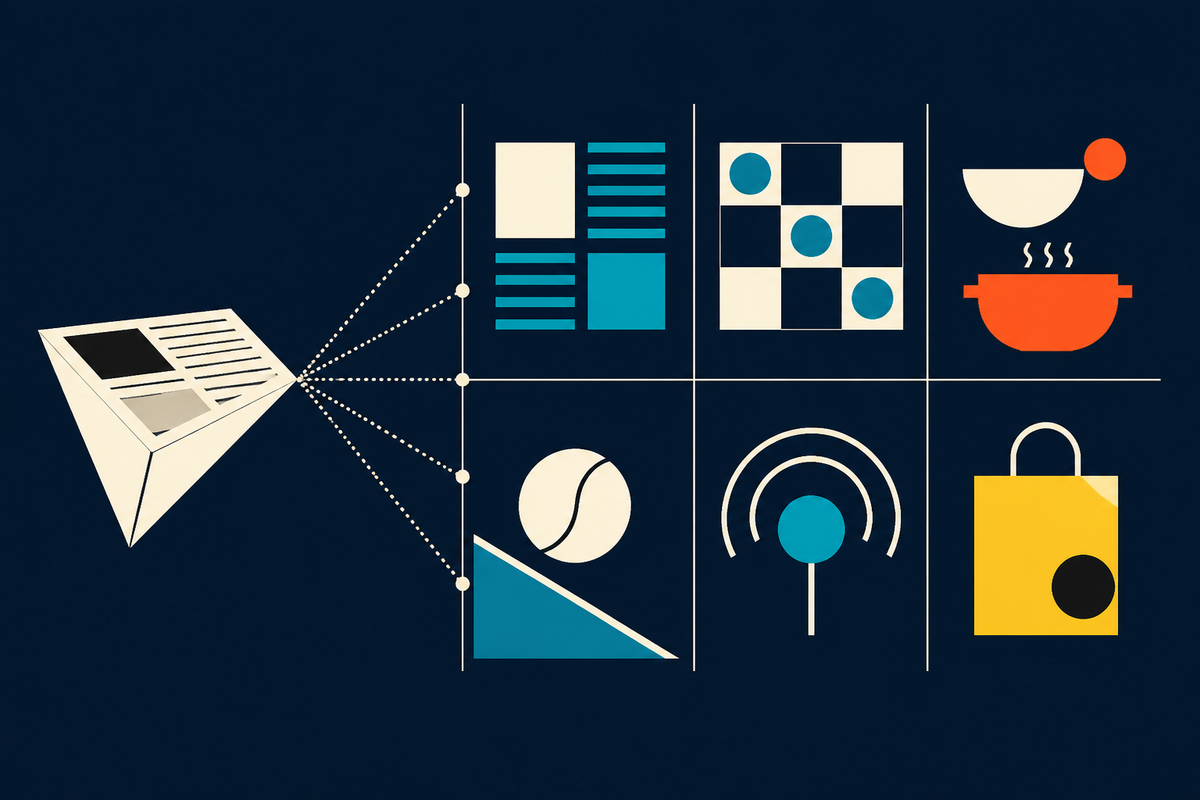
A bundle built from moments, not sections
The conventional way to describe the Times is by inventory: articles, newsletters, podcasts, recipes, reviews and puzzles. The more useful way is by occasion. News meets the reader who wants to understand what happened. The Athletic meets the fan checking a lineup. Cooking appears at 5:47 p.m. when dinner has become a problem. Wirecutter arrives just before a purchase. Audio fills a walk or commute. Games offers a small, social ritual that can begin before coffee.
Those moments rarely compete with one another. They stack. A person who would hesitate over a news-only subscription can justify All Access because a partner cooks from it, a child plays Connections or a weekend is organized around sports. The family plans introduced in 2025 made that household logic explicit. In subscription language, this is retention. In ordinary language, more people would notice if it disappeared.
The scale is now unusual in paid news. At June 30, 2026, the company counted 13.35 million subscribers, 12.80 million of them digital-only. The definition includes individual, group and family subscriptions, so it should not be mistaken for a count of unique human readers. Even with that caveat, the direction is plain: the Times added roughly 1.5 million digital-only subscribers in the twelve months to June.
“The newspaper is the sun. But a modern subscriber may enter the solar system through a yellow square called Wordle.”A portfolio strategy, translated into breakfast
The paywall learned to open doors
When the metered paywall arrived in 2011, the proposition was fairly direct: frequent readers should pay for journalism. It worked, but it also exposed a hard ceiling. Breaking news is abundant. Search engines, television, aggregators and social platforms can tell a casual reader what happened. The Times needed to make its version sufficiently original and useful to command payment, then give the subscriber reasons to return when the world was not on fire.
The answer combined reporting depth with product design. Its differentiation begins with a large reporting operation, international reach, visual storytelling, data work and editorial judgment. It continues with delivery: a news app, narrated articles, podcasts, live sports pages, saved recipes, streaks, recommendations and alerts. Competitors can match pieces of this. Reuters can be faster, ESPN can go deeper into a score, a specialist recipe site can offer more dishes. The Times' wager is that the pieces become more valuable together, attached to one trusted account.
News
Original reporting, analysis, opinion, visuals, newsletters and podcasts across web, apps, audio and print.
Games
The Crossword, Wordle, Connections, Spelling Bee, Strands, Sudoku and Crossplay turn daily cadence into play.
Cooking
Tested recipes, technique, video and the saved recipe box solve the recurring question of what to make.
The Athletic
Team-focused sports reporting, live coverage, analysis and podcasts widen both audience and calendar.
Wirecutter
Research and real-world testing reduce the time, uncertainty and regret attached to buying things.
Audio
Podcasts and narrated journalism move the report into time when a screen is inconvenient.
The product portfolio also changes acquisition. A difficult investigation may persuade one reader. Wordle may introduce another who did not arrive looking for news at all. The Athletic brings team loyalty; Cooking benefits from search and utility; Wirecutter appears at the moment of commercial intent. Each is a front door with its own audience and economics. All Access is the hallway connecting them.
The business hiding beneath the byline
The company is subscription-first, not subscription-only. In 2025, it generated $2.825 billion in revenue. Subscriptions contributed $1.951 billion, advertising $566 million, and affiliate, licensing and other activities $308 million. Print copies represented less than five percent of subscription revenue, a striking inversion for a company that still rolls a physical newspaper onto doorsteps seven days a week.
2025 revenue mix
Advertising still matters, especially when a larger, more engaged audience gives marketers premium inventory across the site, apps, podcasts, newsletters and video. Wirecutter adds affiliate commissions when a reader follows a recommendation and buys. Licensing and syndication put journalism and archives into other institutions. Commercial printing remains in the mix. These secondary lines are useful, but the governing choice is clear: build for the paying reader first.
That choice helps solve a problem that has hollowed out much of publishing. Advertising rewards scale, speed and cheap attention; accountability reporting is slow and expensive. Reader revenue creates a more direct exchange. The Times spends on correspondents, investigations, graphics, audio, product and engineering; the audience pays because the result is difficult to reproduce. Lifestyle products then make the relationship more frequent and less dependent on a relentless breaking-news cycle.
A growing paid audience, in millions
A moat made of trust - and tiny interactions
The Times sits at the premium end of a fragmented market. It competes with the Wall Street Journal and Washington Post for subscribers, with the BBC, CNN, Reuters, AP and countless free feeds for attention, and with specialist products in every lifestyle category it has entered. It also competes with doing nothing. A reader can hear the headline on a group chat, cook from memory and buy whatever the marketplace ranks first.
Its defense is a compound advantage. The brand and archive are old; the digital behavior is not. A reporting network produces work that earns citations, awards and reader trust. Product teams turn that work into formats people can use. Daily games create voluntary check-ins. Cooking and Wirecutter provide practical answers. The bundle captures more of the value than any single article could. Data from those direct relationships helps the company understand what subscribers use, though it also creates the ordinary privacy and platform responsibilities of a large consumer internet business.
The arrangement is difficult to copy because it took time, acquisitions and cultural negotiation. The Times bought Wirecutter in 2016 and The Athletic in 2022. It acquired Wordle the same year, reportedly for a low-seven-figure price. It built Cooking and much of Games internally. Each product needs enough editorial identity to feel credible, yet enough connection to make the bundle coherent. Too much integration flattens what people love; too little leaves a bag of unrelated subscriptions.
“A paywall asks whether one article is worth paying for. A portfolio asks whether the whole relationship is worth keeping.”The shift from access to attachment
What the next edition has to prove
The growth plan is visible. The company aims for 15 million subscribers by the end of 2027. Family plans can spread products across households. A 2026 partnership with Delta puts news, games, cooking and sports in front of travelers. Crossplay, the Games unit's first designed two-player title, makes a solitary ritual social. Video is receiving investment as the Times adapts to audiences trained on motion and personality.
The pressures are visible too. News fatigue can weaken demand. Subscription prices and promotional offers can irritate loyal readers. Generative AI systems challenge search traffic, licensing norms and copyright control; the company is already spending on related litigation. A unionized workforce and a large reporting operation create costs that cannot be switched off with an algorithm. Editorial controversies can damage trust quickly because the brand is both the asset and the product.
Still, the most instructive part of the Times is not a number or acquisition. It is the decision to treat curiosity as broader than news consumption. A reader can want a sober investigation in the morning and a ridiculous pangram before lunch. The same person can care about Ukraine, the Knicks, a Dutch oven and whether today's Connections grid is cheating. The Times built a business around that whole person.
For customers, the practical value is equally broad: understand a story, follow a team, cook a meal, choose a product, fill ten minutes or listen while walking. For the company, those acts form a loop. Journalism establishes trust. Useful products create frequency. Frequency supports retention. Retention funds more journalism and product work. The old newspaper bundle was held together by folded paper and a rubber band. The new one is held together by habit.
Keep exploring
Watch and listen to Times interviews, reporting and podcasts on YouTube.