At the top of a gym bleacher, an iPad sits on a tripod. Below it, a volleyball game gets underway. The person behind the lens may be a student who played an earlier match. The audience is scattered across kitchens, offices, and perhaps another country. This was The Cube's proposition: the most modest of television studios could give an ordinary school night a second set of seats.
- The Cube gave schools their own channels for live games, performances, ceremonies, replays, and highlights.
- Viewers watched free; schools could begin with a phone or tablet and add production gear as they grew.
- Nearly 5,000 schools used the platform when PlayOn! Sports acquired its assets in 2018. The Cube platform closed that May.
There is a familiar temptation to describe this as a sports story. Football and basketball supplied the obvious schedule, and sports brought predictable crowds. But the service was built around a broader fact: schools produce important public moments that rarely make television. A graduation has no network rights auction. A choir concert may matter enormously to twelve families and hardly at all to anyone else. The Cube treated that uneven importance as a reason to build a platform, rather than a reason to keep the camera off.
A channel for every school
Larry Cotter and Kevin Doyle founded High School Cube in 2012. Each participating school received a channel, called a cube. A school could broadcast live in HD from a mobile device, tablet, laptop, or a fuller production setup. Afterward, viewers could revisit a replay or a clipped highlight. Its school-facing material described a web studio, scoreboard tools, social sharing, and ad production. The promise was practical: get the feed online without requiring a television station's budget or crew.
The customer relationship ran through the school, but the viewers were parents, alumni, friends, and anyone too far from the venue to walk in. That distinction mattered. Schools had the event and the permission to film it. Families had the reason to watch. The Cube connected the two with a link and a timetable. The most important feature was sometimes less visible than HD: a fan could arrive without a subscription.
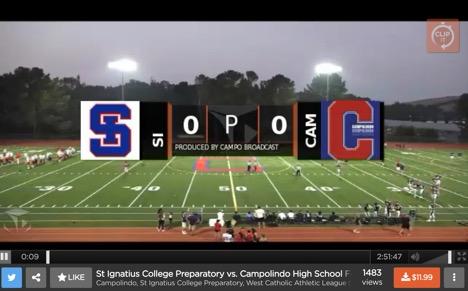
An early Chicago Sun-Times report described the work in plain, almost comic terms: a two-person crew could mean one announcer and one producer handling the camera and laptop. The same report noted the cracks in the picture. The on-screen scoreboard had no clock, and scores could lag behind the game. Those defects were real. So was the achievement of covering several games at once with almost no machinery.
One stream could do several jobs: live attendance, a record of the event, and a clip worth sharing later.
Free is a feature with a bill attached
St. Ignatius College Prep in San Francisco supplies the clearest example of why the model appealed. A school staff member said The Cube had reached out by cold email, offering a free-to-view alternative after the NFHS Network moved to a subscription model. The school wanted the widest possible audience. HD mattered too; the account said NFHS was then streaming in standard definition. St. Ignatius streamed roughly 30 games a year and reported audiences ranging from about 400 to almost 8,000 per game, depending on sport and opponent.
The school's broadcasts were not free to produce. St. Ignatius sold sponsorships, including live reads and prerecorded spots, to cover equipment and freelance producers. That is a useful distinction for anyone tempted by the phrase “free streaming.” The viewing fee had been removed; the camera, operator, bandwidth, and time had not. In a 2013 school newspaper account from Omaha, educators weighing The Cube against Ustream, Livestream, and StrivTV admired the free program but disliked its advertising. The bill always finds a place to land.
“We wanted to have our games free to the public so we could reach the widest audience possible.”St. Ignatius College Prep staff member, 2017
It was still a shrewd trade for many schools. Notre Dame College Prep thanked a local insurance agent whose support enabled a playoff broadcast for out-of-town fans. Sioux Falls students turned live sports into broadcasting practice. The Cube made room for those arrangements because it supplied a common destination while schools supplied the peculiar local knowledge: who played, who sang, and who had a grandmother three states away.
Scale did not buy permanence
In 2014, High School Cube announced a partnership with USA TODAY High School Sports. Its broadcast tools would reach schools through athletic directors, and the resulting live streams, replays, and highlights could travel through Gannett's local digital outlets. The company said it had showcased more than 5,000 schools and 1.2 million students in all 50 states and 20 countries. Those are company claims about content it had showcased, not a verified count of active paying customers. But they show the ambition: an intensely local event could have national distribution infrastructure.
The 2018 school count came from PlayOn! Sports' acquisition notice; it described “almost 5,000” schools.
The end is unusually well documented. By February 2018, The Cube's corporate parent, Tronc, intended to shut it down and offered the company for sale. PlayOn! Sports acquired the assets, seeing a chance to invite those schools onto its NFHS Network. Its notice to schools said the old platform would run until April 30, then close permanently on May 1. Schools were told to download archived content to their own storage devices. The Cube had accumulated a network of participants valuable enough to buy, yet the product they used would disappear.
That move changed the bargain for viewers. The NFHS Network was the alternative some schools had left precisely because it charged for access. A 2019 account from Illinois State University said one former student broadcaster started High School Zoom after the free Cube streams gave way to NFHS's paid model. Another school, Notre Dame College Prep, moved its media crew to YouTube. Those responses do not prove which model was best. They do show what people missed: a public viewing link, attached to a school event, without a ticket desk in front of it.
The useful part to steal
The Cube's most durable idea is wonderfully small. Start with the event the community already cares about. Give it a reliable channel and an easy link. Let students do some of the telling; they know the players and learn a trade at the same time. Then decide, before the first stream, who will pay for the equipment, production hours, and archive. St. Ignatius answered with sponsors. Other schools chose subscriptions or their own video channels. What failed first for The Cube was the corporate owner's willingness to keep the free platform alive, not the existence of an audience.
There are limits. A phone at the back of a gym is vulnerable to weak connectivity, thin audio, and a volunteer who has homework. Advertising can make a free service unacceptable to a school. A sponsor may pay for a rivalry game and ignore a Tuesday concert. Rights and permissions matter too. The Cube worked best where a school controlled the event, had somebody willing to film, and could tell its community when to tune in. It was never a substitute for those human arrangements.
The same iPad at the top of the bleachers can look quaint now. Yet it solved a problem that remains oddly modern. A seat is a scarce thing; a school moment is brief; distance is stubborn. The Cube made the seat easier to share. For several years, that was enough to turn a local game into a little piece of public media.