At first glance, a hotel opening is a matter of doors. Someone removes the protective film from the brass, a general manager turns a key, and the first guest discovers where breakfast is served. But the more consequential opening often happens months earlier, in an editor's inbox. That is the opening Brandman has learned to arrange.
The New York communications firm specializes in luxury hotels, resorts, destinations and the expensive pleasures around them. Its work includes media relations, openings and renovations, brand partnerships, influencer programs, social strategy, content production and campaign reporting. It is a service business, paid by other businesses to make a place intelligible and interesting before a traveler ever sees the lobby.
This sounds simple until you consider what the agency actually sells. A hotel is rooms, restaurants, architecture and service. A story needs tension, novelty and a reason to exist now. Brandman's job is to find the narrow bridge between the two.
The opening before the opening
Consider The Ritz-Carlton Maldives, Fari Islands. The resort is visually cooperative: circular villas, long walkways over clear water, gardens planted against a turquoise horizon. Beauty supplies the photograph. It does not supply the editorial calendar.
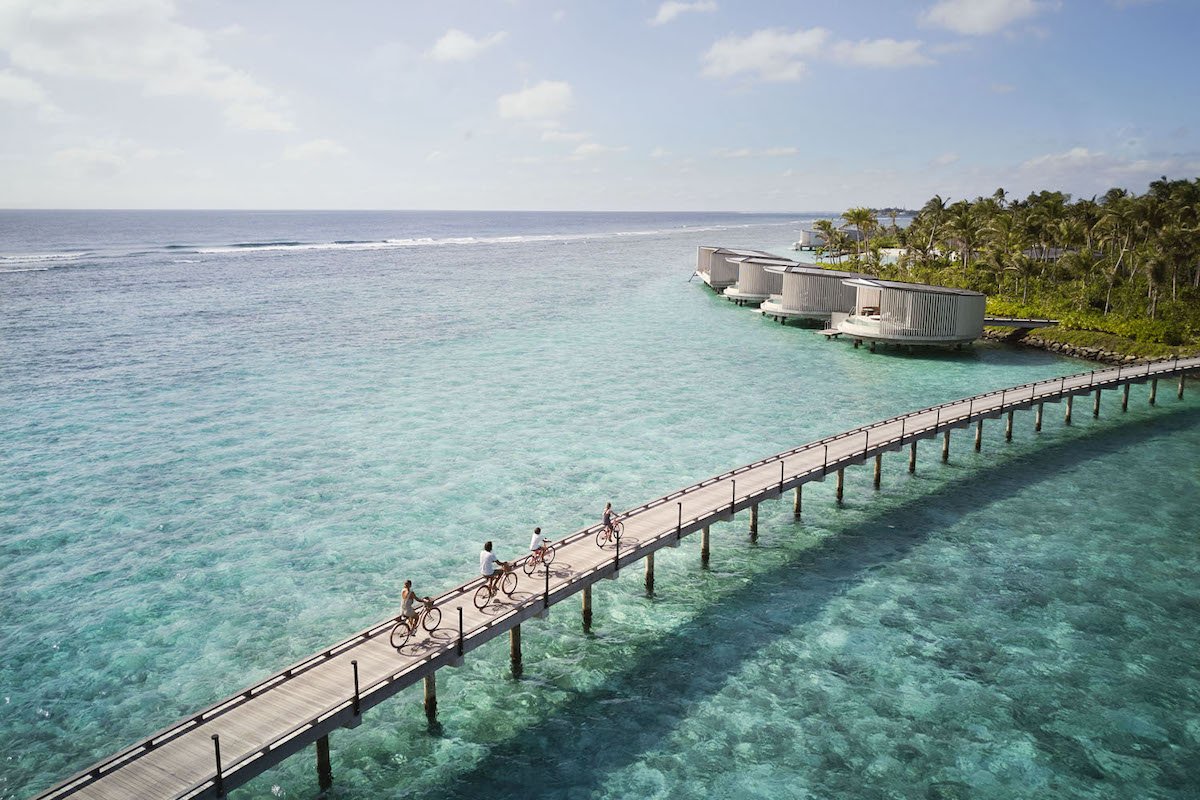
For the 2021 opening, Brandman says it secured more than 70 pieces of coverage. The property appeared in Condé Nast Traveler, Travel + Leisure, Robb Report, Architectural Digest, Town & Country and other outlets, then landed on prominent hotel and design lists. The agency put the estimated audience above 334 million.
The giant number is the least portable lesson. Impressions are estimates of possible exposure, not a head count of future guests. The useful part is the multiplication of angles. Architecture belongs to one editor. Sustainability belongs to another. A first-person visit, a design award and a new-hotel list all have different clocks. One set of doors can therefore “open” repeatedly, provided the story changes with the audience.
A life inside the lobby
Melanie Brandman did not arrive at this work from a general advertising shop. Before founding the firm, she spent 15 years with InterContinental Hotels Group, ultimately leading global public relations. She had also worked on the editorial staff of Vogue Australia. One institution taught her the machinery of hotels; the other taught her that presentation is part of the product.

Moving to New York and starting a consultancy was not, according to the agency's anniversary account, a master plan. It grew out of industry knowledge and relationships. Current company listings date the founding to 2000, though an Inc. profile published in 2012 said 2001. The discrepancy is small and oddly appropriate: consultancies often begin as a person helping a client before they become a company with an anniversary.
The firm now works across New York, Los Angeles, London, Sydney, Charleston and Palm Beach. Its public client roster reads like a particularly ambitious itinerary: The Peninsula Hotels, Six Senses, Regent, Raffles Singapore, La Mamounia, The Ritz-Carlton properties, Explora Journeys and destination organizations. The company competes with specialist travel agencies, global communications networks and the in-house teams at hotel groups. Its claim to difference is depth: years inside the category, senior counsel and relationships accumulated across several media cycles.
In luxury travel, the press release is rarely the product. Access, timing and a credible reason to care are.
The operating idea behind the portfolio
The year every door closed
Then, in 2020, the travel industry lost its basic verb. People stopped going.
Brandman's response was not to pretend the interruption was another lifestyle trend. In an industry essay that July, she argued that reopening could be treated as a rare second debut. Hotels had concrete new information to explain: reduced capacity, sanitation, booking flexibility, outdoor experiences and the growing appeal of less crowded destinations. The story had changed because the traveler had changed.
This was the first large, publicly documented disruption to the model, not evidence of the agency's first failed campaign. The distinction matters. There is no reliable public account of a specific Brandman project failing first, and campaign costs are private. What can be observed is the adjustment: reopenings became launches, practical reassurance became part of luxury messaging, and digital channels became more central.
By 2022, the agency described a fully integrated digital and social operation. It had also brought crisis management and media training into a partner program. The following year it added media planning and paid campaigns. The shift was less a rejection of earned media than an admission that the old press clipping no longer completed the journey.
A publisher on the other side of the agency
Brandman's most unusual extension is Travel Curator, the luxury-travel publication Melanie Brandman founded in 2011. The company says it reaches more than 650,000 subscribers. Through a Content Studio, the publication creates and distributes material for hospitality brands, giving the agency a route into paid media as well as earned coverage.
That can solve a familiar client problem. An editor may decline a pitch for reasons unrelated to quality: the calendar is full, the destination ran recently, or there is no news. Paid distribution guarantees space and control. Earned coverage offers something else - an independent outlet's decision that a story belongs. The formats can support each other, but they should not be collapsed into one result.
This dual structure also reveals the firm's business model. Brandman sells bespoke professional services, usually as an ongoing relationship or a defined campaign. Travel Curator adds a distribution product. There is no public rate card, and there is no disclosed outside funding or valuation. The supplied firmographic estimate puts annual revenue at about $5.3 million, but it is not independently verified.
The invoice has more than one line
What does this cost? The honest answer is not published. A prospective client should resist comparing two agency proposals by the retainer alone. A hotel launch can also require travel, photography, video, an event, creator arrangements, product, shipping and paid media. Some are agency fees; others are production or pass-through expenses. The clean brief separates them.
It should also name the desired result. “Make noise” is expensive because it cannot be finished. A more useful assignment might be to establish a new resort's design credentials in the United States, or to reach families in a particular market before the winter booking period. Once the audience and action are explicit, the agency can decide whether the answer is an editor visit, a creator partnership, a social series, a paid Travel Curator feature - or no event at all.
The limitations follow from the same logic. The method weakens when there is no newsworthy change, no access, poor visual material or a celebrity partner whose audience has little in common with the guest. It also weakens when approval cycles outlast the news. Relationships can open an email. They cannot make a vague claim interesting.
The part worth copying
In March 2026, the company marked 25 years with a refresh. “The Brandman Agency” became “Brandman.” The shorter name works because the long work came first. A surname had accumulated enough associations - luxury travel, discretion, editorial access - to carry the business by itself.
That same month, Brandman handled the American launch of Explora Journeys' “Explore the Ocean State of Mind” campaign. The sequence included a Forbes.com exclusive, coordinated embargoed coverage and a New York gathering for more than 160 journalists, travel advisors, partners and tastemakers. It is a compact example of the model: one message, several audiences, ordered release.
The reader need not run a Maldives resort to borrow the idea. Begin with the calendar. Write down every moment when the same development becomes newly relevant to a different person. Decide which audience deserves an early look, which needs proof, and which needs a practical invitation. Keep paid placement separate from independent coverage. Then measure the action after attention, not just the attention itself.
A hotel opens when the keys work. A reputation opens when the right person can explain why those keys matter. Brandman has built a business in the interval.