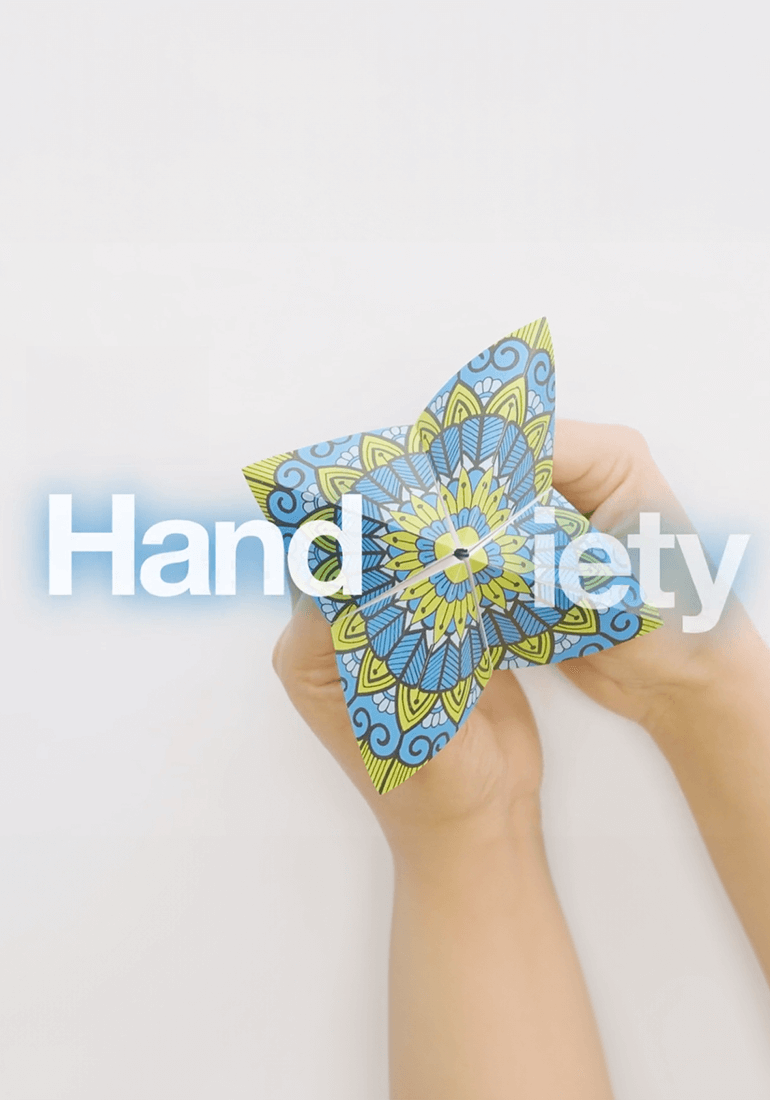
A folded paper fortune teller is an odd object to find in a healthcare agency’s portfolio. It belongs to the world of playground predictions: pick a color, choose a number, open a flap. In The Bloc’s Handxiety work for BrainTap, that familiar object becomes a grounding aid. Hand movements and guidance in a therapist’s voice address a practical problem: the therapist cannot accompany someone through every anxious moment.
- The Bloc helps health organizations turn scientific information into campaigns, education and engagement.
- Its BE-COMMS method starts with the behavior a client wants to change.
- The business combines creative work, medical expertise and international market knowledge.
The object is modest. The question behind it is large. What happens between receiving useful advice and being able to use it? Healthcare communications often live in that interval. A message can be accurate, carefully approved and beautifully produced while leaving the next decision untouched.
Before the campaign, the diagnosis
The Bloc calls its approach BE-COMMS, short for Behaviorally Enriched Communications. Its four stages are Understand, Define, Activate and Optimize. Those verbs organize the work from investigating an audience’s decisions to refining the resulting communication. The promise is to make behavioral thinking part of the brief, rather than an explanation attached after the creative team has finished.
Consider the difference between an audience that lacks information and one that lacks an opportunity. More explanation might help the first. The second could understand perfectly and still face a closed door. A third audience might have knowledge and access but feel little urgency. Treating all three as an awareness problem would produce a very tidy campaign with a very untidy premise.
- 01UnderstandFind the barrier
- 02DefineChoose the action
- 03ActivateDesign the encounter
- 04OptimizeMeasure and refine
In January 2026, a perspective paper by Bloc employees and an academic collaborator described the method’s foundations, including the established capability, opportunity and motivation model, COM-B. One epilepsy workshop identified more than 120 barriers and drivers around a single target behavior. That is a useful rebuke to the idea that a reluctant audience needs only a louder message.
The paper also supplies a necessary boundary: the authors call their analysis non-systematic. It explains a working approach and accumulated experience. It does not establish that every Bloc campaign improves clinical outcomes. For a prospective customer, that distinction suggests a sensible question: which specific behavior will this engagement measure?
Give the doctor a reason to play
The portfolio makes the method less abstract. For LEO Pharma, eLEOmental turns dermatological cases into an online game for dermatologists, pediatricians and primary care physicians. The audience encounters a challenge, with medical knowledge embedded in an experience that asks for participation. The creative decision concerns the form of learning as much as the wording.
Novo Nordisk’s Speak Liver addresses a different obstacle: a disease that can remain quiet. The campaign introduces the language of liver health around MASH, using visual storytelling tied to personal identity. Handxiety, meanwhile, puts guidance into an object someone can handle. These projects occupy different formats because their intended encounters differ.
“Our creative process has always started with understanding why people behave the way they do.”Jorge Munoz / creative director
There is a lesson here for anyone buying creative work. Ask the agency to describe the moment it wants to alter. Is someone deciding whether to seek information, return to a learning experience, or use a coping technique? A format becomes easier to judge once the intended action has a name.
The business behind the brief
The Bloc sells professional agency services to health organizations, from large pharmaceutical companies to smaller biotechs bringing a first product to market. Its remit includes brand strategy, creative campaigns, scientific communication and engagement across channels. The Value Builders, its sister agency, brings market access expertise, including the value arguments that matter to payers and reimbursement decisions.
This combination reflects the fragmented route from a treatment’s promise to its adoption. A patient, a clinician and a payer have different questions. A brand team may need an agency capable of speaking to each without losing the underlying science. The Bloc’s commercial proposition sits at that intersection of medical knowledge, persuasive communication and delivery.
The company’s 2026 agency profile reports 26 active business clients and more than 20 percent growth over the previous year. Those are agency-reported business figures. The same profile describes an internal platform, Bloc VIVD, supporting work across strategy, creative, engagement, analytics and project management. The framework and tools sit inside a services business whose output still depends on people doing the work.

Independent, with more places to go
Susan Miller and Rico Viray founded the agency in July 2000. Its stated mission, “Be Great To Do Good,” is accompanied by five cultural values: Passion, Respect, Integrity, Diversity and Excellence. The company presents itself as women-owned and independent. Jennifer Matthews now leads it as global CEO and president.
Independence still requires a credible answer when clients need international execution. In 2023, The Bloc announced acquisitions of Italy’s thenewway and Switzerland’s X-Ray, alongside a German joint venture with Serviceplan Group. London followed in 2025. In July 2026, Jon Chapman joined as European executive creative director. These moves put more capability behind the global proposition.
The expansion has a less glossy prelude. In its 2023 agency profile, leadership acknowledged account losses during 2022 alongside wins. The subsequent push toward a unified global business followed a period containing both. That sequence is worth remembering when considering agency growth: new offices coexist with the continuing need to retain clients and win assignments.
An idea worth borrowing
A team borrowing from The Bloc can begin with a short exercise. Write down the action you want, identify what prevents it, and decide how you would observe a change. Then choose the channel and creative treatment. This is an editorial reading of the method, and a useful discipline even without a proprietary toolkit.
It also makes the limits visible. If the obstacle is affordability, appointment capacity or unavailable care, communication needs an operational partner. A compelling message cannot supply the missing appointment. The interesting test for The Bloc is whether its diagnosis leads to an intervention suited to the real constraint. Sometimes that intervention may be as small, and as carefully considered, as a folded piece of paper.