Thar Casey’s latest business proposition involves moving something a very short distance. The destination is the underside of a server motherboard, directly beneath an AI processor. In a field preoccupied with the next model, the next chip and the next enormous building, he is asking people to consider the commute electricity makes before the computing even begins.
It is an agreeably awkward pitch. A processor can command the attention of an entire industry; the equipment feeding it power usually gets invited to the conversation when something goes wrong. Casey, founder, president and CEO of AmberSemi, has built his current argument around that overlooked equipment. Give the current a shorter route, his company proposes, and more of the electricity can reach the place where it earns its keep.
There is a certain continuity here. Before AmberSemi, he ran a fingerprint-technology business. Before PowerTile, the company’s AI-focused power device, he was talking about wall switches and circuit breakers. Across those changes, Casey keeps returning to the bits of infrastructure people use without giving them much thought. Familiarity, in his line of work, can conceal a business opportunity for years.
A fingerprint before a power switch
Casey’s route into semiconductors came through running companies. He holds a bachelor’s degree in business administration from California State University, Hayward. His earlier positions included vice president of finance at Monterey Bay Bank and founder and CEO of Phantom IT Solutions. Finance and operations are part of his professional foundation, rather than a late addition to a laboratory career.
He went on to become co-founder, president and CEO of PicoField Technologies, which worked on fingerprint sensing. In September 2013, IDEX acquired PicoField’s technology and intellectual-property assets and brought members of its executive team aboard. Casey became president of IDEX America, based in Silicon Valley.
The distinction between an invention and a business runs through that history. A sensor has to find its way into somebody else’s product. Its maker needs relationships, engineering capacity and a route to manufacturing. Those concerns would follow Casey into electricity management, where a persuasive demonstration is only the beginning of a customer’s decision.
Amber began in December 2016. Casey and chief scientist Mark Telefus were looking at power and control with a question broader than how to improve an existing component. They wanted to consider a different way of doing the job. The first arena was the electrical hardware already sitting in buildings: familiar objects whose exteriors gave little indication of the work required to redesign their insides.
The wall had a space problem
A wall switch has an unglamorous constraint: it must fit in the wall. Circuit breakers have their own fixed accommodations. Adding connectivity, sensing or control means finding room inside a product whose dimensions customers and installers already expect. A clever feature that requires rebuilding its surroundings has an additional sale to make.
Amber’s early work sought to replace bulky electrical components with semiconductor-based conversion and switching. Its AC/DC technology was designed to extract usable direct current from the alternating-current supply. Its switching technology addressed controlling and interrupting power without the moving contacts of an electromechanical device. The aim was to create room for intelligence inside established electrical forms.
Casey needed other companies to see a reason to adopt it. In 2021, Amber and Infineon announced a collaboration spanning smart breakers, switches and outlets, alongside exploration of broader semiconductor applications. The arrangement paired Amber’s architecture with an established supplier’s power-switch and control technology. An invention with ambitions for the wall had acquired a route into conversations with the people supplying it.
Nordic Semiconductor followed with an exploratory partnership in November 2023, covering sales, marketing, development and reference designs. In January 2025, Jasco announced a partnership to explore bringing Amber’s power technologies into its electrical-product portfolio. These were specific development relationships. Their language also captured how much adoption still depended on testing, integration and a customer’s own product decisions.
Lateral delivery: current travels across the board.
Vertical delivery: place conversion beneath the processor.
Then the customer’s problem changed
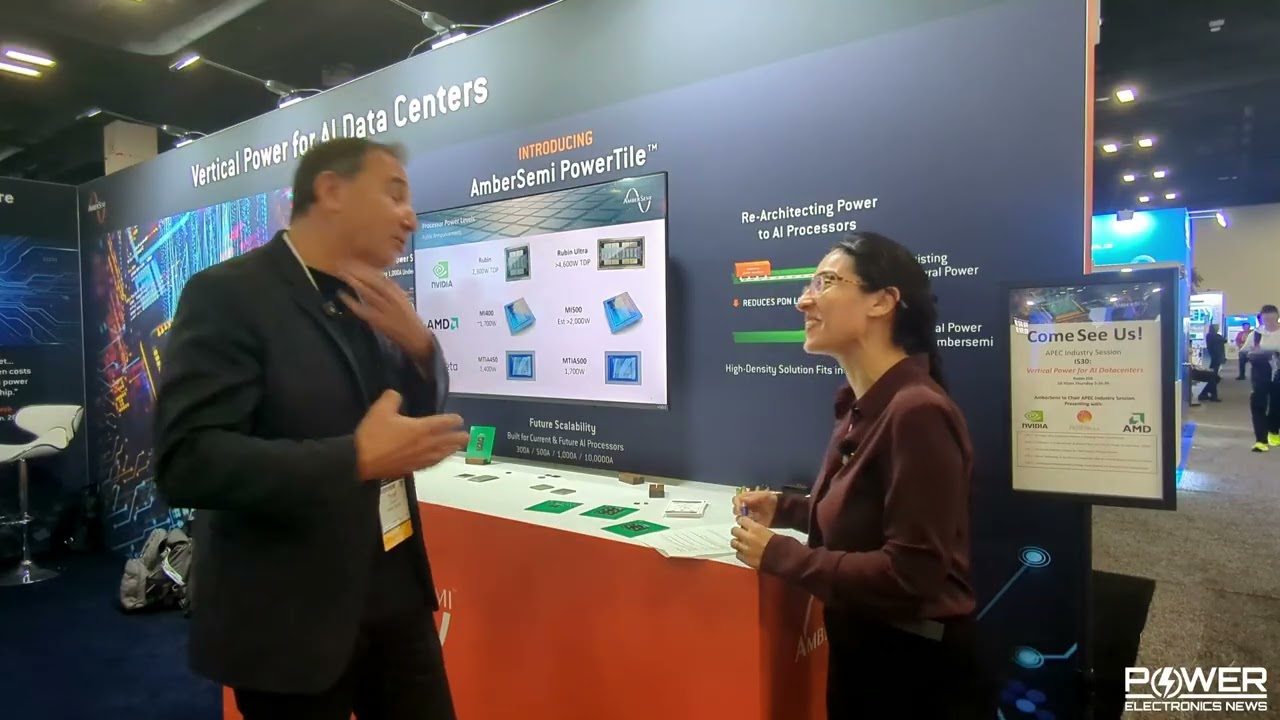
By March 2025, Amber was publicly describing a power-delivery initiative for AI data centers, targeting conversion from 50 volts to roughly 0.8 volts at the processor. Casey presented the work at the Applied Power Electronics Conference in Atlanta. The company that had spent years explaining electrical outlets was now explaining the journey from a server’s power supply to its computing silicon.
The connection was power management, but the urgency was different. AI processors demanded more power in tightly constrained spaces. Casey saw a reason to apply Amber’s work to that problem. At the 2026 conference, he described a deliberate decision to pause other initiatives and concentrate the company’s resources on AI power delivery.
For a founder accustomed to describing many possible applications, choosing fewer is a consequential act. Each paused project represents an opportunity that must wait. It also frees engineers and money for a product with an immediate customer requirement. Running a small semiconductor business means deciding which promising problems the available team can actually finish.
“In a company of our size, you can’t afford to be distracted.”
Thar Casey, APEC 2026 interview
PowerTile gives that choice a physical shape. AmberSemi describes a module measuring 20 by 24 millimeters and 1.68 millimeters high, designed to supply up to 1,000 amps from beneath a processor. Its January 2026 announcement reported a completed tape-out, the design milestone that precedes fabrication. The company says multiple devices can be combined for larger current requirements.
The small dimensions are central to Casey’s pitch. There is limited clearance beneath the processor, and customers supply the requirements. He has explained that a taller solution would be easier to build; the exercise is making one that fits. A blank sheet of paper still has to respect the dimensions of somebody else’s machine.
AmberSemi claims more than an 85 percent reduction in power-distribution losses to the processor with its vertical approach. That is a claim about the delivery path, with a particular comparison behind it. It should be read at that scale. Turning a component-level improvement into an operational benefit depends on the system in which customers put it.
For Casey, the drawing is also a sales problem. The shorter path is easy to sketch. A customer considering a new board design has to weigh the work of adopting it. That is where the operating side of his career meets the architecture he is trying to sell.
The part that does not fit on a chip
In July 2025, Casey attended the energy and innovation summit at Carnegie Mellon University in Pittsburgh, alongside executives from large technology, energy and investment firms. His presence put Amber’s small team in a discussion about national-scale computing infrastructure. His own business remained concerned with what happened inside the server.
There is a useful difference in scale between those conversations. New energy supply involves sites, construction and long planning cycles. Casey’s proposition is to improve how the available electricity is delivered. The two efforts can coexist. His ambition is to make Amber’s work useful to data centers around the world, rather than tie its relevance to one building or one source of energy.
Money is another requirement that refuses to shrink. On March 10, 2026, Amber announced the initial closing of a $30 million Series C round. The stated purposes included product development, customer engagement and commercialization. The announcement set a target for shipments to major customers in the third quarter of 2026. Earlier guidance had described material production volumes in 2027.
Those milestones mark different kinds of work. Completing a design, getting devices into customers’ hands and supplying production quantities each require further execution. Casey’s job stretches across them. He has also discussed building a manufacturing supply chain with established partners, a practical response to customers asking whether a small supplier can support a large deployment.
He sounds less like a semiconductor evangelist when he discusses hiring. In March 2026, he described a team of close to 30 and plans to grow toward 50. He linked those decisions to responsibility for employees and their families. Growth commits a company to people as surely as a product roadmap commits it to engineering.
Leave some room to think
Casey’s public account of his own routine has a quieter rhythm. In 2020, he described reaching his office at six in the morning to organize the day before its demands took over. Away from work, he spoke about family weekends, hiking and horseback riding with his wife, and early kayaking. The attraction was a chance to clear his head.
His advice to aspiring entrepreneurs put support and capable colleagues alongside the product itself: “You need people in your corner.” That is a revealing emphasis from someone selling a change to established hardware. A founder can propose the architecture; bringing it into use requires a much larger cast.
He can also be funny about the limits of an interview. Asked at APEC about the technical ingredients behind PowerTile’s thin construction, he described integrated silicon and magnetics, then declined to go further. “They’d strangle me,” he joked. Even a founder with a lengthy explanation has colleagues who would prefer a shorter one.
Casey’s career has brought him from finance to fingerprints to the underside of an AI processor. The current task joins those experiences: explain the unfamiliar, fund its development and make it dependable enough for somebody else to use. The device must fit in a space measured in millimeters. The business has to carry everything around it.