Three hours a day in Los Angeles traffic is an expensive way to discover what matters. When Tevis Houston’s department closed, she had a one-year-old child and the prospect of a commute that would swallow a substantial part of the day. Her next move had to answer a domestic question as well as a professional one: how could she keep doing the work she cared about without arranging the rest of her life around the journey to it?
The business that followed would eventually become Friends Everywhere. Its cheerful name arrived later, in 2023, as the next phase of TH Creative Co. The underlying decision dated back a decade. Houston had needed a workable alternative. That makes her founder story particularly easy to recognize: the beginning was a closed department, a calendar and a problem that would still be there on Monday.
Her explanation remains remarkably direct. She wanted a way of working that respected both her personal and professional priorities. There was ambition in that calculation, but also arithmetic. A good career had to leave enough of the day for a life.
Before the name, the working idea
Houston’s experience inside Quiksilver had already given her a possible answer. When the creative work required skills her internal team could not reasonably keep on payroll, she brought in small specialist crews. She briefed them and directed the work. The useful unit was a group assembled around the job, with someone inside the brand who understood what needed to happen.
When the division disappeared, other brands began asking for similar help. A method developed within one organization could travel to another. The move into independent work therefore carried something valuable with it: an understanding of the customer’s daily responsibilities. Houston knew the position on the other side of the brief because she had occupied it.
That distinction helps explain the agency she later named. Friends Everywhere works with people inside brand and marketing departments, connecting creative work with the practical arrangements that let it happen. The buyer already has ideas, colleagues and obligations. An outside partner has to enter that existing world without requiring everyone to start again.
“I needed a new way to work”
TEVIS HOUSTON
A snowboard education
Long before this became a question of agency structure, Houston’s interests ran through snowboarding, product design and community. Her early career included JDK, the design agency closely associated with Burton Snowboards. That connection placed the work near the people who used it. A snowboard brand had a world around it, and design belonged to that world.
Houston still names the people who shaped that period: Michael Jager, Giovanna Di Paola Jager, Jared Eberhardt and Lance Violette. She credits them with encouraging curiosity and teaching her to treat a brand as something that requires continuing care. It is an education with a longer horizon than the next campaign deadline.
The connection between those interests and her later work is visible without turning a hobby into a business prophecy. Fashion and youth culture recur in her professional story. So do communities with their own references, tastes and ways of recognizing one another. Making work for those audiences involves paying attention to what they already love.
That early setting also gives the name Friends Everywhere a certain logic. Her account of learning the business contains actual people, named individually. The relationships have survived long enough to remain part of how she explains her work. A founding story can have a cast, rather than just a protagonist.
Springfield, with a production schedule
Consider Levi’s x The Simpsons, where Houston and Liam Cassidy share the creative-direction credit. The project uses the show’s school-age world and its awkward, unruly adolescence as a connection. Denim meets a fictional community whose characters have long since escaped the television screen. The appeal depends on recognition, with room for a joke.
The credits make the collaboration concrete. Sandy Kim supplied the photography; Tsuruda Studio handled production. Hayley Kaufman and Victoria Dinamp worked on copy, Konyin Ayuba on design, and Levi’s internal team on styling. There are several kinds of authorship in an image that a viewer might take in within a second.
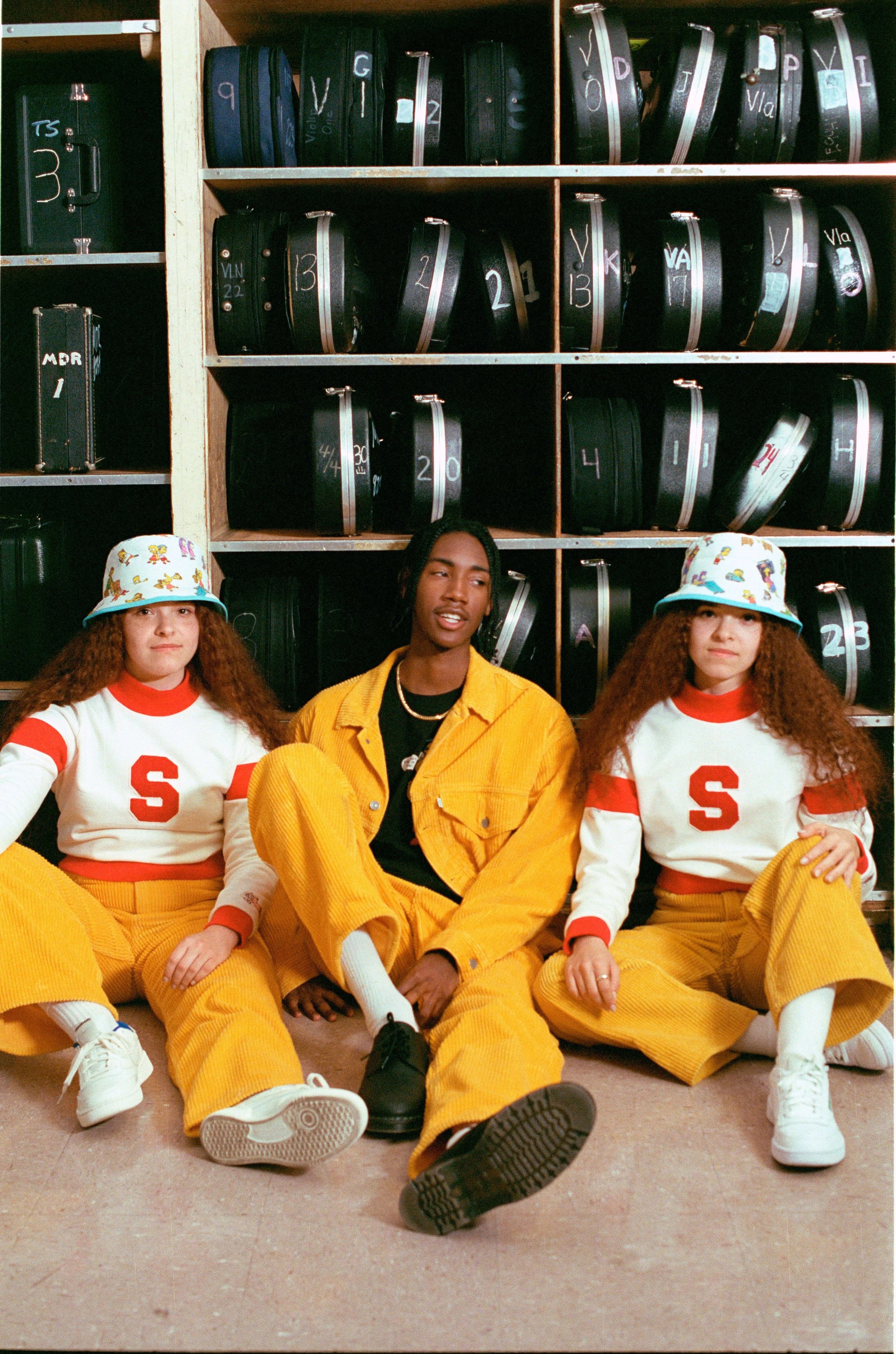
Houston’s work also appears in the less glamorous places where a campaign becomes useful. Designer Adam Ebert credits her and Cassidy for creative and art direction on Levi’s campaign support, describing his own work translating imagery into store signs, outdoor marketing and media ads. The picture needs a second career after the shoot.
That is an illuminating detail in a creative director’s story. A beautiful image has to survive a change of scale, a different setting and a customer who may be walking past. Someone has to consider those destinations. The work continues beyond the moment when everyone agrees that the photograph looks good.
The campaign and the machinery
Friends Everywhere’s services put four disciplines together: operations, strategy, creative direction and content production. Operations appears first. That ordering gives everyday matters such as responsibility, workflow and distribution a place beside the idea itself. A campaign can encounter trouble in any of those places, however persuasive its initial presentation.
The agency’s description of its work is specific about the friction: teams operating in silos, unclear ownership, material produced without a distribution plan. These are recognizable obstacles for anyone who has watched an approved idea make its way through an organization. A new tool can join that journey. It still needs a sensible place to sit.
Operations02Think
Strategy03Ideate
Creative direction04Make
Content production
Its Levi’s case study offers a concrete example of planning for multiple uses. For Give Better, the agency reports seven mini-campaigns and 250 pieces of content from a two-day shoot. Those figures describe production output, rather than sales or audience response. Their interest lies in the relationship between a creative device and the many things a brand needs to publish.
The portfolio labels Give Better as a 2022 project, before the Friends Everywhere launch. Keeping that date in view preserves the continuity of Houston’s career. A later company identity can carry earlier experience without moving the work forward in time. The people and their practice existed before the announcement.
A community of people who own the problem
Houston’s interest in professional relationships extends beyond the client roster. When Christy Hiler and Jean Freeman began Own It, their discussion of agency ownership caught her attention. She wrote that she listened to the first podcast episode three times in succession. Repetition is a fairly convincing review.
She later met Hiler and attended Own It’s first in-person summit in New York in February 2024. In May, she appeared on the podcast herself. The conversation covered her journey, building professional relationships, measuring success and the ownership gap facing women in the agency industry. Her story had become useful to other people considering the same step.
At another Own It gathering, she returned with notes on teams, pitching, legal questions, public relations and planning for the future. Her public recap thanked people by name and described the value of owners supporting one another. Here was a different kind of creative network: people discussing the obligations that arrive when your name is attached to the business.
It adds a useful dimension to the word founder. Owning an agency means making the work possible for other people too. Colleagues need direction; clients need continuity; the business needs decisions. A roomful of peers can offer perspective on responsibilities that rarely appear in a campaign credit.
Keeping a hand on the decisions
Houston’s more recent reflections turn to a question facing creative teams now: how much thinking to hand to artificial intelligence. She describes practical uses such as preparing for meetings, bringing research together and checking a brief. She also draws boundaries around her own opinions, voice and creative judgment. The distinction depends on the task.
It is a considered position for someone whose company includes systems in its creative offer. Improving the process still leaves choices to make about the work. Her interest is in figuring out which assistance is useful and where personal experience should remain decisive. Efficiency does not settle every question of taste.
The same concern runs through her focus on making room for diverse perspectives in creative leadership. Her career began close to a particular community; her business grew from understanding another group, the people working inside brands. Both require attention to the humans doing the choosing, making and receiving.
Return to the original calculation and the continuity becomes clear. Houston needed work to function differently, so she built a business around a way of working she understood. Years later, she is still dealing with the arrangements surrounding creative work: who helps, who decides, how the pieces travel and what deserves someone’s time. Three hours in traffic was a formidable place to begin thinking about that last question.