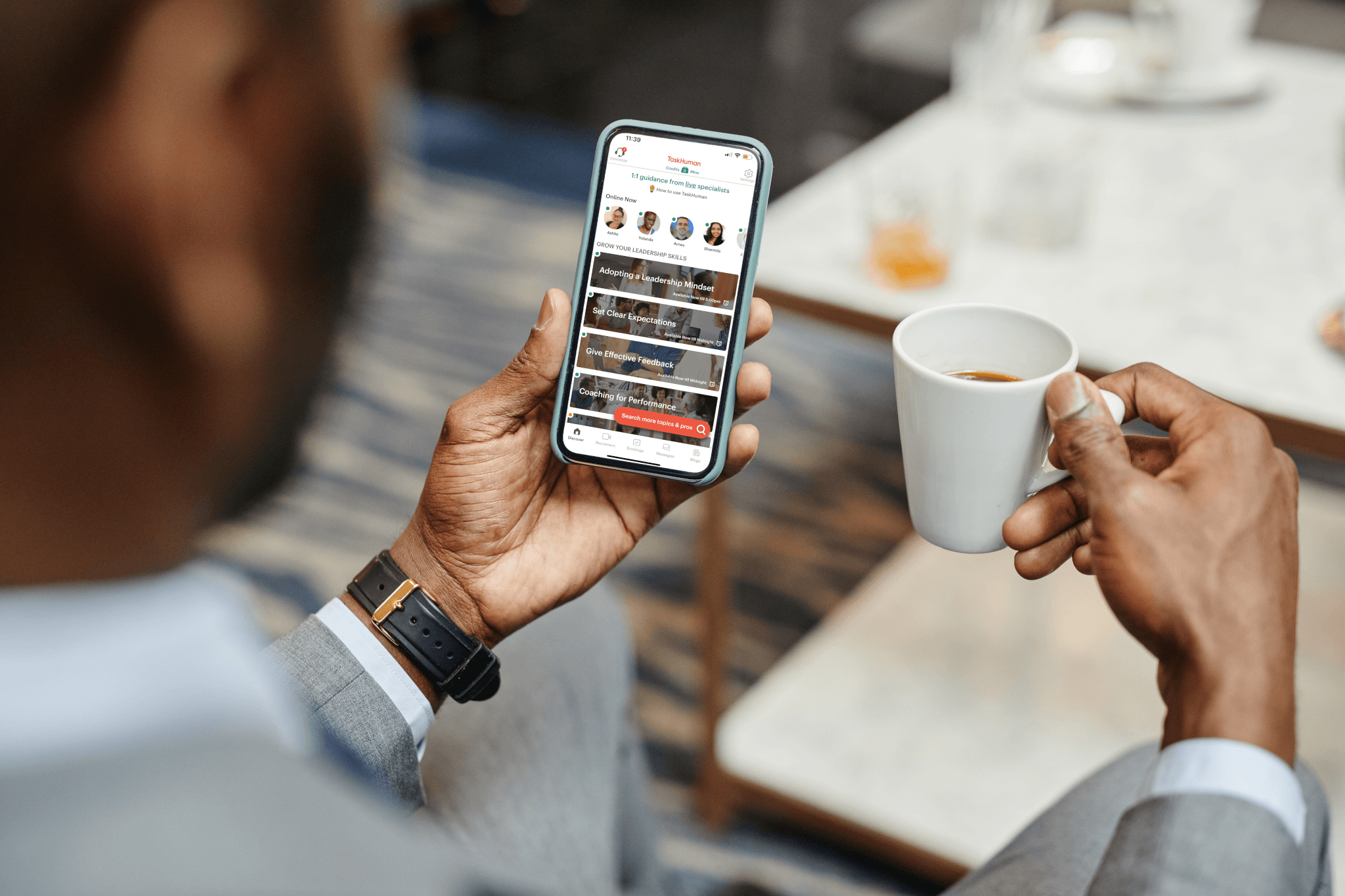
That is the everyday picture inside TaskHuman, the Palo Alto company quietly building what may be the world's largest network of one-on-one human coaches. Not chatbots dressed up as coaches. Not pre-recorded webinars. Actual specialists, on actual video calls, at any hour an employee happens to need one.
The company is seven years old. It has about 230 staff, more than 1,000 contracted coaches, and a customer list that includes Juniper Networks, Zoom and Boomi. It does this in roughly 50 countries. It does most of it without anyone knowing the brand outside of HR departments and the people who use it - which, depending on your read of the market, is either a problem or the whole point.
Coaching used to be a perk for executives. TaskHuman quietly turned it into a benefit for everyone else.
- The thesis, in one line
01The problem they saw
Coaching has always worked. The catch is that almost nobody had access to it. Executive coaches charged the kind of fees that meant a Fortune 500 company could send the C-suite to coaching and call the budget spent. The Vice Presidents got off-sites. The directors got books. The individual contributors - the people doing the actual work - got an EAP brochure and an annual survey asking why they were burning out.
The math was uncomfortable. Coaching changed careers and changed lives, and the people most likely to need that change were the least likely to receive it. Wellness apps tried to fill the gap with content libraries: meditate to this, journal to that. Useful, but lonely. The thing that actually moves people - another human paying attention to them - was missing from every product on the market.
TaskHuman's founders saw that gap and made an unsubtle bet: if coaching at scale was a logistics problem rather than a content problem, then the answer wasn't more content. It was a marketplace.
The whiteboard, day one. One axis: skills. Other axis: humans. Nobody had drawn the grid before.
02The founders' bet
Ravi Swaminathan, the CEO, had spent roughly two decades in big tech - Ericsson, Dell, Motorola, SanDisk - moving through engineering, product marketing and corporate strategy before he started thinking about wellness as a software category. Daniel Mazzella, the CTO, brought the engineering muscle. They co-founded TaskHuman in 2017 with a thesis that ran counter to almost every wellness app then being funded: people don't want more content. They want another person.
It was, on its face, the less scalable bet. Content scales beautifully. Humans don't. But the founders had figured out something subtle. If you could connect users to live specialists on demand - across enough topics, in enough time zones, with low enough switching costs - the marketplace would do the scaling for you. The platform would not need to employ thousands of coaches. It would need to find them, vet them, and route the right one to the right call at the right time.
Content scales. People don't. Marketplaces do the scaling for you - if you build the routing right.
- The unfashionable bet
03The product, plainly
Strip away the marketing and TaskHuman is straightforward. An employer pays a per-seat subscription. Every employee gets the app. Inside the app are coaches - not headshots of celebrities, but searchable, bookable specialists across roughly a thousand skills. Yoga. Leadership. Sales calls. Sleep. Stretching. Public speaking. Calisthenics. Career transitions. Stress management. Pet training, for some reason. Travel planning, for another.
An employee opens the app, searches a topic, picks a coach, and dials in. It is intentionally not complicated. The complication lives below the surface - in coach vetting, in routing, in scheduling, in the unsexy mechanics of running a managed marketplace across fifty countries and as many time zones.
If that sounds suspiciously broad, it is - and the breadth is the product. A leadership coaching company that only does leadership coaching has to convince a CHRO that leadership is the right wedge. TaskHuman doesn't have to argue about wedges. Whatever the workforce needs at 9 a.m. on a Monday, the app probably has a person for it. That is harder to copy than it looks.
Browse the catalog and you'll find pet coaching listed next to executive coaching. This is not an accident.
How it happened
A short walk through the milestones
2017
FoundedRavi Swaminathan and Daniel Mazzella start TaskHuman in Palo Alto with a thesis that 1:1 coaching belongs to everyone.
2019
Early CoachesThe marketplace fills in, one specialist at a time. Wellness comes first - leadership and sales follow.
2021
Series A · $9.5MUSVP, Madrona, RingCentral Ventures back the platform as enterprise pilots convert.
2022
Series B · $20MMadrona leads. Zoom Ventures joins. Total raised passes $35M. Coach network passes 1,000 across 50 countries.
2023
Executive Team ExpandsNew senior hires to support global growth and enterprise sales.
2024+
Going Wider100+ enterprise customers. Catalog grows past 1,000 skills. Integrations with Zoom, RingCentral and Slack ship.
04The proof
The investors got there before most of the press did. By mid-2022, Madrona was leading a $20 million Series B with USVP, Impact Venture Capital, RingCentral Ventures, Sure Ventures and Zoom Ventures on the cap table. The Zoom signal is not trivial: when the company whose product carries every coaching call decides to take equity, they are voting on the workflow as much as the company.
The customers got there in their own time. Juniper Networks rolled it out across teams in 64 countries. Boomi joined. Zoom became both an investor and a customer, which is the kind of compound endorsement that happens when a product is genuinely useful and not just well marketed.
The shape of TaskHuman, in four numbers
Approximate scale · 2024
When Zoom Ventures puts money on a coaching company, they are voting on the workflow, not the brand.
- A read on the cap table
05The mission, in a sentence
TaskHuman wants every working adult to have a coach. Not a chatbot. Not a content library. A person, on demand, in the moment they need one. The phrasing on the website is gentler than that, but the company keeps that single idea close enough to the surface that every product decision can be traced back to it.
There is a quiet political claim folded inside that mission. It says that the productivity gap between executives and everyone else is not really about talent, or even time. It is about access - to the kind of attention that helps a person decide how to handle a hard meeting, or how to recover from a bad quarter, or how to sleep. The platform argues, in product form, that giving more people that access is both good business and good for the workforce. It is the rare claim that holds up either way.
06Why it matters next
The bet ages well. Hybrid work made workforces lonelier. AI tools made the work itself faster, which is to say more relentless. Burnout went from buzzword to budget item. Companies that figured out that culture is a real cost line are looking, sometimes desperately, for benefits that work for everyone and not just the people who already had options.
TaskHuman's competitors in pure executive coaching are well funded and famous. The opening TaskHuman is widening into is different: not the CEO who already has a coach, but the customer success manager in Lisbon, the engineer in Bangalore, the new parent on the operations team in Austin. The mass market for live, personal coaching has not really existed before. TaskHuman is building it anyway, one specialist at a time.
Back to the sales manager in Singapore. The call ends. She closes the laptop. The deal goes a little better the next day. Nobody writes a case study about that call, because case studies are for moments that look big. The whole TaskHuman thesis is that the moments that change a workforce are, mostly, small. A lot of small moments. A lot of small calls. A lot of humans, picking up.