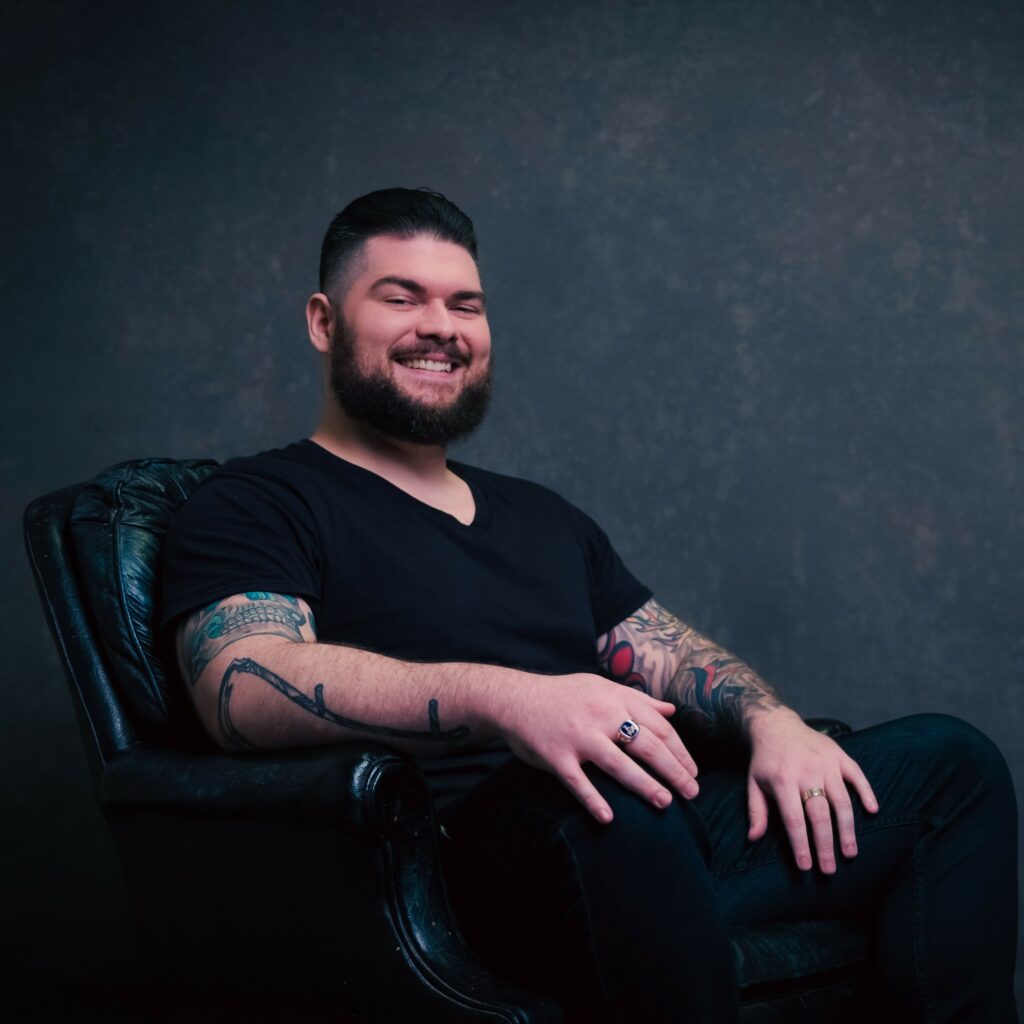
Profile
He was in a hospital bed during a pandemic when he finally asked the question. Not "what should I do with my life?" but a sharper one: "If this were my last week alive, am I satisfied?" The infection was close to septic. The answer was no. That's where the pivot started - not with a vision board or a business plan, but with the simple, clarifying terror of almost not being there.
Corey Wilks, Psy.D. spent fifteen years inside the clinical psychology system. Not the romanticized version - the insurance-driven machine that funds treatment until patients become "subclinical" and then cuts them off. The system was built to help people survive. Corey kept wanting to help people thrive. The mismatch wore on him the way a shoe slightly too small wears on a foot - quietly, then not so quietly.
Then 2020 happened. He got fired when his employer ended remote work policies. He had minimal savings and a 4-6 month delay on getting licensed in his new state. The clinical world was waiting for him to come back. He didn't.
The Holler and the Hustle
Before Austin. Before the Psy.D. Before fifteen years in clinical rooms. There was a holler in Appalachia - a hollow between hills in West Virginia, the kind of place that doesn't usually produce executive coaches to VC-backed founders.
He grew up in poverty, with divorced parents, in a region where certain expectations come baked in. He spent years erasing his Appalachian accent, believing that successful people didn't sound like him. Then in college he stopped trying. He reconnected with the accent, the roots, the origin story. "Successful people don't have to sound a certain way" turned out to be a revelation that reframed everything else. The thing he'd spent years hiding became the thing that made him real.
That pattern - running from a perceived liability until you realize it's actually an asset - became a recurring theme in his work. The accent. The background. The clinical credential that most coaches try to downplay. He leans into all of it.
"You don't have a lack of discipline. You have an abundance of fear."
- Corey Wilks, Psy.D.What Creator Alchemy Actually Is
The word "alchemy" is doing a lot of work here - and on purpose. It's not just a brand; it's a claim. The premise is that psychological transformation is the missing variable in most business conversations. You can have the right strategy, the right market, the right timing. And still freeze. Still self-sabotage. Still pick the easy task over the important one until Tuesday becomes Thursday becomes next quarter.
Creator Alchemy is the umbrella: a weekly newsletter, a podcast with 45+ episodes, a paid community on Circle, a coaching practice serving VC-backed founders and bootstrapped entrepreneurs, and a course called "Alchemy of Fear" now in its fourth cohort. Readers from Microsoft, Harvard, Humana, Coca-Cola, and Honeywell sit alongside indie creators and first-time founders. The common thread isn't industry - it's the particular frustration of knowing what to do and still not doing it.
His podcast guests include Ali Abdaal (NYT bestselling author), Paul Millerd (The Pathless Path), Lawrence Yeo (More to That), and Tim Stoddart (multiple 7-figure companies). He's been on Smart Passive Income with Pat Flynn and Modern Wisdom with Chris Williamson. The endorsement list reads like a directory of the philosophical wing of the creator economy.
"Most business bottlenecks are psychological bottlenecks in disguise. Lack of money, resources, or intelligence isn't what holds entrepreneurs back. Limiting beliefs are."
The Four Horsemen - His Signature Map of Fear
Every practitioner eventually builds a framework. Corey's is the Four Horsemen of Fear - four limiting beliefs that show up repeatedly in founders and creators, dressed in different clothes but carrying the same message: stop.
Fear of Failure
The classic. The one everyone admits to. Dressed up as "perfectionism" or "not being ready yet." The belief that failing at the thing proves something fundamental about who you are.
"What if I'm not good enough?"Fear of Ridicule
The social version. The fear of someone watching you try and seeing you fall. Often masquerades as "strategic caution" or "waiting for the right moment."
"What will people think?"Fear of Uncertainty
The preparation trap. The research rabbit hole that never ends. Waiting for certainty that won't come while calling it "due diligence."
"Am I ready yet?"Fear of Success
The counterintuitive one. The most damaging and least recognized. Success changes who you are, who you know, what people expect from you. Some part of you doesn't want that.
"Will this change who I am?"The fourth horseman is the one that surprises people. Fear of failure is socially acceptable to admit. Fear of success sounds like a humble-brag problem. But Corey argues it's the sneakier saboteur - the one operating in the background while you're busy blaming procrastination, distraction, or lack of motivation.
The Calendar Inversion
One of his sharpest observations is a reframe of a cliche. "Show me your calendar and I'll show you what you value" is the standard productivity wisdom. His version: "Show me your calendar and I'll show you what you're avoiding."
The logic is tight. The most important work - the work that creates the most vulnerability, the most exposure, the most risk of looking stupid - gets scheduled last. It shows up on the calendar only after every lower-stakes task has been completed. Or it doesn't show up at all. The calendar isn't a priorities document. It's an avoidance document with good lighting.
"All the growth you're looking for is in the room you're afraid to enter."
- Corey Wilks, Psy.D.Memento Mori as a Weekly Practice
Most people encounter the Stoic idea of memento mori - "remember you will die" - as a philosophical concept. Corey encountered it as a lived experience. The infection in the pandemic hospital bed wasn't a metaphor. The question "am I satisfied?" wasn't rhetorical. It was asked with the real possibility that there wouldn't be a next week to fix the answer.
He turned that experience into a recurring self-reflection practice. Each week, the same question: if this were my last week alive, am I satisfied with how I'm living and what I'm building? It's not morbid. It's clarifying. It strips away the things you're doing because you feel like you should and leaves only the things that actually matter.
The near-death experience didn't just change his career trajectory. It became a tool. The most uncomfortable psychological fact - that time is finite and you don't know when it ends - became a recurring alarm clock set to "don't waste this."
The 30-Day Experiment and the Book
In September 2025, he published 30 original Substack articles in 30 days. Not repurposed content. Not AI-assisted. Thirty consecutive days of original thinking, typed out and sent to subscribers who numbered in the hundreds, not thousands. The external metrics were modest - 25 to 30 views per issue, no viral moments, no spike in followers.
He doubled down anyway. The experiment confirmed something he already believed: the value of the habit wasn't in the metrics. It was in the thinking. Thirty days of daily writing clarified ideas, sharpened frameworks, and built the intellectual raw material for what came next - a 45,000-word manuscript on navigating fear in creative work. He chose self-publishing over traditional publishing, consistent with his broader stance on not waiting for external validation to start.
His position on AI writing is unambiguous. During the 30-day challenge, he refused to use AI tools, arguing that AI outsources the thinking that makes writing valuable. The credential doesn't matter if the thinking isn't yours. Writing, for him, is fundamentally "conveying ideas and emotions across time and space" - a definition that doesn't survive delegation to an algorithm.
Eudaimonia vs. The Lucrative Misery Trap
His framework for what he calls Intentional Life Design draws on a distinction that goes back to Aristotle. Hedonia: pleasure now. Eudaimonia: flourishing over time, accepting present difficulty for long-term meaning. The trap he sees most often in high performers - what he calls "Lucrative Misery" - is people who are financially successful but internally unfulfilled. They optimized for the metrics that looked like winning and ended up in a life that doesn't fit.
The framework isn't anti-ambition. It's pro-direction. Know your core value, build your calendar around it, filter opportunities through the question of whether they're worth your "Life Units" - the finite 5-year blocks that make up a human life. Kevin Kelly's framing, applied with clinical precision to the specific problem of founders who can't say no.
The Anti-Bullshit Clause
He has a refreshing willingness to say the obvious thing. "None of us fully know what we're doing. The only people who claim otherwise are selling bullshit." This from a Psy.D. with 15 years of clinical experience and a coaching practice serving CEOs. The credentials are real. So is the admission that credentials don't produce certainty - just better questions.
His default response to not knowing something is: "I don't know, but I'll figure it out." He frames this as a model for overcoming perfectionism - the alternative to the perfectionist's trap of refusing to act until the answer is certain. It's also just honest. The gap between knowing what to do and doing it is where most people live, and he's not pretending he exists outside that gap.
"Embarrassment is fleeting. Regret is forever."
- Corey Wilks, Psy.D.BJJ, D&D, and the Shape of a Life
He trains Brazilian Jiu-Jitsu in Austin. He plays Dungeons & Dragons. Both hobbies carry more conceptual weight than they might appear. BJJ is a laboratory for tolerating discomfort, learning from failure in real time, and showing up even when you're getting submitted. D&D is a structured engagement with uncertainty, narrative, and collaborative problem-solving under incomplete information.
Neither is incidental. They're consistent with a worldview that values doing hard things, tolerating not knowing, and finding the growth inside the discomfort rather than managing around it. The psychologist who coaches people through fear also puts himself in positions where fear is the natural response and the only productive move is forward anyway.
He lives in Austin with his wife Rychelle. His intellectual circle - the newsletters he reads and the people he converses with - includes Dan Koe, George Mack, Anne-Laure Le Cunff, Lawrence Yeo, Nat Eliason, and Paul Millerd. The philosophical wing of the creator economy, gathered loosely around the question of how to build a life that's actually worth living.
What He's Building Next
The book is the main project as of early 2026 - 45,000 words on navigating fear in creative work. Self-published, on his own timeline, without waiting for a traditional publisher to validate the idea.
The coaching practice continues to serve VC-backed founders, CEOs, and bootstrapped entrepreneurs in AI, tech, CPG, and media. The fourth cohort of "Alchemy of Fear" is running. The podcast is past 45 episodes and growing. The newsletter ships weekly.
The pattern from his own life shows up in everything he teaches: the thing you're running from is usually the thing worth running toward. The accent he tried to erase became the most authentic part of his story. The clinical career he left in crisis became the credential that makes his coaching credible. The near-death experience he didn't ask for became the sharpest alarm clock he's ever owned.
He's building an infrastructure for the inner game of entrepreneurship - the psychological layer that most business content ignores because it's harder to package and slower to monetize than tactics. The infrastructure includes words, frameworks, a community, and a coaching practice. And now, a book.
"The things we're most afraid to do are often the things that feel the most authentic, most aligned, and most resonant. Fear isn't a stop sign. It's a direction indicator."
Timeline
What He Makes
Creator Alchemy Newsletter
Weekly psychological frameworks for founders and creators. Readers from Microsoft, Harvard, Humana, and independent creators worldwide.
Creator Alchemy Podcast
45+ episodes with guests like Ali Abdaal, Paul Millerd, Lawrence Yeo, and Tim Stoddart. Plus solo episodes and public coaching sessions.
Alchemy of Fear Course
Cohort-based course on fear transformation and limiting beliefs. Now in its 4th cohort. Described by participants as "life-changing."
Creator Alchemy Lab
Paid membership community on Circle for founders and creators working on the inner game of their businesses.
1:1 Executive Coaching
Monthly retainer coaching for VC-backed founders, CEOs, and bootstrapped entrepreneurs. Delivery via Zoom with email support.
Book (In Progress)
45,000-word manuscript on navigating fear in creative work. Self-published route. Expected to consolidate his most important frameworks.