The merger had a calendar problem. People in the United States were arranging meetings during their own working hours. Their Australian colleagues were expected to join late at night or before the working day began. Meetings were missed. People felt excluded. A business combination was developing a distinctly uncombined atmosphere.
Taryn Owen helped identify the cause and change the schedule. The teams established meeting windows that worked across both countries and reserved time for collaboration. It was an ordinary adjustment with a useful lesson: a company can acquire an overseas business without acquiring an instinct for the time there.
Years before she became TrueBlue’s president and chief executive, Owen was learning how ambition collides with daily life. That small scheduling story captures something about her larger career. Recruiting systems, international acquisitions and corporate strategies eventually reach a person who has to make them work.
A career built where the work happens
Owen’s route to the executive office ran through operations. Before PeopleScout, she directed global recruitment process outsourcing engagements at SourceRight Solutions. RPO, the industry’s preferred abbreviation, means an employer entrusts some or all of its recruiting process to an outside partner. The assignment involves finding people, managing delivery and maintaining the customer relationship.
She joined Seaton in 2010 and became PeopleScout’s president in 2013. TrueBlue’s acquisition of Seaton brought PeopleScout into the group in 2014. The sequence matters: Owen had already been running the recruiting business before it became part of the public company she would eventually lead.
Her education included a bachelor’s degree in human relations and management at MidAmerica Nazarene University. She also completed Harvard Business School’s Program for Leadership Development. Those subjects sit comfortably together in her working life. Management supplies the organization chart; human relations supplies some explanation for what happens when people ignore it.
At PeopleScout, her earlier responsibilities included client delivery and global operations. These are jobs with a habit of making abstractions concrete. A promise to a customer has to become a functioning service. Someone has to answer for the gap between the two.
London, Sydney and the problem of belonging
PeopleScout’s expansion gave Owen a succession of opportunities to work across that gap. She led acquisitions involving Australia’s HRX and Aon Hewitt’s RPO business. In June 2018, TrueBlue acquired Britain’s TMP Holdings through PeopleScout, adding recruitment marketing and employer branding expertise alongside recruiting operations.
The geography became more substantial. TMP’s London office became PeopleScout’s headquarters for Europe, the Middle East and Africa, joining Chicago and Sydney in its regional structure. Its Bristol operation joined the delivery network. Andrew Wilkinson, TMP’s chief executive, entered PeopleScout’s leadership team with responsibility for EMEA.
That combination expanded what Owen’s organization could offer an employer. It could help with the message that attracted applicants as well as the machinery that processed them. A job advertisement and a hiring process belong to the same experience, even when companies put them in different departments.
Global growth also gives the word “team” a longer journey to make. In a 2019 conversation about leadership, Owen emphasized a shared PeopleScout identity that valued different backgrounds. She described authenticity as the leadership trait she valued most. Belonging, in that account, required people to contribute as themselves.
“We are one global PeopleScout”
PeopleScout’s cultural principle, discussed by Owen in 2019
The application should be easier than the job
There was another form of integration underway: the recruiting process itself. In November 2017, while Owen was PeopleScout’s president, the business introduced Affinix. The platform brought artificial intelligence, recruitment marketing and predictive analytics into a mobile-first experience for candidates and hiring managers.
Its premise was recognizable to anyone who had used a convenient shopping website and then attempted a cumbersome job application. PeopleScout wanted the application experience to have the simplicity people expected elsewhere online. Finding work already carries enough uncertainty without adding a software endurance event.
Affinix connected with applicant tracking and vendor management systems. It included tools for sourcing, digital assessment and video interviewing. Owen’s role was to lead the business introducing the technology, with investment in people and delivery centers alongside the platform.
The distinction matters when considering her achievements. She was responsible for an operating organization, its customer commitments and its investment choices. Technology was being placed inside an existing service business, where its usefulness would depend on how recruiters, applicants and clients actually used it.
Affinix
Recruiting pipelines
Candidate engagement
Hiring decisions
JobStack, renewed
Available shifts
Worker matching
Staffing orders
A different clock at PeopleReady
At the end of December 2019, Owen moved to the presidency of PeopleReady. Her earlier organization helped employers recruit; this one supplied on-demand labor and skilled workers. Construction, manufacturing and logistics put staffing decisions close to the physical work of keeping a business moving.
In September 2021, TrueBlue announced that she would lead PeopleScout as well. The businesses retained their own brands and teams. The expanded assignment put two different hiring rhythms under one leader, with a common emphasis on improving technology and how services were delivered.
By December 2024, when Owen was CEO of the parent company, PeopleReady announced the next generation of JobStack. ReadyMatch connected job requirements with qualified workers; Instant Accept let pre-qualified workers take shifts immediately. Customers could rate workers, invite them back and coordinate orders across locations.
The app still had a local service network behind it. Hundreds of branch teams supported PeopleReady across all 50 states. That pairing gives a practical shape to Owen’s digital agenda: a worker can use a phone to find an assignment, while a local team remains part of the service.
A recruiting message at racing speed
In 2022, Owen had an unusual setting in which to explain PeopleReady’s work: IndyCar. The company’s Force for Good Challenge used motor racing to bring attention to its staffing business and charitable commitments. The connection gave a labor-market conversation an audience well beyond a recruiting conference.
Explaining the program, she put the previous year’s activity in concrete terms. PeopleReady had connected 220,000 people with work and supported 94,000 businesses across North America in 2021. She wanted employers and job seekers to know where to turn for staffing help or a job. Racing supplied a way to carry that message further.
It is a less expected entry in an operations executive’s career. Running the service and making people aware of it are separate assignments. An available job cannot help someone who never hears about it. The racing partnership brought Owen into the second conversation, explaining the purpose of a staffing business to people who might have arrived for the cars.
Making room for somebody else’s answer
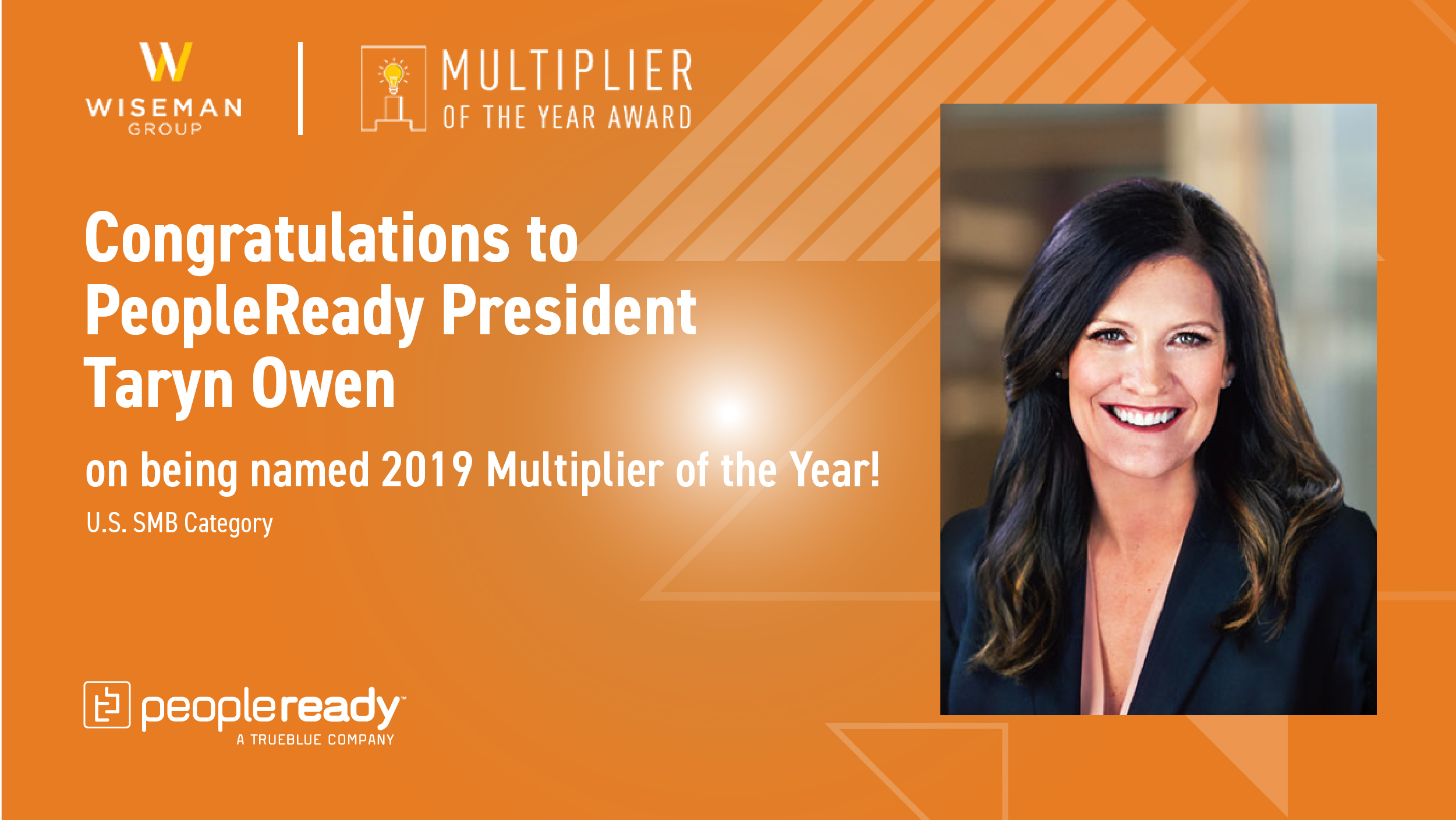
In January 2020, Owen was announced as the 2019 Multiplier of the Year in the U.S. SMB category. The Wiseman Group’s award recognized leaders who developed the thinking and capabilities of people around them. Employees nominated leaders; judges and a public vote contributed to the selection.
PeopleReady described her approach with the award framework’s term “Liberator”: someone who creates room for people to think while expecting them to bring their judgment to the work. It is a demanding version of delegation. The team gets space, and responsibility arrives with it.
There is a useful tension here for an operations leader. A person promoted for solving problems must eventually allow other people to solve them. Otherwise the organization grows around a single bottleneck with an impressive title. Owen’s recognition concerned her ability to help others contribute, a quieter achievement than occupying the biggest seat.
Taking the seat, inheriting the numbers
Owen became TrueBlue’s president and chief operating officer in September 2022. A year later, on September 12, 2023, she became president, CEO and a director, succeeding Steven Cooper. Cooper stayed on in an advisory capacity through the end of that year.
The appointment put an experienced internal operator in charge of the whole group. She knew its recruiting and on-demand staffing businesses from running them. The parent-company role added the obligation to explain the combined company’s direction and results to its board and shareholders.
By the second quarter of 2026, TrueBlue reported revenue of $443 million, up 12 percent from the comparable quarter. Adjusted EBITDA increased to $11 million from $3 million. The company also reported a net loss of $3.4 million, compared with $0.2 million a year earlier.
Those figures deserve to sit together. More revenue and a stronger adjusted operating measure represented progress, while the net loss remained part of the result. Owen pointed to demand in skilled markets and a return to growth in the core on-demand business. Her performance has a financial scorecard as well as a human one.
The next assignment still needs people
Owen’s agenda also reaches beyond matching an existing worker to an existing opening. TrueBlue’s WorkUp program supports the development of construction skills. Its energy apprenticeship program provided more than 200,000 hours of work to over 300 people in the period described in its 2025 corporate citizenship report.
The same report described collaboration with more than 2,500 community organizations worldwide. Community colleges, employment centers and charitable organizations can help make the first connection between someone looking for work and a business prepared to hire. Training expands what becomes possible after that connection.
In October 2026, Owen and Jill Quinn, who leads TrueBlue’s Centerline and skilled businesses, were named to SIA’s Global Power 150 Women in Staffing. By then, Owen’s recent work included reorganizing PeopleReady’s on-demand operation around territories, expanding sales capacity and advancing the group’s technology platforms.
Her career keeps returning to a deceptively practical question: what would make it easier for people to do the work? Sometimes the answer is an application. Sometimes it is training or a different operating structure. And sometimes, before anyone writes another strategy document, it is worth checking what time the meeting starts in Australia.