youth-mental-health
(11)
SecondMuse builds the missing middle of innovation
A prototype can work perfectly and still go nowhere. SecondMuse helps build the relationships, manufacturing routes and financing that give useful ideas a market.
Brightline Learned the Waiting Room Was the Product
Brightline raised more than $200 million to take pediatric mental health nationwide. Then it retreated from 45 states, opened real clinics, and discovered that access is not the same thing as presence.
Civilian lets the audience into the writers’ room
The agency behind California’s Never a Bother campaign gave young people a say in the message, the design, and the messenger. Its most useful lesson begins before anyone buys an ad.

Clayful
Clayful is a tech-enabled mental health company that gives K-12 students on-demand, chat-based coaching with a certified coach in about 60 seconds, across 133 languages. Founded in 2021 by Maria Barrera and Melissa Pelochino, the platform is purchased by school districts and free for students, aiming to make proactive mental health support a right rather than a privilege.

Hopelab
Hopelab is a San Francisco social innovation lab and impact investor founded in 2001 by Pam Omidyar. It works at the intersection of technology and adolescent mental health, combining behavioral science, youth co-design, and research to advance the well-being of young people ages 10-25, with a focus on BIPOC and LGBTQ+ youth. Best known for the cancer video game Re-Mission, Hopelab now runs research programs, youth fellowships, and Hopelab Ventures, which has invested more than $12 million across roughly 20 youth mental health startups.
InSite Health
InSite Health is a New Jersey-based behavioral health company building an integrated mental health and wellness platform for K-12 schools, families, colleges, and organizations. Founded in 2022 by Christopher Gaeta, it pairs a software platform with in-person and virtual clinical services - therapy, outpatient psychiatry, medication management, behavioral threat assessments, and school-based screenings - aiming to replace the patchwork of point solutions districts juggle with one holistic, clinically-run program.

Cartwheel
Cartwheel is a Cambridge, Massachusetts company that delivers evidence-based mental health care to K-12 students through their schools. Working as a telehealth partner to school districts, it provides rapid-access individual therapy, group therapy, psychiatric evaluations, medication management, and family and parent guidance, with most care covered by insurance. By 2026 it had grown to roughly 350 school districts across 15 states, positioning itself as the largest school-based mental health telehealth provider in the United States.

Marble Health
Marble Health is a New York-based youth mental health company building a school-centered model of care. It partners with school counselors - not just school district budgets - to identify struggling students and match them with licensed therapists within days, covering visits through insurance including Medicaid. Marble combines individual, family, and group teletherapy with a purpose-built therapist EHR and AI documentation tools, and folds counselors and parents into a collaborative care team. Founded by former Headway co-founders Jake Sussman and Dan Ross, the company has facilitated more than 15,000 therapy sessions since launching and raised a $15.5M Series A in October 2025.
InStride Health
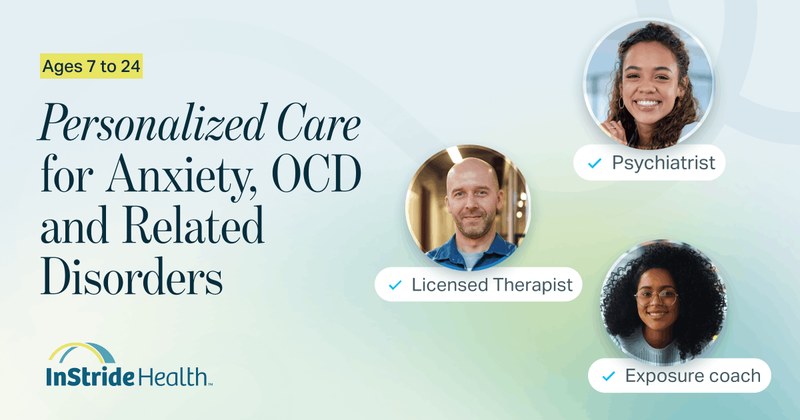
InStride Health is a Boston-based virtual specialty clinic that treats anxiety and OCD in kids, teens, and young adults ages 7 to 24. Founded by Harvard-trained clinicians from McLean Hospital, it delivers insurance-covered, evidence-based care - cognitive behavioral therapy with exposure and response prevention - through a dedicated three-person care team that coaches patients in the real-world settings where their anxiety actually shows up: school, home, the dinner table. The company has raised $56 million and operates across the Northeast.
Somethings
Somethings is a New York-based digital mental health company that connects teens and young adults (ages 13-26) with trained, certified near-peer mentors in their 20s for real-time text and video support. Built around lived experience rather than clinical therapy alone, every mentor is background-checked, certified as a peer specialist, and supervised by licensed clinicians. The company sells primarily to states, Medicaid managed-care plans, schools, and community organizations as an early-intervention layer in the youth mental health system.

Daybreak Health
Daybreak Health is a school-based teletherapy provider building the first digital mental health system for youth. The Y Combinator-backed company partners with public school districts across the United States to deliver personalized, clinically-validated mental health care to students - including teletherapy, on-site clinicians, classes, and universal screeners. As of 2023 it served more than one million students across 60+ districts and reported 81% of students showed symptomatic or behavioral improvements.