rna-therapeutics
(19)
Deep Genomics wants to find the flaw before the trial
An RNA drug can hit its target and still cause trouble elsewhere. Deep Genomics is building AI that reads both sides of that bargain, with laboratory experiments keeping score.
Envisagenics is hunting cancer targets in the edits
A gene can tell more than one story. Envisagenics reads the RNA edits that conventional drug discovery can miss - and pharma is paying for a closer look.
Ascidian Therapeutics wants to save sight by rewriting the message
The gene behind Stargardt disease is too big for a conventional delivery vehicle. Ascidian’s wager: replace the faulty passages in RNA, and let the cell keep its original manuscript.
The Drug Was the Same. The Instructions Were Different.
Inceptive says five AI-designed RNA sequences turned a familiar CAR-T experiment into a test of something stranger: whether a model can choose better molecular instructions before a scientist makes them.

Atisama Therapeutics
Atisama Therapeutics (formerly Rage Bio) is a Melbourne-based clinical-stage biotech developing precision splice-switching oligonucleotide (SSO) therapies for chronic inflammatory disease. Its lead asset, RB042, is an inhaled RNA drug that targets the RAGE receptor to treat chronic obstructive pulmonary disease (COPD) - a condition affecting hundreds of millions worldwide with few disease-modifying options. Spun out of a collaboration between IP Group Australia, Monash, Murdoch and the University of Western Australia, the company raised a $29M Series A in 2025 and advanced RB042 into Phase 1 clinical trials in 2026.
AIRNA
AIRNA is a clinical-stage biotechnology company building RNA-editing medicines that harness ADAR, a naturally occurring human enzyme, to make precise, programmable and non-permanent edits to RNA. Its RESTORE+ platform uses short oligonucleotides to recruit ADAR to a target transcript and swap a single letter, correcting disease-causing variants without altering DNA. AIRNA's lead candidate, AIR-001, targets alpha-1 antitrypsin deficiency (AATD) and has advanced into a Phase 1/2 clinical trial, with a broader pipeline aimed at cardiometabolic and other diseases. The company is headquartered in Cambridge, Massachusetts, with research operations in Tübingen, Germany, and has raised roughly $245 million from investors including ARCH, Forbion and Venrock.
NextRNA Therapeutics
NextRNA Therapeutics was a Boston-based biotechnology company pioneering small-molecule drugs that target long non-coding RNAs (lncRNAs) - a vast, largely undrugged region of the genome that regulates gene expression. Built on the science of Dana-Farber's Carl Novina and led by co-founder and CEO Dominique Verhelle, the company developed a proprietary discovery engine to map disease-relevant lncRNA-protein interactions and drug them with selective small molecules across oncology and immunology. NextRNA raised roughly $56 million in seed and Series A financing and signed a collaboration with Bayer worth up to $547 million before winding down operations in August 2025 amid a difficult biotech market and a missed partnership milestone.

AusperBio
AusperBio is a clinical-stage biopharmaceutical company operating in the United States and China that develops antisense oligonucleotide (ASO) therapies aimed at a functional cure for chronic hepatitis B. Built on its proprietary Med-Oligo ASO platform and targeted delivery technology, its lead candidate AHB-137 is an unconjugated ASO advancing into Phase III trials in China, with early data showing a 30% functional cure rate in a subset of patients. Founded in 2019 and headquartered in San Mateo, California, the company has raised over $200 million to date.
Creyon Bio
Creyon Bio is a San Diego biotech reinventing how RNA-targeted medicines are designed. Founded in 2019 by former Ionis Pharmaceuticals scientists, the company pairs machine learning with quantum-level molecular modeling in its NucleIQ platform - an AI-Powered Oligo Engineering Engine - to predict the safety, efficacy, and delivery of oligonucleotide-based medicines before they ever reach a lab bench. The goal: replace slow, expensive trial-and-error with computational design rules that make precision therapeutics engineerable 'on demand,' for both rare and common diseases across neuromuscular, CNS, and immunologic areas.
SonoThera
SonoThera is a South San Francisco biotech developing an ultrasound-guided, nonviral platform for delivering genetic medicines. Instead of the viral vectors that dominate gene therapy, it uses focused ultrasound and injectable microbubbles - a process called sonoporation - to open transient pores in target cells and shuttle DNA or RNA payloads into specific organs. The pitch is delivery that is targeted, potentially redosable, and decoupled from the immune and manufacturing headaches of viruses. The company raised a $125M Series B in June 2026 and is pushing lead programs in Duchenne muscular dystrophy and polycystic kidney disease toward the clinic.

Axelyf
Axelyf is a Brookline, Massachusetts biotech (with an R&D subsidiary in Iceland) building next-generation lipid nanoparticle delivery systems for RNA medicines. Founded by former Moderna drug-delivery leaders, it pairs a proprietary AXL ionizable-lipid library with an AI model called ANNA to make RNA and gene-editing payloads reach the right tissue with higher potency and less toxicity. In mouse liver studies its AXL LNPs showed roughly 4-5x higher gene-editing efficiency than the LP-01 clinical benchmark at equivalent doses, without evidence of liver toxicity. The company closed $2.6M in seed funding in August 2025 to push its lead autoimmune program and lipid library toward preclinical and non-human-primate studies.

Flashpoint Therapeutics
Flashpoint Therapeutics is a clinical-stage biotech spun out of Chad Mirkin's nanotechnology lab at Northwestern University, developing 'structural nanomedicines' - drugs whose potency comes not from new molecules but from how existing therapeutic components are arranged at the nanoscale. By co-delivering RNA, DNA, peptide and CRISPR payloads to individual cells with precise stoichiometry and synchronized activation, the company reports it can turn conventionally ineffective drug components into curative therapies, with early data showing dramatically stronger immune activation and tumor killing. Founded by Adam Margolin and backed by a $10M seed round led by Riyadh-based Beta Lab plus a $50M KAIMRC partnership, Flashpoint is advancing its lead immuno-oncology candidate FLASH-001 through the clinic.
Tiba Biotech
Tiba Biotech is a Cambridge, Massachusetts preclinical biotech spun out of MIT and the Whitehead Institute that is building a new generation of RNA vaccines and therapeutics. Its RNABL platform swaps the fragile lipid nanoparticles behind first-generation mRNA shots for fully synthetic, biodegradable dendrimer nanoparticles that carry larger RNA payloads with less toxicity and gentler cold-chain demands. The company is applying the technology across human vaccines, cancer immunotherapy, gene editing delivery, and animal health, backed by CEPI, BARDA, the NIH, and the NCI.
Switch Therapeutics
Switch Therapeutics is a South San Francisco preclinical biotech building conditionally activated siRNA (CASi) therapies that only switch on inside the cell types where they're needed. The platform - born from research at Caltech, Harvard and City of Hope - aims to make RNA interference safe enough for the brain, with a lead program targeting APOE for Alzheimer's disease.

Atomic AI
Atomic AI is a South San Francisco biotechnology company fusing machine learning with structural biology to unlock RNA drug discovery. Its platform pairs in-house wet-lab chemical-mapping data with deep learning models - including ATOM-1, a foundation model for RNA structure, and PARSE, its RNA structure exploration platform - to find structured, ligandable RNA motifs and design selective small molecules and RNA-based medicines for targets long considered undruggable.

Basking Biosciences, Inc.
Basking Biosciences is a clinical-stage biopharmaceutical company developing the first reversible thrombolytic therapy for acute ischemic stroke. Its lead candidate, BB-031, is a first-in-class RNA aptamer that inhibits von Willebrand Factor to break up clots quickly, paired with a companion reversal agent, BB-025, that can switch the drug's activity off in minutes if bleeding occurs. Spun out of research begun at Duke University and founded in 2019, the company is based in the Research Triangle of North Carolina and is advancing BB-031 through a Phase 2 RAISE trial.
HAYA Therapeutics
HAYA Therapeutics is a clinical-stage precision medicines company spun out of Lausanne University Hospital (CHUV) in 2019. It develops RNA-guided programmable therapeutics that target long non-coding RNAs in the so-called 'dark genome' - the roughly 98% of human DNA that does not code for proteins - to reprogram disease-driving cell states. Its lead candidate, HTX-001, is an antisense oligonucleotide targeting the cardiac lncRNA Wisper for heart failure, with a broader pipeline spanning fibrosis, metabolic disease and cancer. The company is headquartered in Lausanne, Switzerland, with US laboratory operations in San Diego, and raised a $65M Series A in May 2025.
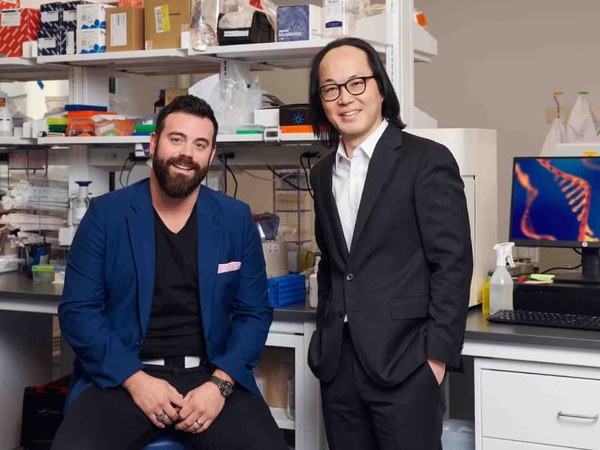
Strand Therapeutics
Strand Therapeutics is a clinical-stage biotech building 'programmable' mRNA medicines - drugs engineered with logic circuits so they switch on the right protein, in the right cell, at the right time. Spun out of MIT in 2017 by synthetic biologists who wrote the first programming language for mRNA, Strand's lead candidate STX-001 is a self-replicating mRNA that makes tumors manufacture their own IL-12, turning cold cancers hot from the inside. Backed by Kinnevik, Regeneron, Amgen and Eli Lilly with over $250M raised.

Asimov
Asimov is a Boston-based synthetic biology company building computer-aided design (CAD) tools for engineering living cells. Founded in 2017 by bioengineers from MIT and Boston University, it combines mammalian synthetic biology, software, and machine learning through its Kernel platform and 'Edge' production systems to help drug makers design and manufacture cell, gene, and RNA therapies more reliably. The company has raised over $200M, including a $175M Series B in January 2023 led by CPP Investments.