product-discovery
(20)
Avensia fixes the parts of shopping you never see
Behind the storefront, the Swedish commerce specialist untangles product data, connects unruly systems and tests whether better search actually sells more. Its customer results are a lesson in execution; its own accounts show the price of selling expertise.
Rezolve Ai is buying its way to the checkout
The London company is assembling search, payments and loyalty businesses around a retail AI engine. Its next test is turning acquired customer relationships into better shopping - and a business that pays for itself.

Bloomreach Wants to Be the Brain Behind Every Shopping Cart
The company that began by fixing bad search results now wants to coordinate every digital conversation between a brand and a shopper. Its wager is that the best commerce AI will know the catalog, the customer, and the merchant's rules at the same time.
The Search Box Is Becoming the Company Brain
Coveo spent two decades teaching companies to find their own information. Now that same retrieval machinery is becoming the context layer beneath shopping conversations, support answers and enterprise AI agents.
The Search Company That Decided Keywords Weren't Enough
Lucidworks grew up inside open-source Solr, then bet its future on a harder problem than matching words: understanding what people mean. Here is how the Salt Lake City and San Francisco company sells relevance to the world's largest catalogs.

Ocula
Retailers spent years teaching product pages to rank for humans. Ocula is betting the next customer may be an algorithm - and rebuilding the catalogue for both.

Zeda.io
A product-discovery platform betting that the fastest way to build the right thing is to stop guessing and start listening - at scale, with an AI copilot reading the customer for you.

Cycle
The Paris startup that turned scattered customer feedback into a product roadmap - then handed its engine to Atlassian.

Constructor
Constructor is an AI-powered product discovery and search platform for enterprise ecommerce. Its clickstream-trained models run search, browse, recommendations, autosuggest, quizzes, and agentic shopping experiences for retailers like Sephora, Petco, Under Armour, Birkenstock, and The Very Group - tying every result back to KPIs like revenue per visitor.

Dovetail
Dovetail is a Sydney-founded customer intelligence platform that pulls scattered customer signals - sales calls, support tickets, surveys, app reviews, usability tests - into one searchable place and uses AI to turn them into themes, dashboards and decisions. Started in 2017 by two ex-Atlassian employees, Benjamin Humphrey and Bradley Ayers, it began life as a repository for user researchers and grew into an organisation-wide intelligence layer used by roughly 40% of the Fortune 500, including AWS, Visa, Atlassian, Canva and Johns Hopkins. Accel led a US$63M Series A in January 2022 at a valuation north of US$700 million.

Wizard
Wizard is an AI-native shopping agent that turns online buying into a single conversation. It interprets natural-language requests, searches across websites, customer reviews, editorial and social content, and returns a tightly curated set of products - usually a top five - then lets shoppers complete the purchase through native checkout without leaving the app. Cofounded by CEO Melissa Bridgeford and chairman Marc Lore, the New York company launched publicly in February 2026, beginning with electronics and a native checkout integration with Best Buy.

Askable
Askable is an Australian, AI-powered user research platform that combines a global panel of verified participants, certified human researchers, and research-specific AI into a single system meant to replace a team's whole research stack. Founded in 2017 in Brisbane, it started as recruitment software - the self-described 'Uber for user testing' - and has grown into an end-to-end product research suite used by teams at brands like Atlassian, Canva, Wise and Toyota. After roughly six years bootstrapped and profitable, the company raised a A$22M Series A led by AirTree Ventures in 2024 to expand in the US and UK and deepen its AI tooling.

Product Hunt
Product Hunt is a community-driven website where makers launch new products and the internet votes on them, surfacing a daily leaderboard of the most interesting tech, apps, and AI tools. Founded in 2013 by Ryan Hoover and now led by CEO Rajiv Ayyangar, it has become the default starting line for startup launches, helping millions discover and rank software, hardware, games, and side projects.

Strella
Strella is an AI-powered customer research platform that lets product, UX, and marketing teams run in-depth, AI-moderated interviews at scale and get synthesized insights in hours instead of weeks. Its adaptive AI moderator conducts dynamic, probing conversations, handles recruitment and scheduling, and turns raw interviews into highlight reels and reports - combining the speed of surveys with the depth of qualitative interviews. Founded in 2024 by Lydia Hylton and Priya Krishnan, the New York company raised a $14M Series A in October 2025 led by Bessemer Venture Partners and counts Amazon, Duolingo, Chobani, and Apollo GraphQL among its customers.

Aha!
Aha! is a bootstrapped, fully remote software company that makes the world's most widely used product development tools. Founded in 2013 by Brian de Haaff and Chris Waters, its suite - Roadmaps, Ideas, Whiteboards, Knowledge, Discovery, Teamwork, Develop, and the newer AI-driven Builder - helps product teams set strategy, gather customer feedback, prioritize features, and ship work people love. It reached profitability without venture capital and is used by more than one million product builders worldwide.

Preferabli
Preferabli is an AI-driven B2B2C product discovery and recommendation software platform for wine, beer, spirits and other sensory consumer products. Formerly Wine Ring, the company pairs proprietary, patented machine-learning models with the world's largest assembled group of Masters of Wine and Master Sommeliers to predict what an individual will actually like - then plugs that prediction into retailers, hotels and merchants across roughly 100 countries.
Lily AI
Lily AI is a Mountain View-based retail AI company that translates the language of the customer into the language of the catalog. Its platform uses computer vision, NLP and large language models to enrich product data with thousands of consumer-centric attributes - powering site search, recommendations, SEO/SEM and demand forecasting for retailers like Macy's, Bloomingdale's, Gap and thredUP.

Maze
Maze is a user research and product testing platform that lets product teams test prototypes, run usability studies, and gather customer insights at speed. Founded in 2018 by Jonathan Widawski and Thomas Mary, it has grown into an AI-powered research platform used by more than 60,000 product teams - from startups to Atlassian, Braze and Lowe's.

Daydream
Daydream is a conversational, AI-powered fashion shopping platform founded by Julie Bornstein. It lets people search for clothing with natural language and images across roughly two million products from 8,000+ brands, then sends them to the retailer to check out.
Wildcard
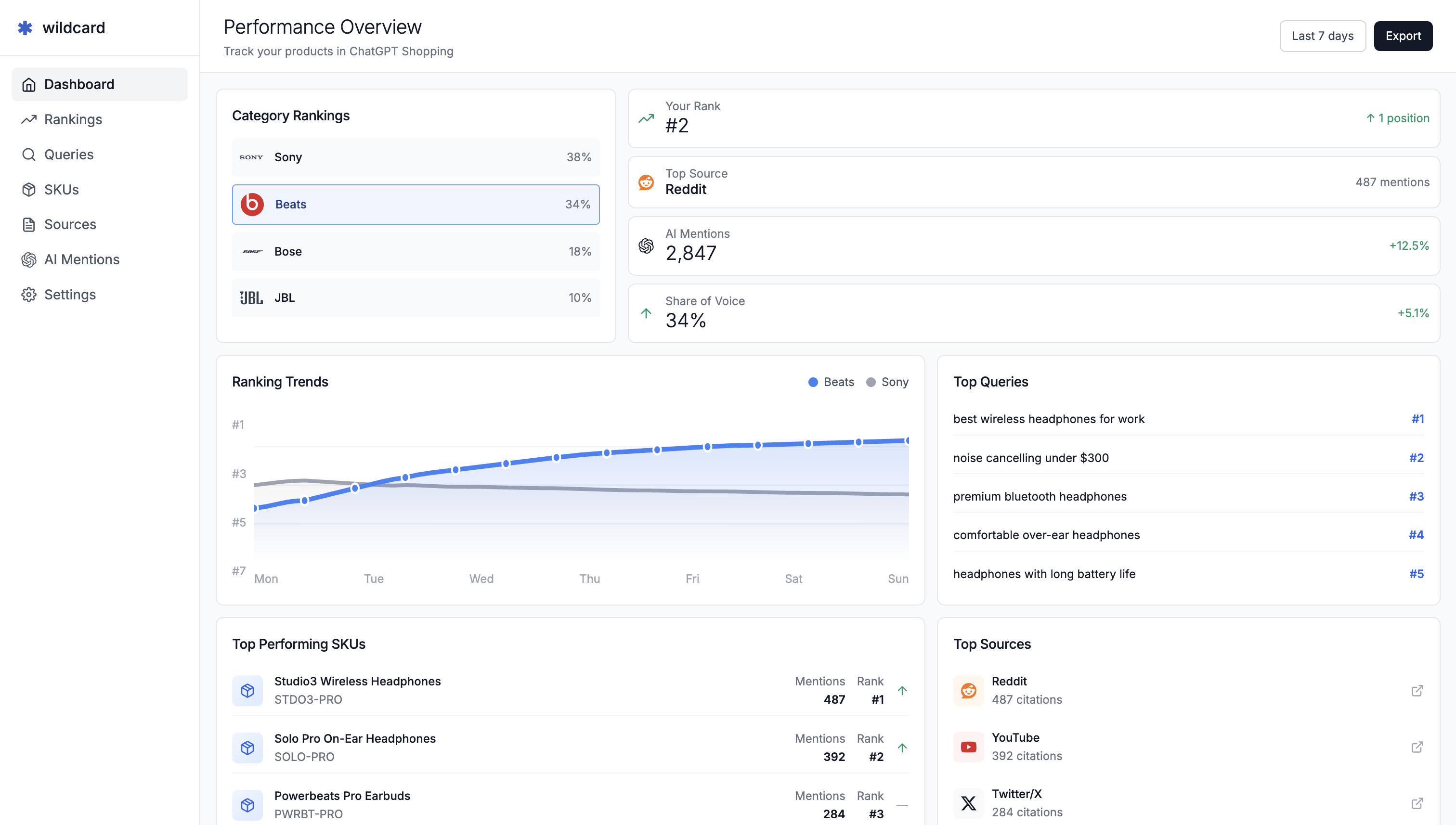
Wildcard is a Generative Engine Optimization (GEO) platform that helps e-commerce brands get their products discovered and purchased through AI shopping channels like ChatGPT Shopping, Google Gemini, Amazon Rufus, and Perplexity. Founded by Kaushik Mahorker and Yagnya Patel - both veterans of Scale AI, Tesla, and Amazon - Wildcard addresses the core problem that 67% of products lack the structured attributes AI engines need to recommend them. Their platform provides SKU-level analytics, catalog optimization, and content creation tools so brands can win in the emerging AI-first commerce landscape.