pcb-design
(5)
Teksun and the art of getting past the prototype
A working demo is a beginning with excellent publicity. Teksun builds the boards, code and manufacturing processes that give connected products a chance at a second act.

Diode Computers, Inc.
Diode Computers is a New York-based startup building an AI-powered, code-first platform for designing and manufacturing custom printed circuit boards. Its open-source toolchain - a Rust-based PCB compiler that treats schematics as Python-readable code - lets AI agents and engineers generate, validate, and manufacture boards in days rather than months, with human-in-the-loop verification. Founded in 2024 and backed by a $11.4M Series A led by Andreessen Horowitz, Diode serves hardware teams in aerospace, robotics, and defense.

AllSpice.io
AllSpice.io is a Boston-based hardware development platform that brings software-style workflows - version control, automated design reviews, visual diffs, and CI/CD - to electronics and PCB engineering. Founded in 2019 by Valentina Ratner and Kyle Dumont, the company connects native ECAD tools so hardware teams can catch errors early, collaborate asynchronously, and ship reliable designs with full traceability. Its AI agent, DRCY, flags issues like misconfigured pins, swapped TX/RX lines, and missing capacitors before they reach production. Customers range from startups to Fortune 500s across aerospace, robotics, defense, autonomous vehicles, and medical devices.
JITX
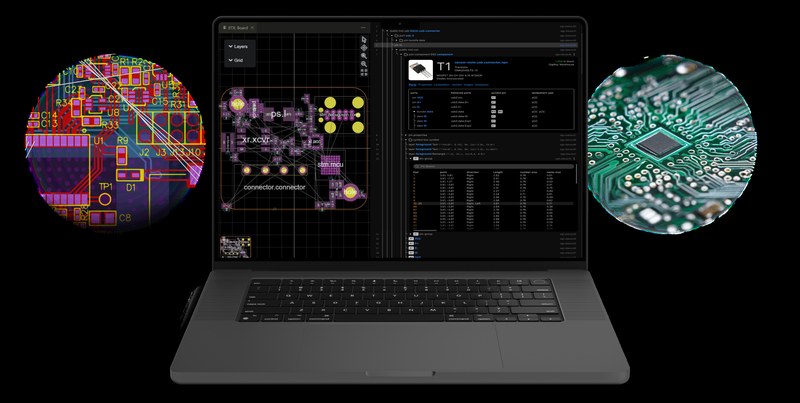
JITX is a Berkeley- and San Jose-based software company building a code-driven, AI-assisted platform for circuit board design. Instead of dragging parts around a canvas by hand, electrical engineers describe what a board must do in code, and JITX selects components, places parts, routes traces, and checks the design against electrical, mechanical, and manufacturing rules. Spun out of UC Berkeley and backed by Y Combinator and Sequoia Capital, the company is used by hardware teams at firms like Honeywell Aerospace, Lockheed Martin, Northrop Grumman, OpenAI, and HP, who report 5-20x productivity gains on complex multi-layer designs.
Quilter
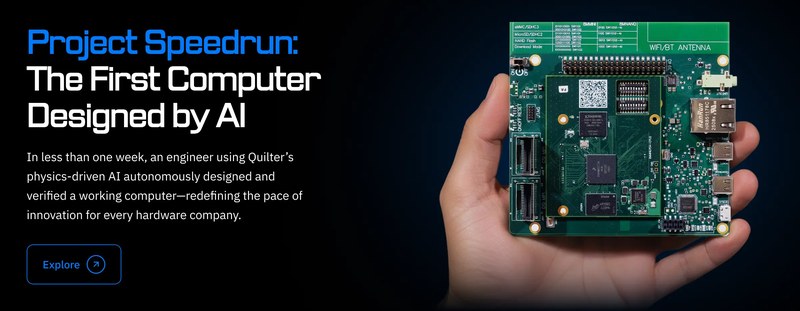
Quilter is a Los Angeles-based company building the first fully autonomous, physics-driven AI for printed circuit board (PCB) layout. Founded in 2019 by former SpaceX avionics engineer Sergiy Nesterenko, Quilter trains reinforcement-learning agents on the laws of physics - not human design patterns - to place components, route traces, and physics-validate complete board designs in hours instead of weeks. The company positions itself as the 'compiler for hardware,' aiming to make manual PCB layout as obsolete as hand-compiling code.