note-taking
(18)
Reflect Put Your Notes Back in Your Hands
The calm note app has made a noisy bet: local Markdown, open source code and your own AI keys. Here is who should move, who should wait, and why Reflect still feels unusually good to write in.

Your Notes Have Been Asking for Better Plumbing
Capacities turns the shoebox of digital notes into a cast of people, books, meetings and ideas. The catch is deliciously specific: it works best when you are willing to stop thinking in folders.
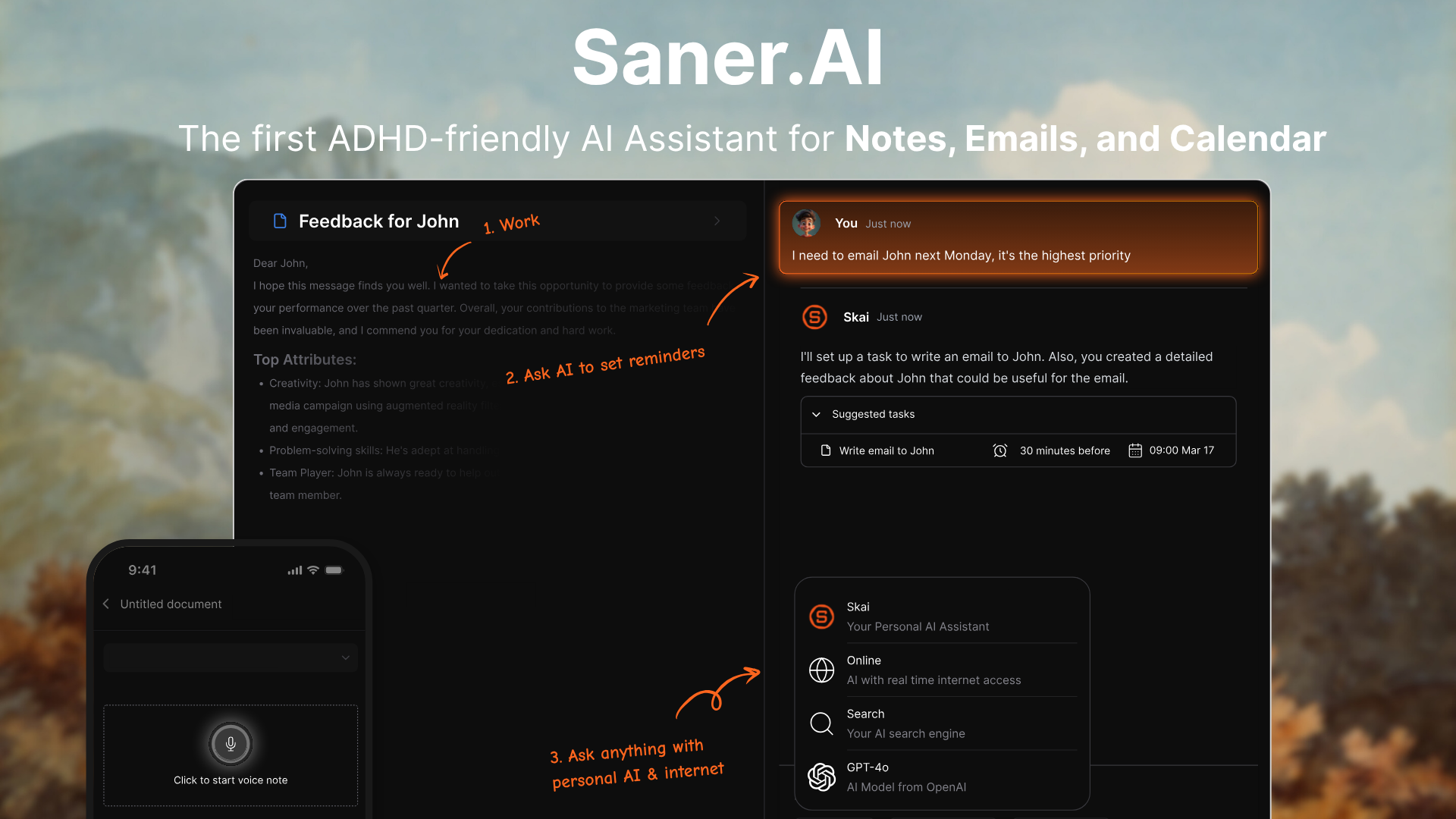
Saner.AI Wants Your Messy Brain, Not Your Filing System
Saner.AI turns brain dumps, inbox clutter and calendar loose ends into a plan you can approve. The idea is unusually humane; the young mobile apps still have some growing up to do.

Routine Puts Your Whole Week in One Window
For founders, freelancers, and calendar-led operators, Routine turns the daily scramble between tasks, meetings, and notes into one unusually calm control room. The catch is simple: the more of your working life you bring in, the more setup and trust it asks of you.

The E-Ink Slab That Refuses to Buzz
One 4.8mm sheet of glass that reads books, takes handwritten notes, glows amber at midnight, and runs the same apps as your phone - minus the doomscroll.

The E-Reader That Fits in Your Back Pocket and Fights Above Its Weight
A paperback-sized slab of E Ink that reads your library, takes your notes, and runs Android apps a Kindle will never touch - for the reader who refuses to carry a backpack.

The E-Reader That Runs Away From Home
Onyx put the whole Google Play Store behind a sheet of E Ink, shaved it to 4.8mm, and pointed it at everyone who ever wanted to leave the Kindle walled garden without giving up their books.

Martin Schneider
Martin Schneider is the co-founder and CEO of RemNote, the all-in-one note-taking and spaced-repetition app he started coding as an MIT computer science student in 2017 to fix his own habit of forgetting everything he learned a semester later. What began as a private side project he used alone for three years grew into a learning platform with over a million users, backed by a $2.8M seed round from General Catalyst, 468 Capital, Soma Capital and Dorm Room Fund. He blends learning science, neuroscience and software to chase a single idea: that you should be able to learn something once and remember it forever.
Tana
Tana is an AI-native workspace that turns messy notes, meetings and voice memos into structured, queryable knowledge. Its signature feature, Supertags, lets any bullet point become a database record with defined fields, so notes double as a living knowledge graph that AI agents can read, summarize and act on. Founded in 2021 by ex-Googlers and productivity builders and based in Palo Alto with an engineering hub in Oslo, Tana raised a $14M Series A in February 2025 (led by Tola Capital), reaching $25M total funding after emerging from a stealth beta with a 160,000+ person waitlist.
Ideaflow
Ideaflow is a Palo Alto-based AI company building an 'intelligence amplification' layer for knowledge work. Its flagship product is a notebook that augments your thinking as you type, letting people capture and stitch together fragments of information. The company has since expanded into team knowledge tools - Base, which surfaces context from Slack, meetings, and documents, and meeting intelligence - aiming to become an organization's collective memory. Founded around 2015 by MIT Media Lab designer Jacob Cole and Etherpad/Meteor veteran David Greenspan, it has raised roughly $11M in seed funding from First Round Capital, 8VC, StartX, Naval Ravikant, and Tim Draper.
Productive.ai
Productive.ai (legally Phoneic, Inc.) is a San Mateo, California startup that turns ordinary cell phone calls into finished work. Its AI Call Assistant records and transcribes business calls, then automatically generates summaries, notes, tasks and calendar events and logs everything into the user's CRM - so that when the call ends, the paperwork is already done. Founded by messaging-and-voice veteran Enlai Chu, the company targets real estate agents, salespeople, recruiters, mortgage and medical professionals, and won the National Association of REALTORS 2023 Pitch Battle.

RemNote
RemNote is an all-in-one learning platform that fuses note-taking, PDF annotation, and spaced-repetition flashcards into a single app, so students never have to bounce between Notion, Anki, and Quizlet. Born at MIT in 2020, it lets learners write notes and turn them into flashcards instantly - or let its AI generate cards, quizzes, and summaries from PDFs, lectures, and videos. Backed by a $2.8M seed round and used by hundreds of thousands of learners (especially medical and pre-med students), RemNote aims to reinvent how people learn, think, and remember.
Notion
Notion is an all-in-one connected workspace that blends notes, docs, wikis, databases, projects, calendar, and email into a single, modular tool - 'LEGO for software.' Founded in San Francisco in 2013 by Ivan Zhao and Simon Last, it nearly collapsed before its 2016 rebirth and has since grown to more than 100 million users, $600M+ in annual recurring revenue, and an $11 billion valuation, increasingly positioning itself as an AI workspace with built-in agents.

Mem
Mem is an AI-native notes app that doubles as a thought partner. Founded by Kevin Moody and Dennis Xu, the company is rebuilding personal knowledge management around a simple bet: you should never have to organize information again. Backed by the OpenAI Startup Fund and Andreessen Horowitz, Mem captures voice, web, and email inputs and resurfaces them at exactly the right moment.

Kevin Moody
Kevin Moody is the co-founder and CEO of Mem, an AI-powered knowledge management platform backed by OpenAI and Andreessen Horowitz. A Stanford Computer Science graduate who once worked at Google X on drone delivery, he spent five years quietly building toward a single obsession: making your past knowledge work as hard as your present focus. Mem has raised $34.7M and is redefining how individuals and teams capture, connect, and retrieve information at the speed of thought.

Prayag Narula
Prayag Narula is the Co-Founder and CEO of Marvin (HeyMarvin), an AI-native customer insights platform that centralizes, analyzes, and shares qualitative research data for product and UX teams. A researcher-turned-entrepreneur, he previously co-founded LeadGenius (Y Combinator W2011), which raised over $30 million and grew to hundreds of employees before he stepped down to return to his roots in user-centric design. With a graduate research background spanning UC Berkeley's School of Information and Helsinki's Ubiquitous Interaction Group, Narula built Marvin alongside his brother Chirag Narula in 2020 — this time with AI baked in from the ground up. The platform now serves 4,000+ teams and 13,000+ users, including 10 Fortune 100 companies.

Nathan Xu
Nathan Xu (also known as Xu Gao) is the co-founder and CEO of Plaud AI, the company behind the world's best-selling AI voice recorder and notetaker. A serial entrepreneur who failed three times before hitting gold, Xu bootstrapped Plaud from a Kickstarter campaign in 2023 to $180M+ ARR by 2025 - without a single dollar of venture capital. His credit-card-sized Plaud Note and wearable NotePin devices, which transcribe, summarize, and analyze conversations in 112 languages, have shipped to over 1.5 million users in 170+ countries. Based in San Francisco with roots in Wuhan, China, Xu represents a new breed of transpacific founder betting that the next great hardware platform fits in your pocket - or around your neck.

Tiago Forte
Tiago Forte is the founder of Forte Labs and creator of the Building a Second Brain methodology - a framework that has helped 20,000+ people in 70+ countries organize their digital lives and unlock creative potential. Author of the bestselling book of the same name (Simon & Schuster, 2022), named Financial Times Book of the Year, he has built one of the most influential productivity brands online, with 125,000+ newsletter subscribers and a YouTube channel crossing 100K subscribers. Known for the PARA method and Progressive Summarization, Forte turned his own struggle with information overload into a global movement.