Reflect is for people who would rather write a note than tend a note-taking system. Its default page is today. Meetings, errands, stray observations and the name of that restaurant your friend mentioned all land there first. Links do the filing later. The appeal is mundane in the nicest way: open app, type thought, continue with life.
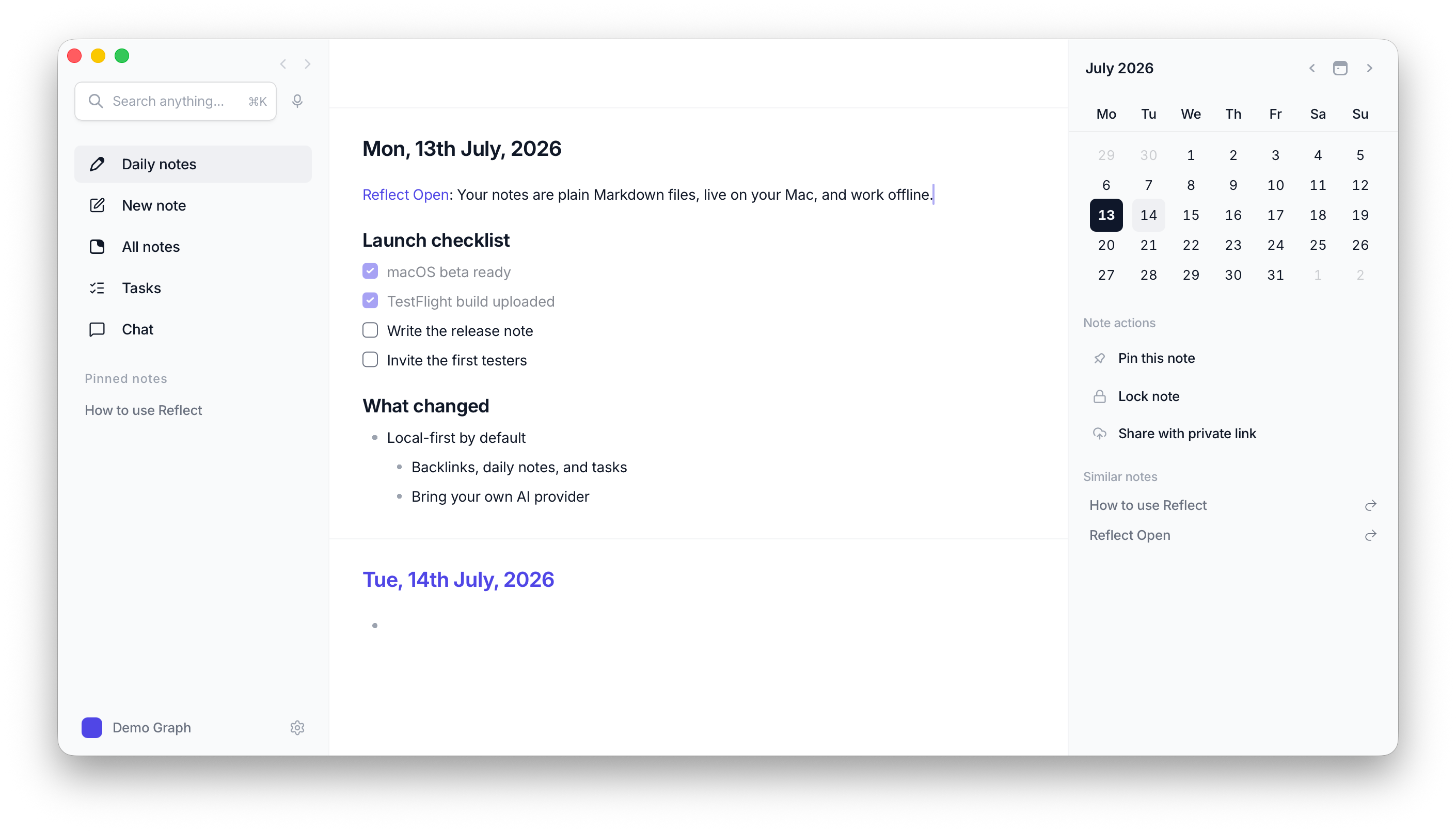
That has always been Reflect's pitch. The surprise arrived in July 2026, when founder Alex MacCaw announced Reflect Open, a separate rebuild that stores your graph as plain Markdown files on your computer. The Mac app is free, the source is MIT licensed, AI uses keys you supply, and sync can run through iCloud or Git. The original $10-a-month Reflect continues to exist, complete with its encrypted sync and web app. New development, however, is happening in Open.
Who should use it?
Start with the person who lives by the calendar. Reflect can place events beside the daily note, turn a meeting into a linked page and connect attendees to people notes. Over time, a colleague's page becomes a quiet record of conversations, promises and useful context. MacCaw has called this his answer to a "goldfish brain." It is a personal CRM built from memory rather than sales stages.
Writers and researchers are another natural fit. Browser capture saves a link, selection, screenshot or page text. Backlinks expose the places where an idea reappeared. Search covers titles, content, tags and links. In Reflect Open, optional semantic search runs on the Mac, while AI chat can answer across notes and point back to its sources. The value is retrieval, not decoration.
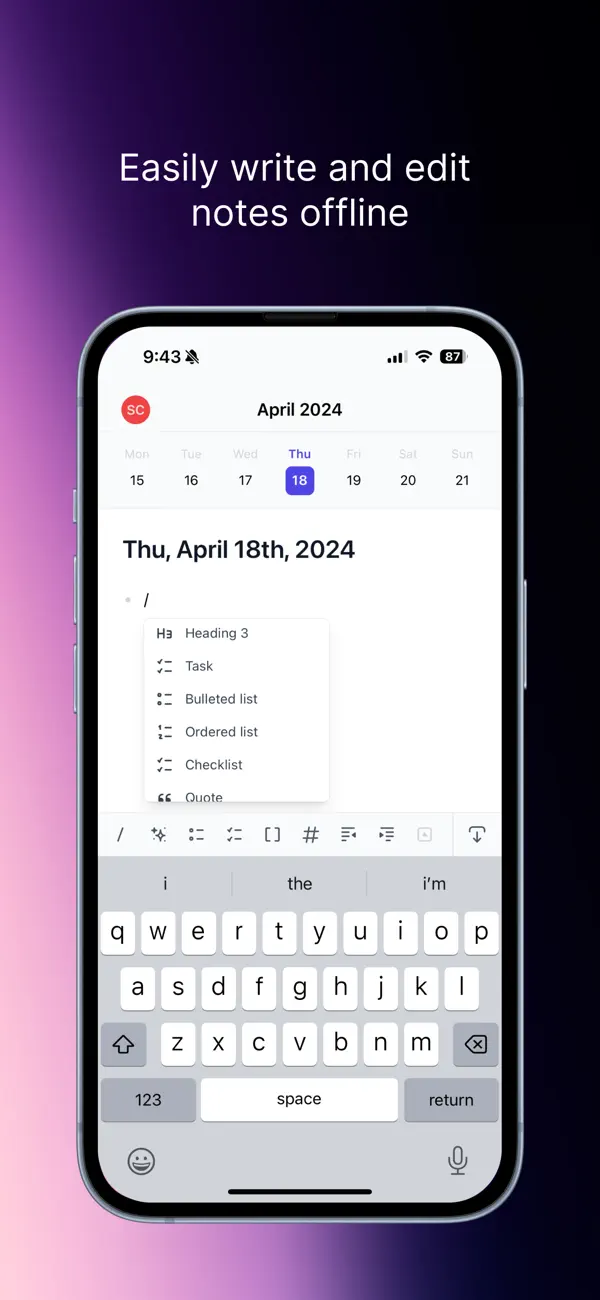
There are clear exclusions. Teams looking for a shared wiki should choose a collaborative product. Android users remain poorly served. Reflect Open has no Windows or Android release date, and its iPhone build is a limited TestFlight. People who love canvases, databases, colored blocks and elaborate dashboards may find the restraint severe. Reflect gives you an editor, a graph and a daily rhythm. It does not hand you a box of digital Lego.
One name, two notebooks
The buying decision now begins with an awkward fact: Reflect and Reflect Open do not sync with each other after import. Moving to Open creates a copy. Your old graph stays untouched, but later edits live on separate tracks. Existing users can keep the hosted app indefinitely, and the company says it will maintain it and fix bugs. There is no migration deadline.
Original Reflect
Web, Mac and mature Apple mobile apps. Reflect-managed encrypted sync. AI included in the annual subscription. Publishing and older integrations remain available.
Reflect Open
Mac today, iPhone in limited beta. Local Markdown, no Reflect account, your own AI key, iCloud or Git sync, open source code and a command line.
This split matters most for privacy. The original app adds end-to-end encryption to its hosted system. Reflect Open has no Reflect server holding the graph and adds no encryption layer of its own. Your protection depends on the device, iCloud settings or repository you choose. Notes marked private are blocked from AI and other services that read note content, but that switch does not remove them from your backup location.
“All we're trying to build is a simple tool that just works and gets out the way.”Alex MacCaw, speaking to Ness Labs
The daily note earns its keep
Most note apps begin by asking where a thought belongs. Reflect begins with when it happened. That removes a tiny decision from every capture. Type the note under today's date, wrap a person's name or project in a wiki link, and let the linked page collect the reference. The method suits meetings especially well because chronology and context arrive together.
The editor supports templates, tags, attachments, tasks and live-preview Markdown. Checkboxes from around the graph gather in a task view, where they can be searched, scheduled, completed and archived. Audio memos can be transcribed into the daily note. Apple Calendar and Contacts provide the scaffolding for meeting notes. Reflect Capture handles the browser. None of these ideas is novel alone. Their coordination is the product.
Reviews repeatedly praise that balance. One App Store reviewer who had used Reflect for two years pointed to integrated dictation, the daily note structure and chat across historical notes. A Reddit user arriving from Obsidian liked that Reflect was simpler, faster and available on the web. Another praised the calendar and AI, then asked for richer visuals and stronger task management. The recurring criticism is just as useful: limited customization, weak Android support, occasional mobile frustration and a price that feels high if you mainly need plain text.
AI without the mystery meat
The original Reflect bundles AI into the subscription and has previously advertised OpenAI models and Whisper transcription. Reflect Open changes the contract. You connect OpenAI, Anthropic, Google or OpenRouter directly, keep the credential in the operating system keychain and pay that provider's charges. A private-note control prevents selected content from being sent to AI or other reading services.
This arrangement takes a few more minutes to configure, but it makes the route visible. The AI can summarize, rewrite, translate and answer questions across the graph with citations. Developers get an extra door: commands including reflect today, reflect search and reflect show let scripts or coding agents work with notes without scraping the interface. Earlier in 2026, Reflect also added MCP access and editing to the original product. The company's direction is clear: notes should be legible to both their owner and the tools their owner chooses.
| If you value... | Try... | Because... |
|---|---|---|
| Low setup and a web app | Original Reflect | Sync, AI and integrations arrive as one managed service. |
| Local files and portability | Reflect Open | The graph is a folder of Markdown and assets you can inspect or edit elsewhere. |
| Plugins and deep tinkering | Obsidian | Its ecosystem and customization range are broader. |
| Team docs and databases | Notion | Collaboration and structured workspaces are the center of the product. |
| Quick Apple-native capture | Apple Notes | It is already on the device and asks for almost no setup. |
Price, patience and the beta tax
The old price remains simple: $10 a month billed annually after a 14-day trial, with AI included. The new price is simple only on Mac: free and open source. The iPhone TestFlight is also free for now, but Reflect expects to charge for mobile later and has not decided the amount or timing. Existing subscribers are promised access when that happens. Bring-your-own AI also means provider usage lands on your bill.
Open is young software. Publishing and some integrations have not crossed over. There is no web or iPad app yet, despite the iPhone TestFlight also being offered to iPad testers. Reflect explicitly advises keeping the original graph and backing up the new folder. TestFlight builds expire, so a phone should never contain the only copy. This is sensible beta hygiene, and it is part of the cost.
The company's record buys it some patience. Reflect reported 3,000 paying customers in September 2023 and profitability that December. Its original front end moved to SQLite across web, iOS and macOS in 2025 to improve speed with large graphs. The Open repository passed 1,400 GitHub stars by September 2026. Those figures do not guarantee the future, but they describe a small product with paying users, a working business and a public codebase.
The YesPress verdict
Choose Reflect if your notes are personal, chronological and linkable, and if your ideal system disappears while you use it. New Mac users comfortable with beta software should begin with Reflect Open. Existing subscribers who rely on web access, publishing or mature mobile apps should wait before migrating. Android-first users should look elsewhere. Reflect's defining feature remains its refusal to make every possibility visible at once.
Five questions before you move
Is Reflect Open replacing Reflect?
No. It is a separate app and the original remains available, though Open is where new development is happening.
Can I use both?
Yes, but edits do not sync between them after you import a copy of the old graph.
Are the local notes encrypted?
Reflect Open adds no encryption layer. Notes inherit the protection of your Mac, iCloud configuration or Git setup.
Can another editor open the graph?
Yes. Notes and daily pages are ordinary Markdown files, while images and attachments sit in an assets folder.
What is missing?
The beta currently lacks a web app, a dedicated iPad app, Windows and Android versions, plus publishing and some integrations from the original.