A receipt is a peculiar test of a technology company. On the day you receive it, it is barely worth looking at. Six months later, when a warranty claim depends on it, the same scrap becomes important. The information has not changed. Your need for it has. Evernote built a business in the space between those two moments.
- The job: collect scattered information and make it retrievable.
- The advantage: web clips, documents, images and tasks living together.
- The turn: Bending Spoons bought Evernote in 2023 and moved most operations to Europe.
- The bargain: an expanding archive now meets explicit capacity limits and paid plans.
A place for the thing you forgot
Consider an ordinary workday. A useful article sits in a browser tab. A decision sits in a meeting transcript. A photograph of a whiteboard sits on a phone. Each item has a perfectly respectable home, and none of those homes knows much about the others. Evernote offers them a common address. You can type a note, attach a document, save an image or clip a page, then arrange the collection with notebooks and tags.
The attraction is practical. A notebook can hold the research behind a proposal alongside the proposal itself. A student can keep reading notes near lecture material. A consultant can retain the context behind a follow-up task. Evernote serves individuals and teams whose information arrives in several forms and on several devices. Its apps cover Windows, Mac, iOS, Android and the web.
Web Clipper gives this approach a particularly useful entry point. It saves articles, pages, PDFs and screenshots into Evernote, with options for annotation and organization. A bookmark remembers where something lived. A clip preserves material inside the working collection. The distinction matters when the web has become a room full of open drawers.
“An interesting moment in life lasts only a moment.”
Stepan Pachikov, Evernote founder
Pachikov’s founding idea concerned augmenting human memory. Evernote opened its web service to everyone in June 2008, with Phil Libin leading the company. The premise suited a world in which a phone could capture a moment and a computer could help retrieve it later. A digital notebook became an answer to a familiar human failing: we remember that we knew something, but cannot remember where we put it.
The archive becomes the advantage
An empty note app has a difficult sales pitch. It is a container. After years of use, that container may hold the reasoning behind a project, a collection of recipes, travel plans and the history of a business relationship. Its value comes partly from accumulated material. Moving to another app then involves deciding what to transfer, how to preserve its organization and whether familiar routines will still work.
That is an advantage, with a condition attached. An archive earns its place when the owner can recover something useful. Filling it is easy; finding a detail under pressure is the examination. Evernote’s search tools reach into supported attachments and images, making the photograph or PDF part of the searchable collection rather than an object you must open and inspect individually.
The scale of that habit was visible by November 2022. The acquisition announcement reported almost 11 billion notes created, millions of paying customers and approximately $100 million in recurring revenue. Those are historical company figures, not a count of today’s active users. They nevertheless explain the appeal to a buyer: Evernote already occupied a place in people’s working lives.
Its competitive position follows from that habit. Notion places shared documents, projects and knowledge bases together. Obsidian emphasizes locally stored notes and the connections between them. OneNote offers a digital notebook within Microsoft’s broader productivity world. Evernote’s case rests on collecting mixed material and recovering it with relatively little ceremony. Which approach fits depends on the information you handle and how you prefer to arrange it.
Repairing a memory business
A promise about memory depends on mundane machinery. Notes must load. Edits must arrive on the other device. The notebook list must agree with what the user just changed. When these operations falter, even an elegant interface starts to feel unreliable. Evernote’s 2023 engineering account described accumulated technical debt and a decision to give the foundations priority over new features.
Bending Spoons completed its acquisition in January 2023. In July, Evernote announced that most operations would move to Europe. Most employees based in the United States and Chile lost their jobs in the transition. The company described separation packages generally including 16 weeks of salary, health-insurance coverage and a prorated performance bonus. The corporate reset had a human cost as well as a technical agenda.
The repair work addressed real-time editing, synchronization, monitoring and old code. Evernote reported removing approximately 40,000 lines of legacy code during 2023. A year later, its RENT project tackled metadata: notebook names, tags, sharing permissions and the other information surrounding the text. The old process polled for updates. The replacement pushed changes to clients.
In August 2024, Evernote reported key sync operations running up to three times faster after RENT. A company-reported improvement, rather than an independent benchmark.
There is a lesson here for anyone running a mature software product. A feature can look impressive in a demonstration while the ordinary work underneath it remains irritating. Evernote’s own account suggests that improving the unglamorous parts was necessary before adding more ambition. Customers experience architecture as waiting, inconsistency or relief.
The price of one more note
The financial bargain has changed too. Evernote now offers Free, Starter, Advanced and Enterprise plans. Its published US-dollar transition FAQ lists Starter at $99 a year and Advanced at $249.99 a year. Monthly billing is $14.99 and $24.99 respectively. Regional rates and app-store prices can differ, so those annual figures should be read as a specific published schedule.
*Published USD transition pricing, checked October 2026. †Safeguard limits apply. Capacity from the current plan comparison.
The important boundary is capacity. Someone with 1,001 notes already exceeds Starter’s published note allowance, regardless of whether they feel like a power user. An occasional writer with a long archive and a daily writer with a small one can land on different sides of the same limit. Frequency of use and amount of accumulated material are separate things.
For businesses, Enterprise adds organizational controls and support around the shared collection. For individuals, the calculation is more personal: how often does this archive save a search, preserve context or prevent work from being repeated? A person collecting a handful of shopping lists may find the paid tiers difficult to justify. A professional consulting years of client records may reach another conclusion. Habit is evidence of familiarity; it is not, by itself, evidence of value.
The search box learns the gist
Version 11 arrived in January 2026 with AI Assistant, Semantic Search and AI Meeting Notes. The assistant can help retrieve and draft content or organize notes through a conversation. Meeting tools turn recorded discussions into transcripts and summaries. These additions extend an existing proposition: information in the archive should become usable when someone needs it.
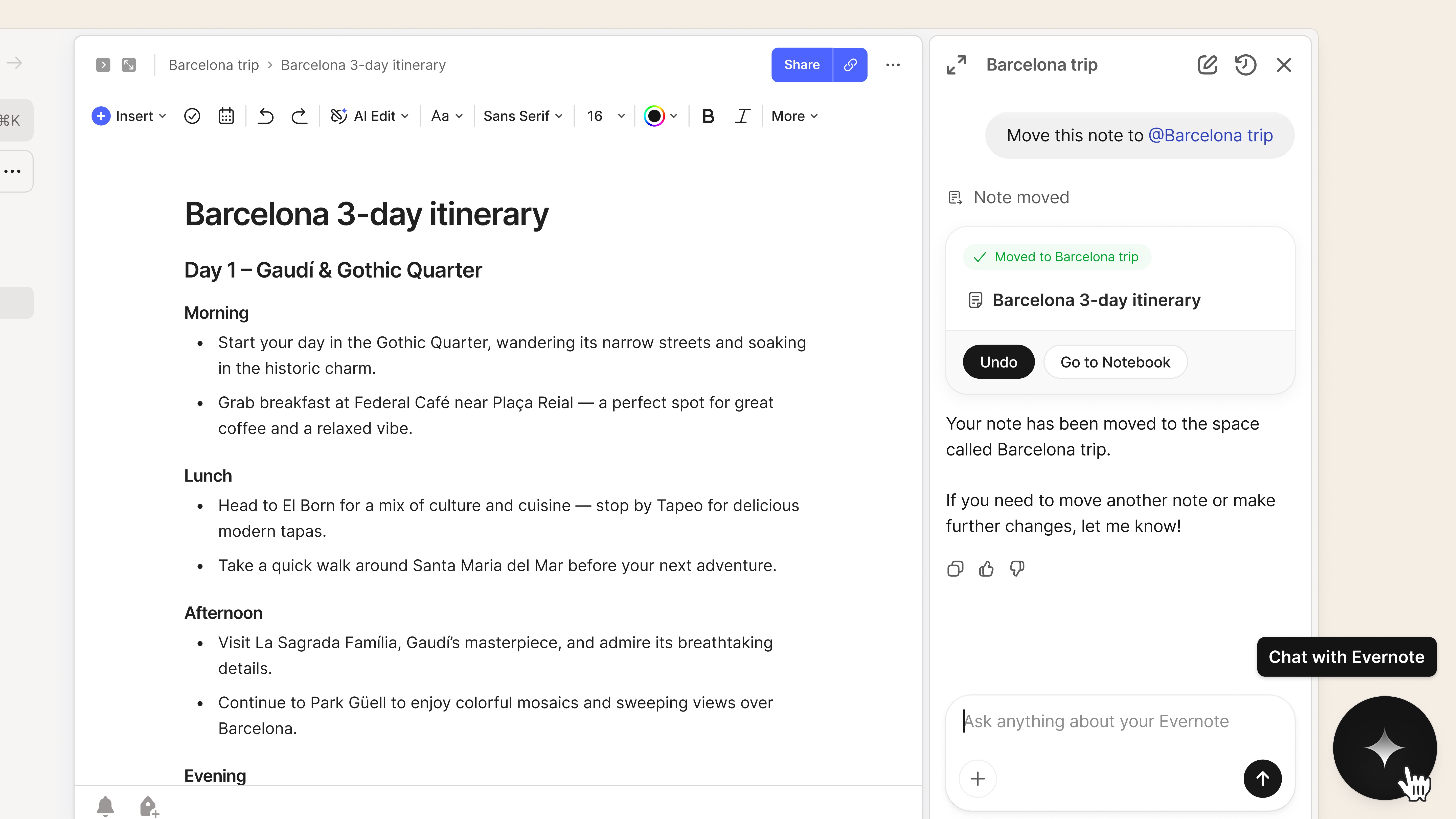
Semantic search addresses a more subtle difficulty. Sometimes you remember the subject but choose a different word from the one in the note. Searching by meaning can recover related material without requiring an exact match. That suits an old archive, where the vocabulary of the person searching may differ from the vocabulary of the person who saved it years earlier.
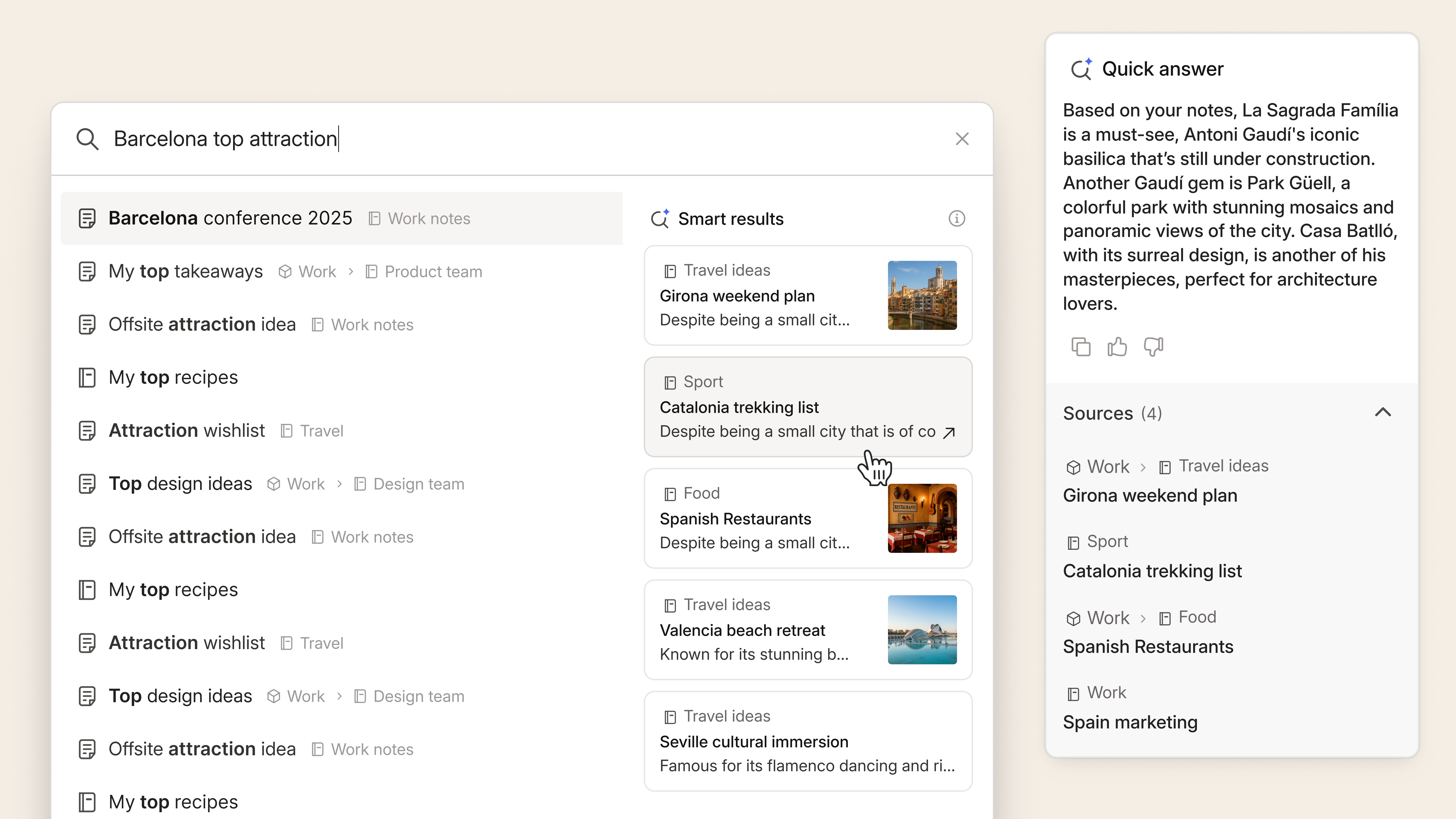
Evernote’s current developer documentation also describes a beta connection for compatible AI tools to read, search and create account content. That makes the archive available beyond the app’s own interface. It remains a gradual rollout. For users, the useful question is whether another way to reach the collection produces better work, rather than simply another place to type a request.
Trust remains part of the product. In 2016, Evernote withdrew a proposed privacy-policy change after users objected to provisions about employee access connected with machine learning. The episode offers a clear example of what changed the company’s mind: customer feedback. An archive can contain the sort of information people would hesitate to leave on a desk. New capabilities need to respect that relationship.
Try losing something on purpose
A reader can borrow a modest experiment from this story. Create one notebook for a real project. Save a clipped article, an annotated image and a document. Add a note explaining why each matters. A week later, try to retrieve a detail using the words you naturally remember. Then turn a finding into a task. That exercise tests the entire journey, from capture to action, with material you actually care about.
The approach depends on maintaining enough context to make the collection useful. It will disappoint if saving becomes an end in itself, if a simple list would do the job, or if the storage and device limits are a poor match for your archive. Before committing, count what you intend to keep and identify how you will retrieve it. The satisfaction of collecting can otherwise disguise the absence of a working system.
Evernote’s enduring appeal lies in a small promise: a useful thing can survive the moment when you stop paying attention to it. Its present business asks customers to put a price on that convenience. The elephant can remember. The owner still has to decide what deserves remembering.
Open another notebook
Explore Evernote, current plans, Web Clipper, product updates and the company blog.
Follow LinkedIn, X, Instagram, Facebook or GitHub. Watch the v11 product demonstration and visit Evernote’s YouTube channel.