insurance-ai
(13)
ICE-Tech wants to give insurers their time back
Aviva cut its quote journey from 20 minutes to 10. Ticker reached market in six months. Behind both sits ICE-Tech, an insurance software business built around a stubborn idea: customers should be able to change their own products.
Applied Systems Built the Plumbing of Insurance - Now It Wants AI to Run the Pipes
For four decades, Applied Systems has turned the insurance agency's least glamorous chores into software. Its next bet is that the company controlling the workflow can also control where AI becomes useful.

The $5.35 Billion Bet on the Software Underneath Insurance
Vertafore began with punch cards and became a software utility for insurance distribution. Now it has to prove that half a century of embedded workflows can become an AI advantage - without asking customers to rip out the systems that run their businesses.

BriteCore Put Six Small Insurers in the Product Room - Now 100+ Carriers Run on the Result
BriteCore began with six carriers, one software shop and a failed rating-engine integration. Its useful idea is still the same: let mid-sized insurers modernize the machinery without handing the keys to an army of consultants.
Intact Built a $25 Billion Insurance Machine - Then Sent It Toward the Fire
Canada's largest property and casualty insurer grew by treating insurance as an operating system: price risk better, control more of the repair, and buy only what the machine can improve. The catch is that climate volatility keeps stress-testing every advantage it has built.
ProNavigator Turned a 97-Minute Hold Into the Search Bar Insurance Bought
Joseph D'Souza started with a chatbot for stranded policyholders. The more valuable business was hiding behind the call center: helping insurance employees find the one trustworthy answer buried across PDFs, portals, inboxes, and shared drives.

Monitaur
Monitaur is a Boston-based B2B software company that builds an AI governance platform for highly regulated industries, most notably insurance and financial services. Its 'policy-to-proof' approach helps enterprises define AI policies, inventory and manage models, and automatically generate the evidence, monitoring, and audit trails that businesses, regulators, and consumers need to trust high-impact AI. Founded in 2019 by Anthony Habayeb, Andrew Clark, and Michael Herman, the company raised a $6M Series A in 2024 and has been recognized by Forrester as a Customer Favorite in AI governance.
FurtherAI
FurtherAI builds domain-specific AI 'teammates' for the insurance industry, automating the busywork of underwriting, claims, submissions, policy comparison and compliance. Founded in 2023 by Aman Gour and Sashank Gondala and launched out of Y Combinator's Winter 2024 batch, the San Francisco company parses messy insurance documents - broker letters, property schedules, ACORD forms, loss runs - and turns them into structured, actionable data so professionals can focus on judgment instead of re-keying. It raised a $25M Series A led by Andreessen Horowitz in October 2025, roughly six months after a $5M seed, and supports customers writing over $15 billion in premiums across all 50 states.

Liberate
Liberate is a San Francisco-based startup building insurance-native AI agents that automate the industry's most operational, phone-heavy work - quoting policies, filing claims, servicing endorsements - across voice, email, SMS, and digital channels. Its voice assistant, Nicole, handles inbound and outbound calls, while reasoning AI agents plug directly into carriers' core systems to complete end-to-end tasks rather than just answer questions. In October 2025 the company raised a $50M Series B led by Battery Ventures at a $300M valuation, after scaling from 10,000 monthly automations to 1.3 million automated resolutions and processing more than $100B in premium volume.

Qumis
Qumis is a Chicago-based insurtech building attorney-trained AI for commercial insurance. Its coverage intelligence platform reads dense property and casualty policies the way a seasoned coverage attorney would - comparing quotes and endorsements, flagging gaps across policy towers, and backing every answer with source-linked citations and transparent reasoning. Founded by a former coverage attorney and a former Goldman Sachs engineering leader, Qumis already serves five of the 15 largest U.S. brokers, along with specialty carriers and insurance law firms, and has raised $6.75M to put a coverage specialist at every desk.
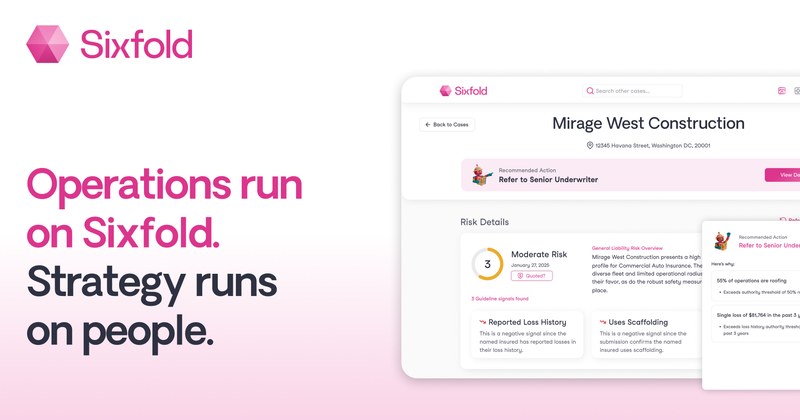
Sixfold
Sixfold is a New York-based enterprise AI company building purpose-built artificial intelligence for insurance underwriters. Its platform learns a carrier's risk appetite, reads and summarizes complex submissions, surfaces cited risk signals, and deploys AI agents that research, write referrals, and advance cases - so underwriters spend their time on judgment instead of paperwork. The company serves global carriers, MGAs, and reinsurers across property & casualty and life & health, and has processed more than a million submissions for insurers representing hundreds of billions in gross written premium.

Lyzr AI
Lyzr AI is an enterprise agent-infrastructure company that helps banks, insurers, and other regulated organizations move AI agents from proof-of-concept to production. Its open-core Agent Framework bakes Safe AI and Responsible AI modules into the core architecture, while products like Agent Studio and a roster of named agents (Jazon the AI SDR, Skott the AI marketer) let teams build, govern, and deploy autonomous agents inside their own firewall or VPC. Backed by Accenture and valued at $250M, Lyzr positions itself as the trusted layer between large language models and the compliance-bound enterprise.
Unframe
Unframe is a managed AI delivery platform for enterprises that turns critical business operations into production-ready AI workflows in days, not quarters. Built by the former Noname Security team, the company packages agent orchestration, a knowledge fabric, data connectivity and modular building blocks into a single OS for production AI - and bills only for outcomes that ship.