gpu-cloud
(18)
Northern Data bought the chips. Then came the hard part.
A former Bitcoin miner built a European AI cloud with a hardware bill to match. Its more revealing achievement was learning how to keep the machines earning.

io.net and the art of renting somebody else’s GPU
The AI compute shortage has an awkward companion: idle hardware. io.net wants to connect the two, but its most revealing lessons concern trust, incentives and the price of a finished job.
Aarna.ml and the Missing Cloud Around the GPU
A GPU is a machine. A cloud is a promise that the machine will be there when someone asks, properly isolated, metered and ready to work. Aarna.ml built the software between those two ideas.
The $200,000 Answer to a Billion-Dollar Question
HPC-AI Tech sells a way to make expensive AI work less expensively. Its open-source video model supplies the most interesting receipt: an 11-billion-parameter experiment built for a reported $200,000.
Aethir rented the GPUs. Now it wants to build the capacity.
The Singapore company turned distributed computing into a business serving AI and gaming. Its next bet is more physical: bringing new GPU capacity online where customers are already asking for it.
CoreWeave
The crypto-mining startup that became the picks-and-shovels supplier of the AI boom - renting Nvidia GPUs to the labs building the future, one megacluster at a time.
DigitalOcean
DigitalOcean built a public cloud by making servers feel less like a procurement exercise and more like a developer tool. Now it is trying to carry that same clarity into the expensive, unruly business of production AI.
6Estates
6Estates is a Singapore-based enterprise AI company that turns messy, unstructured financial documents into structured decisions. Spun out of the NExT++ research center (NUS, Tsinghua, University of Southampton), it builds domain-specific large language models, intelligent document processing, and agentic AI tools that banks and lenders across Asia use to automate credit assessment, financial statement analysis, and trade finance checks.
TensorPool
TensorPool (YC W25) is a San Francisco startup that turns cloud GPUs into a git-style command line. Instead of wrestling with SSH sessions, provider dashboards, and idle-instance billing, machine learning engineers describe a training job in a config file and run 'tp job push' - TensorPool spins up a multi-node cluster across partner clouds, streams logs, saves outputs, and shuts everything down, billing only for runtime. It advertises GPU access at roughly half the cost of major cloud providers, with H100s starting around $1.99/hr. Founded by three Stanford dormmates, the company was accepted into Y Combinator's Winter 2025 batch.

Modal
Modal is a serverless cloud platform that lets developers run compute-intensive AI and data workloads - inference, training, fine-tuning, batch jobs, and sandboxed code - without managing infrastructure. Built from scratch in Rust with a custom container runtime, file system, and GPU memory snapshotting, it delivers sub-second cold starts and elastic autoscaling from zero to thousands of GPUs, billed by the second. Founded in 2021 by Erik Bernhardsson and Akshat Bubna, the New York-based company reached roughly $300M in annualized revenue and raised a $355M Series C in 2026 at a $4.65B valuation.

Parasail
Parasail is a San Mateo-based AI inference cloud that lets developers run open-source and custom models without buying or committing to their own GPUs. Instead of owning chips, it orchestrates rented GPU capacity across roughly 40 data centers in 15 countries plus its own clusters, automatically routing each workload to the cheapest, fastest hardware. Founded in 2023 by Mike Henry (ex-Groq CPO, Mythic founder) and Tim Harris (Swift Navigation founder), the company processes on the order of 500 billion tokens a day and pitches a token-based economy - pay for output, not hardware.
VESSL AI
VESSL AI is an MLOps and GPU-cloud company that helps AI teams train, deploy, and scale machine learning models without wrestling with infrastructure. Its platform pools GPU capacity across on-premise clusters and multiple cloud providers, automatically routing workloads to the cheapest available resources - a hybrid, multi-cloud approach the company says can cut GPU spend by up to 80%. Founded in 2020 by ex-Google and PUBG engineers and split between Seoul and the San Francisco Bay Area, VESSL serves roughly 50 enterprise customers and 2,000-plus users, and has expanded into AI-agent tooling with its open-source Hyperpocket project.
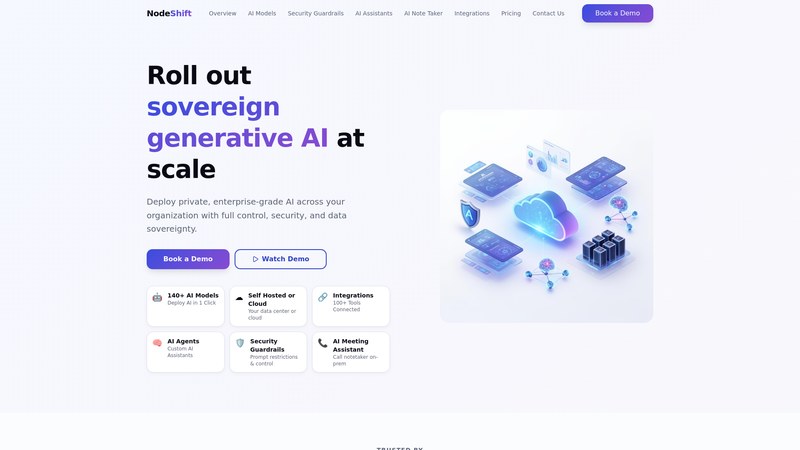
NodeShift
NodeShift is a decentralized cloud platform that aggregates spare compute, GPU and storage capacity from independent data centers and web3 networks, then resells it through one simplified UI and a single API. By tapping underused infrastructure instead of building hyperscale data centers, NodeShift offers developers and enterprises GPUs, virtual machines and storage at prices it claims are up to 70-80% cheaper than traditional cloud providers - positioning itself as a 'sovereign AI cloud' for teams that want affordable, distributed, compliance-friendly compute.

MetalSoft
MetalSoft is a Chicago-based infrastructure software company that turns racks of physical servers, switches, and storage into cloud-like, self-service infrastructure. Its CloudPlex platform automates the full lifecycle of multi-vendor bare metal hardware - discovery, OS and firmware deployment, network fabric configuration, and storage - so enterprises and service providers can provision dedicated infrastructure on demand via a UI or API. Spun out of cloud hosting company Hostway in 2019 and led by serial founder Lucas Roh, MetalSoft raised a $16M Series A in December 2022 and has since pivoted hard toward orchestrating GPU clusters and 'AI factories' for telcos, data center operators, and Fortune 500 enterprises.
Deep Infra Inc.
Deep Infra is a Palo Alto-based AI inference cloud that lets developers run hundreds of open-source machine learning models - large language models, image and video generation, speech, and embeddings - through a simple, OpenAI-compatible, pay-per-use API. The company owns and operates its own GPU fleet across multiple US data centers, processing trillions of tokens per week for companies that want production AI without managing infrastructure.
Hyperbolic
Hyperbolic is an open-access AI cloud built for developers and researchers. It aggregates underutilized GPUs from data centers, mining farms and idle machines into an on-demand marketplace, and pairs that with serverless inference for state-of-the-art open-source models. The pitch is simple: fast, affordable access to compute and inference without sales calls or feature gates, at prices it says can run up to 75% below incumbents.
GMI Cloud
GMI Cloud is an AI-native GPU cloud built around NVIDIA's H100 and H200 accelerators. Founded in 2021 and headquartered in Mountain View, it sells on-demand and reserved GPU compute, an orchestration layer (Cluster Engine), and a low-latency Inference Engine to AI labs and enterprises building generative models. In 2025 NVIDIA named it one of seven Reference Platform Cloud Partners worldwide.

Together AI
Together AI is a San Francisco-based AI acceleration cloud that lets developers and enterprises train, fine-tune, and run open-source generative AI models on a high-performance GPU platform. Backed by $533M+ from General Catalyst, NVIDIA, Salesforce Ventures and others, it has become one of the most prominent challengers to the closed-model status quo.