freight
(5)
The Robots Learned to Do the Paperwork
An AI workforce for logistics is a system of AI agents that autonomously execute the repetitive administrative work that runs freight and supply chain operations — order entry, quoting, tracking, billing, customs filings and customer service. Pallet's platform deploys these agents across email, voice, documents, APIs and remote desktops, encoding a company's operating procedures so agents can run workflows from quote to cash. The goal is to automate the roughly $1 trillion in annual coordination work that keeps the physical economy moving, freeing human teams to focus on judgment, relationships and growth.
The Bot That Reads the Room: Why Logistics Is Trading Scripts for Judgment
A plain-English breakdown of the difference between AI agents and traditional robotic process automation (RPA) in logistics. RPA runs rigid, rules-based scripts that break the moment a portal button moves or a document arrives in the wrong format; AI agents reason toward a goal, read unstructured email and PDFs, and handle the exceptions that make up the bulk of real freight work. The piece uses Pallet (pallet.com) and its CoPallet AI workforce as a lead example, and surveys other players in the space including HappyRobot, Vooma, and FleetWorks.

Harish Abbott: Building the AI Teammate Rewiring Global Logistics
On Joe Lonsdale's American Optimist podcast, serial entrepreneur and billionaire Harish Abbott, co-founder and CEO of Augment, explains how his AI teammate 'Auggie' is transforming the fragmented $10 trillion global logistics industry. Abbott, who previously built Deliverr (sold to Shopify for roughly $2.1 billion) and helped build Amazon's fulfillment network, argues that AI's reasoning models and expanding context windows finally make it possible to automate the endless emails, phone calls, and texts that move freight. Auggie already helps manage roughly $25 billion in freight, works 24/7 across email, phone, Telegram and WhatsApp, and follows written workflows like a human employee. Abbott lays out a massive opportunity: not just tens of billions in productivity gains, but a $300 billion U.S. (nearly $1 trillion global) chance to cut waste from an industry hobbled by low-bandwidth, asynchronous communication.

The $2.5 Trillion Question: Why 95% of Enterprise AI Pilots Fail (and How Supply Chains Beat the Odds)
Sushanth Raman, founder and CEO of San Francisco-based supply chain AI company Pallet, delivers a conference keynote tackling the central paradox of the enterprise AI boom: despite a projected $2.5 trillion in AI spending in 2026, an MIT study finds 95% of enterprise AI pilots fail. Raman argues the failures stem not from weak frontier models but from messy real-world deployments, uncaptured tribal knowledge, legacy integrations, and poor change management. He offers a three-part framework for evaluating AI vendors, explains why building in-house is harder than it looks, and presents three case studies (Lineage, Prism Logistics, and Mallory Alexander) where Pallet drove millions in savings and 99%+ accuracy on tasks like customs filing.
The Agent Factory: How Pallet Forge Turned Six Months Into Six Weeks
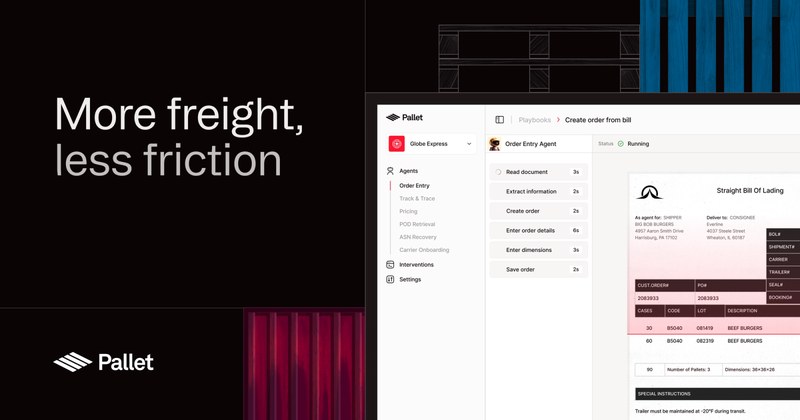
On May 14, 2026, logistics AI company Pallet launched Pallet Forge, an 'agent factory' that compresses the build-and-deploy cycle for production-grade logistics AI agents from roughly six months to six weeks. Authored by co-founder and CEO Sushanth Raman, the announcement frames Forge as Pallet's answer to the industry's pilot-to-production gap — citing the MIT finding that only 5% of enterprise GenAI pilots generate measurable P&L impact. Forge works by connecting to a customer's systems (TMS, WMS, ERP, EDI, email, and legacy AS400), encoding operational rules and carrier preferences inferred from historical data instead of hand-written SOPs, and running thousands of simulations to tune agent accuracy automatically. Early proof points include Everest Transportation running on 20,000+ customer-specific encoded memories and Eassons Transport Group hitting 98% touchless processing after going live in 40 days — with subsequent customers onboarded in as little as 48 hours.