estate-planning
(18)
Empathy Turned Grief's Worst Chore List Into a 50-Million-Person Benefit
The startup began with an app for the brutal paperwork after a death. Its bigger invention was persuading insurers and employers to put practical, human-guided care inside benefits people already have.
The $1.7 Billion Wealth Firm That Sold the Plumbing - and Kept Its Name
US Financial Services spent three decades building a planning practice around life transitions. Then it made a counterintuitive succession move: join a larger platform, preserve the local brand, and turn the firm itself into a home for other advisers.
NorthRock Built a $12 Billion Firm Around the Rich Person's Worst Job: Coordination
Wealth creates options - and an absurd amount of administrative work. NorthRock's bet is that affluent clients will pay one team to make the investment manager, CPA, estate lawyer, insurance adviser and philanthropy plan behave like one system.
Ark Financial Wants to Be the COO of Your Family Money - But the Model Comes With Homework
The Austin firm turned a rich-family institution into an operating system for entrepreneurs. Its cleverest product is coordination - and its most useful lesson is that even a coordinator must be audited.
The $4 Billion Freedom Bet: How XML Financial Group Built a Wealth Firm by Refusing to Build Alone
XML Financial Group escaped the big-bank playbook, then discovered that independence works better with infrastructure. Its repeatable trick is equal parts personal advice, succession planning and culture-first M&A.

The $6 Billion RIA Built to Make Complicated Money Feel Boring
Ashton Thomas sells a scarce luxury: one coordinated view of a wealthy family’s messy financial life. Its post-2023 expansion shows how a regional adviser can add offices, specialists and assets without sanding away the local teams clients hired in the first place.

The Richmond Firm That Manages $4.9 Billion by Managing Memory
A former KPMG tax partner built a Richmond multi-family office on a stubborn premise: the hardest part of managing $4.9 billion isn't the portfolio - it's the paperwork, the people and the memory behind it.
Gratus Capital Built the Anti-Wall-Street Wealth Firm - Then Chose a Bigger Bench
Hank McLarty left the wirehouses to put tax, estate and investment specialists on one team. Nineteen years and roughly $3.8 billion later, Gratus made the counterintuitive move: surrender the stand-alone firm to expand what clients could get.

The Chicago Firm That Sold Wall Street's Playbook to Families Who Aren't Endowments
Two Chicago traders spent a decade turning hedge-fund tactics into a wealth business for families who aren't endowments. In 2026 they sold it - $5.6 billion later.

The Business-in-a-Box Built for People Who Hate Paperwork
Prime Corporate Services has turned the scattered chores of starting a company into one guided relationship. Its bet is simple: a live adviser can be more useful than another filing form.

LegalZoom Wants to Be the Legal Department for Everyone Who Doesn’t Have One
The company that put LLC paperwork on the internet is chasing a larger role: the always-on legal and compliance layer behind America’s smallest businesses. Its bet is that AI can start the work, but trust - and recurring revenue - live in the human-assisted last mile.

Bernstein Private Wealth Management
A research house that started by publishing uncomfortable truths now spends its days on the harder question wealthy families rarely say out loud: who gets it, and will the money outlast the people who made it.

Raymond James
A firm that started in a downtown St. Petersburg apartment now watches over $1.92 trillion - and it still measures itself one advisor and one client at a time.

Farther
Farther is a New York-based technology-driven wealth management firm that pairs human financial advisors with a proprietary 'Intelligent Wealth Platform.' Founded in 2019 by Taylor Matthews and Brad Genser, the company gives advisors an all-in-one digital ecosystem for financial planning, investing, tax optimization, and estate planning, while offering clients a family-office-style experience. After a $150 million Series D led by General Atlantic in 2026, Farther has grown to roughly $23 billion in recruited assets and ranks among the fastest-growing financial services firms in the United States.

Harness (Harness Wealth)
Harness (Harness Wealth) is a New York fintech that pairs software with a curated marketplace of vetted tax, financial and estate advisors, aimed at people with complex finances - startup founders, equity-holding employees, business owners, crypto investors and other 'builders.' It combines a vertical SaaS platform that powers collaboration between tax advisors and their clients, a marketplace to discover specialist firms, and consumer tools for tracking equity and net worth. Founded in 2018 by David Snider, the former CFO/COO of Compass, the company has raised roughly $40M and grew revenue by more than 1,500% between 2021 and 2024.
Autumn
Autumn is a New York-based deathcare startup that built what it called the world's first deathcare marketplace: a free platform that walks bereaved Americans through the tangle of tasks that follow a death - funerals, estates, probate, moving, grief - with step-by-step guides and a directory of more than 500,000 local providers like funeral homes, estate attorneys, financial planners and grief specialists. Launched in July 2022 with a $600,000 pre-seed round led by Bullish, the company made the process free for grieving families and earned revenue from providers who paid to be listed.
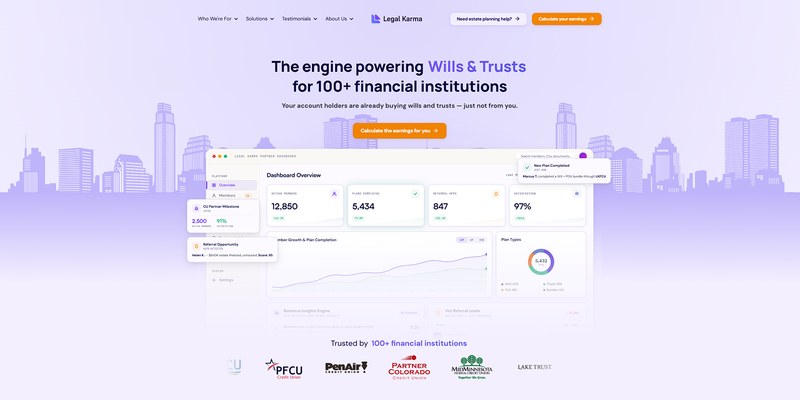
Legal Karma
Legal Karma is an Austin-based B2B legaltech company that gives banks and credit unions a white-label engine for offering wills, trusts, and powers of attorney directly to their account holders. It handles the document automation, 50-state attorney-reviewed legal infrastructure, compliance, member support, and marketing so a financial institution can stand up a profitable estate planning department in about four weeks - while keeping 100% of the revenue and ownership of the customer relationship.

Alix
Alix is a San Francisco wealthtech company that automates estate settlement, the slow, paperwork-heavy process of closing a person's affairs after they die. Pairing agentic AI with human Settlement Specialists, Alix handles 100+ tasks, from asset discovery and debt negotiation to probate filings and account closures, that typically take an executor up to 900 hours over 9 to 18 months. Founded in 2023 by Alexandra Mysoor and Hugh Tamassia, the company raised a $20M Series A in July 2025 led by Acrew Capital, with backing from Charles Schwab and Edward Jones Ventures.